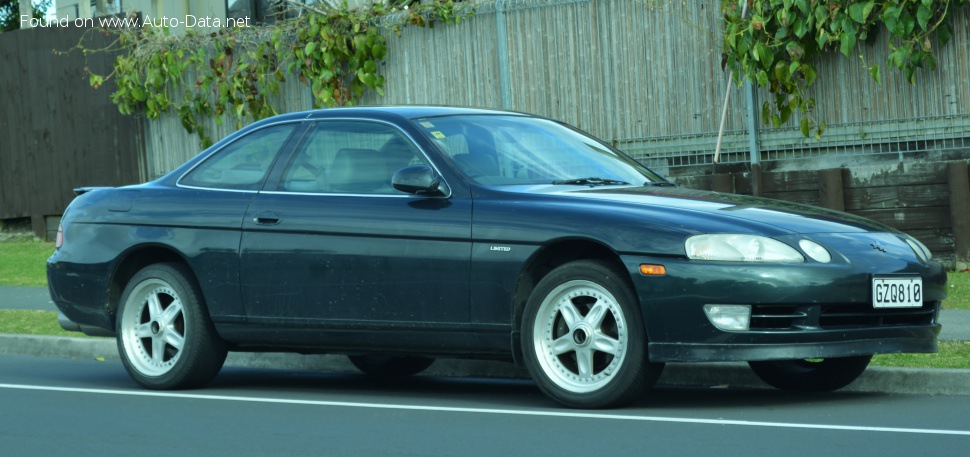
The Toyota Soarer holds a distinctive place in automotive history, particularly within the realm of Japanese luxury grand tourers. The third generation, known internally as the Z30, represents a significant evolution in design, technology, and performance for the brand. Specifically, the
Toyota Soarer III (facelift 1995) 4.0 i V8 32V GT (265 Hp)
variant, produced from 1995 to 2001, stands as a testament to Toyota’s engineering prowess during a period of intense innovation. While primarily a Japanese Domestic Market (JDM) vehicle, the Soarer III shared its platform and many mechanical components with the first-generation Lexus SC, which was successfully marketed in North America. This particular model, following its mid-cycle refresh, embodied a blend of opulent comfort, high-speed cruising capability, and sophisticated technology, solidifying its reputation as a performance-oriented luxury coupe designed for discerning drivers. It was a vehicle that pushed the boundaries of what a Japanese luxury car could offer, challenging established European rivals with its distinctive blend of refinement and robust performance, all while adhering to the brand’s legendary standards of reliability.
Engine and Performance: The Heart of the Toyota Soarer III (facelift 1995) 4.0 i V8 32V GT (265 Hp)
At the core of the 1995 facelifted Toyota Soarer III 4.0 i V8 32V GT lies a formidable powertrain, meticulously engineered to deliver a compelling balance of smooth power and refinement. This variant is equipped with Toyota’s renowned 1UZ-FE engine, a 4.0-liter (3969 cm3 or 242.2 cubic inches) V8 unit. This naturally aspirated engine features a sophisticated DOHC (Double Overhead Camshaft) valvetrain with four valves per cylinder, totaling 32 valves, which was advanced for its time. It produces a robust 265 horsepower at 5400 rpm, translating to a power-per-liter output of 66.8 HP/l, a respectable figure for a luxury grand tourer of its era. Torque output is equally impressive, peaking at 267.74 lb.-ft. (363 Nm) at a relatively accessible 4600 rpm. This broad torque band, combined with the engine’s V-configuration and multi-port manifold injection system, ensures effortless acceleration and strong mid-range pull, ideal for both spirited driving and relaxed highway cruising.
Power is efficiently managed through a 4-speed automatic transmission, which channels the engine’s output to the rear wheels. This drivetrain architecture, with the engine mounted longitudinally at the front, contributes to a balanced weight distribution and characteristic rear-wheel-drive handling dynamics. Performance figures for this luxury coupe are quite strong: the 0-60 mph sprint is achieved in a swift 6 seconds, while 0-100 km/h takes 6.3 seconds. The vehicle’s top speed is electronically limited to 130.49 mph (210 km/h), reflecting its grand touring intentions rather than outright track performance. The Soarer III 4.0 i V8 32V GT also demonstrated commendable efficiency for a V8-powered luxury car of its size and weight. Its combined fuel economy is rated at 20.6 US mpg (11.4 l/100 km), with urban consumption at 15.9 US mpg (14.8 l/100 km) and extra-urban at 23.1 US mpg (10.2 l/100 km). Furthermore, the vehicle met the Euro 4 emission standard, indicating a forward-thinking approach to environmental considerations even in the mid-1990s.
The engine’s layout features a cylinder bore of 3.44 inches (87.5 mm) and a piston stroke of 3.25 inches (82.5 mm), contributing to its smooth, high-revving nature. A compression ratio of 10.4:1 further optimizes combustion efficiency. With a kerb weight of 3858.09 lbs (1750 kg), the Soarer achieves a weight-to-power ratio of 6.6 kg/Hp (151.4 Hp/tonne) and a weight-to-torque ratio of 4.8 kg/Nm (207.4 Nm/tonne), underscoring its performance capabilities relative to its luxury appointments. The seamless integration of this powerful V8 engine with a refined automatic transmission ensures that the Soarer III delivers a driving experience that is both engaging and exceptionally comfortable, truly embodying the spirit of a high-performance grand tourer.
Design and Features: A Timeless Grand Tourer
The Toyota Soarer III (Z30 generation) is instantly recognizable for its sleek, aerodynamic, and distinctive coupe silhouette, a design that has aged remarkably well. The 1995 facelift subtly refined these aesthetics, maintaining its elegant lines while incorporating minor updates to keep it contemporary. As a 2-door coupe with seating for five, the Soarer was engineered to offer a blend of sporty appeal and luxurious practicality. Its generous dimensions contribute to its imposing road presence and spacious interior: a length of 191.34 inches (4860 mm), a width of 70.47 inches (1790 mm), and a height of 52.76 inches (1340 mm). The substantial wheelbase of 105.91 inches (2690 mm) provides a stable platform for high-speed cruising and contributes significantly to the car’s smooth ride quality.
Underneath its stylish exterior, the Soarer III was equipped with a sophisticated chassis designed for both comfort and dynamic handling. The suspension system featured a double wishbone setup at the front, known for its ability to maintain consistent tire contact with the road surface, enhancing steering precision and ride comfort. The rear suspension utilized coil springs, further contributing to the car’s compliant ride. This combination allowed the Soarer to glide over imperfections while maintaining composure during spirited driving. Braking performance was handled by ventilated discs on both the front and rear axles, providing ample stopping power and resistance to fade, especially crucial for a car capable of sustained high speeds. An Anti-lock Braking System (ABS) was a standard assisting system, enhancing safety by preventing wheel lock-up during hard braking maneuvers.
The steering system employed a hydraulic rack and pinion setup, offering a direct and communicative feel to the driver, a hallmark of performance-oriented vehicles. The power steering made maneuvering the substantial coupe effortless in urban environments. The vehicle rode on 225/55 R16 tires, a size that balanced grip, ride comfort, and aesthetic appeal. Inside, the “GT” designation signified a focus on grand touring luxury. While specific interior features often varied by market and trim, the Soarer typically boasted a well-appointed cabin with high-quality materials, advanced climate control, premium audio systems, and a range of power-operated accessories that were cutting-edge for the mid-1990s. The emphasis was on creating a serene and comfortable environment for long journeys, a true testament to its luxury coupe aspirations. With a maximum load capacity of 606.27 lbs (275 kg) and a fuel tank capacity of 20.61 US gallons (78 liters), the Soarer III was well-suited for extended trips, living up to its grand tourer moniker.
Technical Specifications
| Brand | Toyota |
| Model | Soarer |
| Generation | Soarer III (facelift 1995) |
| Type (Engine) | 4.0 i V8 32V GT (265 Hp) |
| Start of production | 1995 year |
| End of production | 2001 year |
| Powertrain Architecture | Internal Combustion engine |
| Body type | Coupe |
| Seats | 5 |
| Doors | 2 |
| Fuel consumption (economy) – urban | 14.8 l/100 km (15.9 US mpg) |
| Fuel consumption (economy) – extra urban | 10.2 l/100 km (23.1 US mpg) |
| Fuel consumption (economy) – combined | 11.4 l/100 km (20.6 US mpg) |
| Fuel Type | Petrol (Gasoline) |
| Acceleration 0 – 60 mph | 6 sec |
| Acceleration 0 – 100 km/h | 6.3 sec |
| Maximum speed | 210 km/h (130.49 mph) |
| Emission standard | Euro 4 |
| Weight-to-power ratio | 6.6 kg/Hp (151.4 Hp/tonne) |
| Weight-to-torque ratio | 4.8 kg/Nm (207.4 Nm/tonne) |
| Power | 265 Hp @ 5400 rpm |
| Power per litre | 66.8 Hp/l |
| Torque | 363 Nm @ 4600 rpm (267.74 lb.-ft. @ 4600 rpm) |
| Engine layout | Front, Longitudinal |
| Engine displacement | 3969 cm3 (242.2 cu. in.) |
| Number of cylinders | 8 |
| Engine configuration | V-engine |
| Cylinder Bore | 87.5 mm (3.44 in.) |
| Piston Stroke | 82.5 mm (3.25 in.) |
| Compression ratio | 10.4:1 |
| Number of valves per cylinder | 4 |
| Fuel injection system | Multi-port manifold injection |
| Engine aspiration | Naturally aspirated engine |
| Valvetrain | DOHC |
| Kerb Weight | 1750 kg (3858.09 lbs) |
| Max. weight | 2025 kg (4464.36 lbs) |
| Max load | 275 kg (606.27 lbs) |
| Fuel tank capacity | 78 l (20.61 US gal) |
| Length | 4860 mm (191.34 in.) |
| Width | 1790 mm (70.47 in.) |
| Height | 1340 mm (52.76 in.) |
| Wheelbase | 2690 mm (105.91 in.) |
| Front track | 1520 mm (59.84 in.) |
| Rear (Back) track | 1525 mm (60.04 in.) |
| Drivetrain Architecture | The Internal combustion engine (ICE) drives the rear wheels of the vehicle. |
| Drive wheel | Rear wheel drive |
| Number of gears and type of gearbox | 4 gears, automatic transmission |
| Front suspension | Double wishbone |
| Rear suspension | Coil spring |
| Front brakes | Ventilated discs |
| Rear brakes | Ventilated discs |
| Assisting systems | ABS (Anti-lock braking system) |
| Steering type | Steering rack and pinion |
| Power steering | Hydraulic Steering |
| Tires size | 225/55 R16 |