
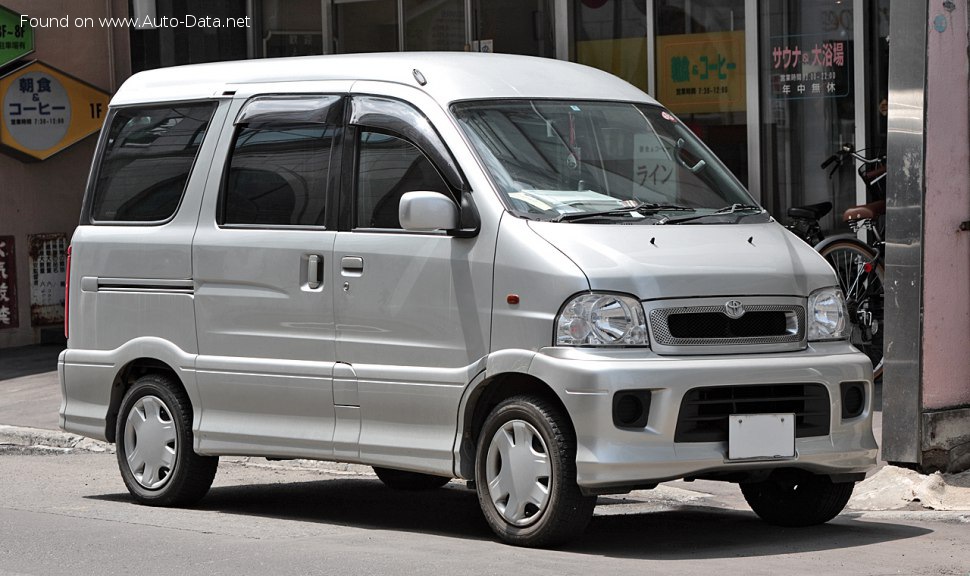
The Toyota Sparky 1.3 i (88 Hp) represents a niche yet highly functional compact minivan primarily designed for the Japanese domestic market (JDM) and select Asian regions. Produced by Toyota from July 2000 to November 2004, this first-generation Sparky was conceived as a versatile, space-efficient vehicle, catering to urban families and businesses requiring ample passenger and cargo capacity within a small footprint. Its design philosophy centered on maximizing interior volume while maintaining a compact exterior, making it an ideal choice for congested city environments where maneuverability and parking ease are paramount. Positioned within the burgeoning compact minivan segment, the Sparky offered a compelling blend of Toyota’s renowned reliability, practical design, and a surprisingly capable powertrain for its class, embodying the brand’s commitment to delivering purpose-built vehicles tailored to specific market needs. The 1.3 i (88 Hp) variant, in particular, was a cornerstone of the Sparky lineup, balancing adequate performance with commendable fuel efficiency.
Engine and Performance of the Toyota Sparky
At the heart of the Toyota Sparky 1.3 i (88 Hp) lies the robust and efficient K3-VE engine, a 1.3-liter (1299 cm³ or 79.27 cu. in.) naturally aspirated inline-four gasoline unit. This engine, known for its durability and smooth operation, features a Double Overhead Camshaft (DOHC) valvetrain with four valves per cylinder, a configuration that optimizes airflow and combustion efficiency. Power output is rated at a respectable 88 horsepower (Hp) at 6000 revolutions per minute (rpm), providing sufficient impetus for urban commuting and light highway duties. Torque delivery is equally practical, peaking at 90.72 pound-feet (123 Nm) at 4400 rpm, ensuring responsive acceleration from a standstill and adequate pulling power when fully loaded.
The K3-VE engine employs a multi-port manifold injection system, a proven technology that precisely meters fuel to each cylinder, contributing to both performance and fuel economy. With a compression ratio of 10.5:1, the engine is designed for optimal combustion efficiency using standard petrol (gasoline). The engine’s layout is somewhat unique for a compact minivan, featuring a rear, longitudinal configuration, and driving the rear wheels. This powertrain architecture, while less common in front-engine, front-wheel-drive minivans, offers benefits such as improved weight distribution and potentially better traction under certain load conditions, contributing to a more balanced driving dynamic.
In terms of efficiency, the Sparky 1.3 i (88 Hp) delivers impressive figures for a vehicle of its size and capacity. Its combined fuel economy is estimated at 37.3 US miles per gallon (mpg), translating to approximately 6.3 liters per 100 kilometers. Urban driving yields around 31.4 US mpg (7.5 l/100 km), while extra-urban conditions see efficiency rise to an excellent 42.8 US mpg (5.5 l/100 km). These figures underscore the Sparky’s economical nature, making it an attractive option for budget-conscious buyers and those facing rising fuel costs. The vehicle’s weight-to-power ratio stands at 12.6 kg/Hp (79.3 Hp/tonne), and its weight-to-torque ratio is 9 kg/Nm (110.8 Nm/tonne), indicating a well-matched powertrain for its intended purpose. The engine oil capacity is 3.4 liters (3.59 US quarts), and the cooling system holds 6.5 liters (6.87 US quarts), reflecting standard maintenance requirements for its class.
Design and Features of the Toyota Sparky
The Toyota Sparky is characterized by its compact minivan body type, a design choice that prioritizes interior volume and practicality. Measuring 148.23 inches (3765 mm) in length, 59.65 inches (1515 mm) in width, and a notable 74.61 inches (1895 mm) in height, the Sparky’s tall, boxy silhouette immediately signals its dedication to maximizing usable space. This vertical emphasis, combined with a relatively short wheelbase of 95.67 inches (2430 mm), allows for exceptional maneuverability in tight urban environments, a critical attribute for its primary markets. The design is unpretentious and functional, with large windows providing excellent visibility, which is a key safety and convenience feature for a family vehicle.
Designed to accommodate up to seven occupants, the Sparky features five doors, including a rear liftgate for easy cargo access. The clever packaging allows for a 7-seat configuration within its compact dimensions, making it a highly versatile people mover. While specific interior amenities for the 2000-2004 model year would have been modest by today’s standards, features like air conditioning, power windows, and a basic audio system would have been standard or optional, providing essential comfort and convenience. The emphasis would have been on durable, easy-to-clean materials suitable for family use.
Safety features for vehicles of this era typically included basic airbags for the front occupants and anti-lock braking systems (ABS) as an option. The Sparky’s design, with its relatively tall stance, would have offered a commanding view of the road, contributing to active safety. Its kerb weight of 2447.13 pounds (1110 kg) and a maximum permissible weight of 3990.37 pounds (1810 kg) highlight its robust construction, capable of carrying a substantial load of 1543.24 pounds (700 kg), whether it be passengers or cargo. The fuel tank capacity of 12.15 US gallons (46 liters) provides a respectable cruising range, further enhancing its practicality for daily use.
The Sparky’s drivetrain architecture, with its rear-wheel-drive configuration, offers a robust and straightforward setup. While common in light commercial vehicles, its application in a compact minivan of this era provided a distinct driving feel, often associated with durability and better traction when carrying heavy loads. The suspension system, while not detailed in the specifications, would have been tuned to provide a comfortable ride for passengers while handling typical road imperfections. Overall, the Toyota Sparky’s design and features underscore its role as a highly practical, reliable, and space-efficient compact minivan, perfectly suited for the demands of urban life in its target markets.
Technical Specifications
| Brand | Toyota |
| Model | Sparky |
| Generation | Sparky |
| Type (Engine) | 1.3 i (88 Hp) |
| Start of production | July, 2000 year |
| End of production | November, 2004 year |
| Powertrain Architecture | Internal Combustion engine |
| Body type | Minivan |
| Seats | 7 |
| Doors | 5 |
| Fuel consumption (economy) – urban | 7.5 l/100 km (31.4 US mpg) |
| Fuel consumption (economy) – extra urban | 5.5 l/100 km (42.8 US mpg) |
| Fuel consumption (economy) – combined | 6.3 l/100 km (37.3 US mpg) |
| Fuel Type | Petrol (Gasoline) |
| Weight-to-power ratio | 12.6 kg/Hp, 79.3 Hp/tonne |
| Weight-to-torque ratio | 9 kg/Nm, 110.8 Nm/tonne |
| Power | 88 Hp @ 6000 rpm. |
| Power per litre | 67.7 Hp/l |
| Torque | 123 Nm @ 4400 rpm. (90.72 lb.-ft. @ 4400 rpm.) |
| Engine layout | Rear, Longitudinal |
| Engine Model/Code | K3-VE |
| Engine displacement | 1299 cm³ (1.3 l / 79.27 cu. in.) |
| Number of cylinders | 4 |
| Engine configuration | Inline |
| Cylinder Bore | 75 mm (2.95 in.) |
| Piston Stroke | 73.5 mm (2.89 in.) |
| Compression ratio | 10.5:1 |
| Number of valves per cylinder | 4 |
| Fuel injection system | Multi-port manifold injection |
| Engine aspiration | Naturally aspirated engine |
| Valvetrain | DOHC |
| Engine oil capacity | 3.4 l (3.59 US qt) |
| Coolant | 6.5 l (6.87 US qt) |
| Kerb Weight | 1110 kg (2447.13 lbs.) |
| Max. weight | 1810 kg (3990.37 lbs.) |
| Max load | 700 kg (1543.24 lbs.) |
| Fuel tank capacity | 46 l (12.15 US gal) |
| Length | 3765 mm (148.23 in.) |
| Width | 1515 mm (59.65 in.) |
| Height | 1895 mm (74.61 in.) |
| Wheelbase | 2430 mm (95.67 in.) |
| Drivetrain Architecture | Internal combustion engine (ICE) drives the rear wheels |
| Drive wheel | Rear wheel drive |
