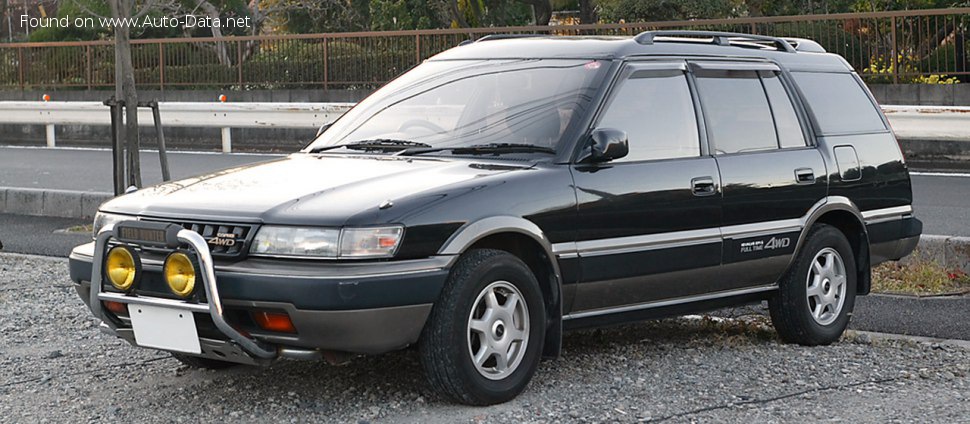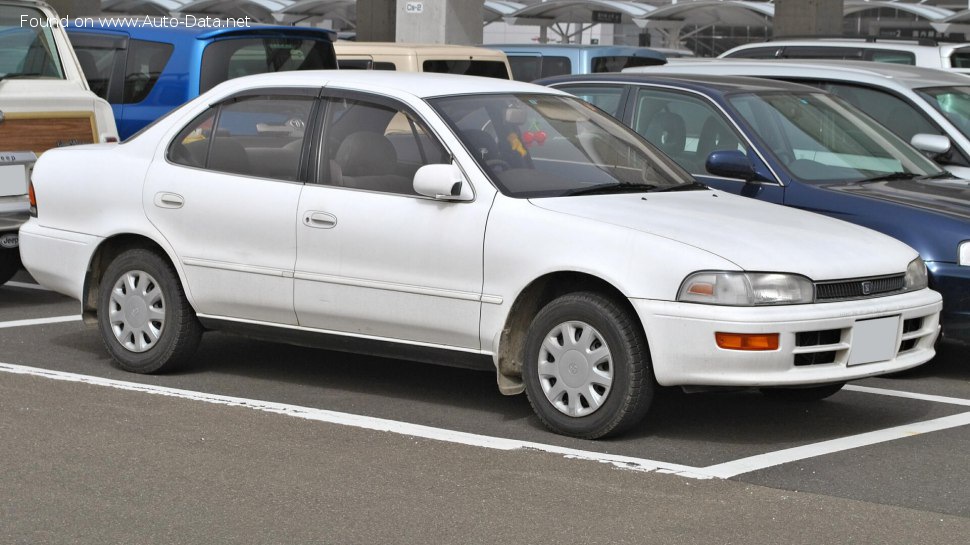
The Toyota Sprinter 1.3 i (97 Hp), produced between 1991 and 1995, represents a significant chapter in Toyota’s long-standing commitment to reliable and efficient compact automobiles. While not a household name in the North American market, the Sprinter series held a pivotal role in its primary markets, particularly Japan, as a twin model to the globally successful Corolla. This specific generation, often referred to as the E100 series when considering its Corolla counterpart, embodied the engineering principles of the early 1990s: robust mechanics, sensible design, and a focus on economical operation. Positioned as a practical and dependable compact sedan, the Sprinter 1.3 i (97 Hp) catered to a broad demographic seeking an unpretentious yet capable daily driver, excelling in urban environments and offering comfortable long-distance travel within its class. Its design and mechanical package were a testament to Toyota’s philosophy of continuous improvement and delivering value, making it a ubiquitous sight in its native Japan and other export markets where its practicality was highly valued.
Engine and Performance: The Heart of the Toyota Sprinter 1.3 i (97 Hp)
At the core of the 1991-1995 Toyota Sprinter 1.3 i (97 Hp) lay a meticulously engineered powertrain designed for efficiency and longevity. The vehicle was propelled by a naturally aspirated, 1.3-liter (specifically, 1331 cubic centimeters or 81.22 cubic inches) inline four-cylinder gasoline engine. This powerplant delivered a respectable 97 horsepower at a relatively high 6400 revolutions per minute (rpm), showcasing its free-revving nature. Torque output stood at 83.34 pound-feet (113 Nm) at 5200 rpm, providing adequate pulling power for its compact dimensions and intended use. The power-per-liter ratio of 72.9 Hp/l was commendable for a non-turbocharged engine of its era, indicating efficient combustion and design.
The engine’s architecture was modern for its time, featuring a Double Overhead Camshaft (DOHC) valvetrain with four valves per cylinder, totaling 16 valves for the four-cylinder unit. This DOHC setup, rather than a simpler Single Overhead Cam (SOHC) or pushrod design, allowed for optimized airflow and more precise valve timing, contributing to both the engine’s power output and its fuel efficiency. Fuel delivery was handled by a multi-port manifold injection system, a significant advancement over older carburetor systems, ensuring more precise fuel metering, better cold starts, and reduced emissions. The engine’s compression ratio of 9.6:1 was typical for a naturally aspirated gasoline engine, balancing power and the ability to run on standard octane fuel.
Further contributing to its mechanical robustness were the precise internal dimensions: a cylinder bore of 2.91 inches (74 mm) and a piston stroke of 3.05 inches (77.4 mm). This slightly undersquare design (stroke longer than bore) often contributes to better low-end torque and fuel efficiency, aligning perfectly with the Sprinter’s practical mission. The engine was mounted transversely at the front of the vehicle, driving the front wheels, a common and efficient powertrain architecture for compact sedans of the period. This Front-Wheel Drive (FWD) layout not only maximized interior space but also offered predictable handling characteristics, especially beneficial in varied driving conditions. The 50-liter (13.21 US gallons) fuel tank capacity provided a reasonable cruising range, further enhancing its suitability as a reliable daily commuter.
Design and Features of the Toyota Sprinter
The 1991-1995 Toyota Sprinter 1.3 i (97 Hp) exemplified the pragmatic design philosophy prevalent in Japanese compact sedans of its era. As a four-door sedan with seating for five occupants, it prioritized functionality, durability, and a clean, unassuming aesthetic. The body lines were smooth and aerodynamic for the early 1990s, aiming to reduce wind noise and improve fuel economy, rather than to make a bold styling statement. Its proportions were well-balanced, projecting an image of understated reliability that was synonymous with the Toyota brand.
Dimensionally, the Sprinter was designed to be maneuverable and space-efficient. It measured 168.9 inches (4290 mm) in length, 71.65 inches (1820 mm) in width, and 54.13 inches (1375 mm) in height. These compact measurements made it highly adept at navigating congested urban environments and fitting into tight parking spaces, a crucial consideration in its primary Japanese market. The wheelbase of 97.05 inches (2465 mm) contributed to a stable ride quality for its size, while the front track of 57.87 inches (1470 mm) and rear track of 57.48 inches (1460 mm) ensured a confident stance on the road. A minimum turning circle of 32.15 feet (9.8 meters) further underscored its agility, making U-turns and tight maneuvers effortless.
Inside, the Sprinter’s cabin was designed with ergonomics and durability in mind. While luxury features were not its primary focus, the interior offered a comfortable and functional environment. Materials were chosen for their hard-wearing properties, capable of withstanding years of daily use. Features typical of a compact sedan from this period would have included manual or power windows, a basic but functional heating and ventilation system, and a radio. Safety features, while rudimentary by today’s standards, would have included three-point seatbelts for all outboard passengers and a collapsible steering column. The car’s overall architecture, including its robust chassis and body structure, provided a foundational level of occupant protection. The Sprinter’s enduring appeal lies in its straightforward approach to automotive design – providing a dependable, efficient, and practical vehicle without unnecessary complexities, a characteristic that cemented its reputation for longevity and low running costs.
Technical Specifications
| Brand | Toyota |
| Model | Sprinter |
| Generation | Sprinter |
| Type (Engine) | 1.3 i (97 Hp) |
| Start of production | 1991 year |
| End of production | 1995 year |
| Powertrain Architecture | Internal Combustion engine |
| Body type | Sedan |
| Seats | 5 |
| Doors | 4 |
| Fuel Type | Petrol (Gasoline) |
| Power | 97 Hp @ 6400 rpm. |
| Power per liter | 72.9 Hp/l |
| Torque | 83.34 lb.-ft. @ 5200 rpm. (113 Nm @ 5200 rpm.) |
| Engine layout | Front, Transverse |
| Engine displacement | 1.3 l (1331 cm3 / 81.22 cu. in.) |
| Number of cylinders | 4 |
| Engine configuration | Inline |
| Cylinder Bore | 2.91 in. (74 mm) |
| Piston Stroke | 3.05 in. (77.4 mm) |
| Compression ratio | 9.6:1 |
| Number of valves per cylinder | 4 |
| Fuel injection system | Multi-port manifold injection |
| Engine aspiration | Naturally aspirated engine |
| Valvetrain | DOHC |
| Fuel tank capacity | 13.21 US gal (50 l / 11 UK gal) |
| Length | 168.9 in. (4290 mm) |
| Width | 71.65 in. (1820 mm) |
| Height | 54.13 in. (1375 mm) |
| Wheelbase | 97.05 in. (2465 mm) |
| Front track | 57.87 in. (1470 mm) |
| Rear (Back) track | 57.48 in. (1460 mm) |
| Minimum turning circle (turning diameter) | 32.15 ft. (9.8 m) |
| Drivetrain Architecture | The Internal combustion engine (ICE) drives the front wheels of the vehicle. |
| Drive wheel | Front wheel drive |