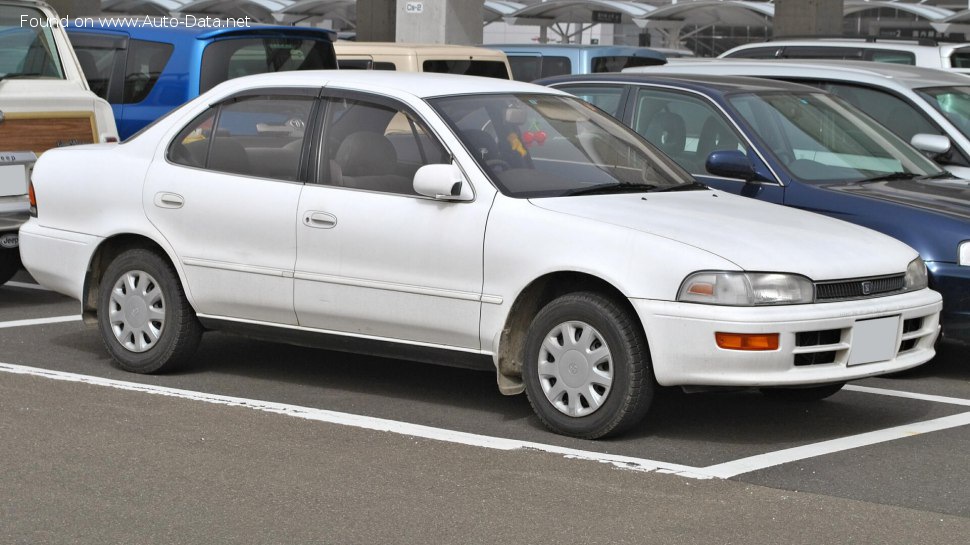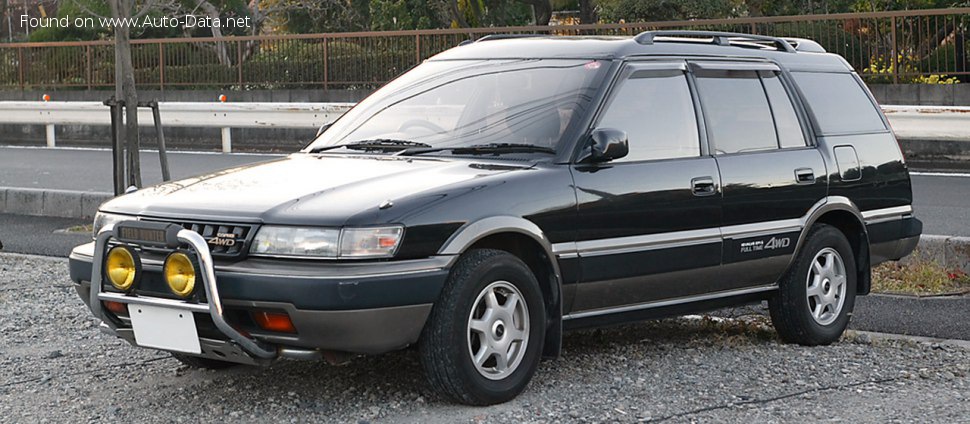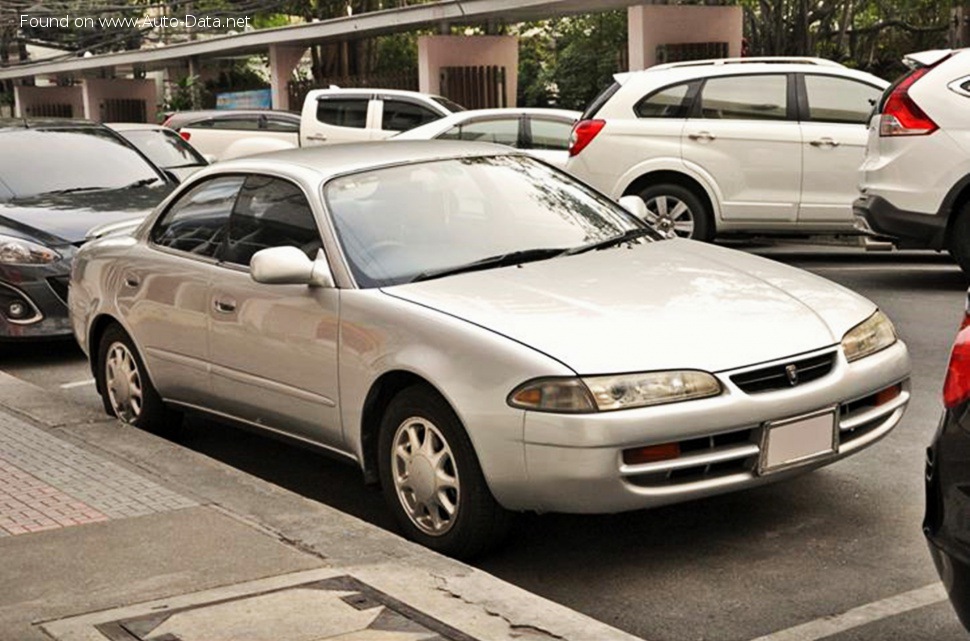
The Toyota Sprinter Marino represents a distinct chapter in Toyota’s prolific history of compact cars, emerging in 1992 as a stylish and sport-oriented variant within the renowned Sprinter lineage. Positioned primarily for the Japanese Domestic Market (JDM), the Toyota Sprinter Marino was designed to appeal to younger buyers seeking a more aesthetically pleasing and dynamic alternative to the more utilitarian Corolla/Sprinter sedan. This particular model, equipped with a 1.5-liter engine generating 105 horsepower, showcased Toyota’s engineering prowess in delivering reliable performance within a compact, fuel-efficient package. As a four-door hardtop sedan, the Sprinter Marino blended practicality with a sleek, pillarless design aesthetic, a popular trend in Japan during the early 1990s, offering a unique blend of sporty appeal and everyday usability. Its production spanned from 1992 to 1997, marking it as a distinctive entry in Toyota’s extensive compact car portfolio.
Engineering and Performance of the Toyota Sprinter Marino
At the heart of the Toyota Sprinter Marino 1.5 (105 Hp) lies a meticulously engineered 1.5-liter (1498 cm3 or 91.41 cu. in.) inline four-cylinder engine. This powertrain, characteristic of Toyota’s commitment to efficiency and durability, delivered a respectable 105 horsepower at a relatively high 6400 revolutions per minute (rpm). Such a power output from a naturally aspirated 1.5-liter engine in the early 1990s was quite competitive, yielding a power-per-liter figure of 70.1 Hp/l, indicative of a well-tuned and free-revving unit. Torque output stood at 127 Nm (93.67 lb.-ft.) peaking at a lower 3200 rpm, providing accessible power for daily driving and urban maneuvering.
The engine’s architecture featured a front, transverse layout, driving the front wheels, a common and efficient setup for compact sedans of the era. Key technical specifications include a Double Overhead Camshaft (DOHC) valvetrain with four valves per cylinder, optimizing airflow for both intake and exhaust and contributing to the engine’s higher-revving nature and efficient combustion. Fuel delivery was managed by a multi-port manifold injection system, a sophisticated technology for the time that ensured precise fuel metering and improved fuel economy compared to earlier carburetor systems. With a compression ratio of 9.4:1, the engine was designed to run efficiently on readily available gasoline (petrol).
Coupled with a 5-speed manual transmission, the 1.5-liter engine offered an engaging driving experience, allowing the driver to fully utilize the engine’s power band. The manual gearbox was a staple for drivers seeking more control and a sportier feel, aligning with the Marino’s youthful target demographic. The vehicle’s relatively low curb weight of 2270.76 lbs. (1030 kg) contributed significantly to its performance metrics. This resulted in a weight-to-power ratio of 9.8 kg/Hp (101.9 Hp/tonne) and a weight-to-torque ratio of 8.1 kg/Nm (123.3 Nm/tonne), indicating a nimble and responsive character for a compact sedan. These figures suggest that while not a high-performance machine, the Sprinter Marino 1.5 was designed to be energetic and enjoyable to drive within its class, particularly in the urban and suburban environments it was intended for.
Design and Features
The design philosophy behind the Toyota Sprinter Marino was a clear departure from the more conventional sedan styling of its Sprinter counterpart. It adopted a “hardtop” sedan body type, characterized by its frameless door windows and a perceived lack of a B-pillar, creating a sleek, coupe-like profile when all windows were down. This design trend was highly fashionable in Japan during the late 1980s and early 1990s, offering a sense of openness and luxury typically associated with more expensive vehicles. The Marino’s four doors and seating for five passengers, however, maintained its practicality as a family-friendly compact car.
Dimensionally, the Sprinter Marino was compact, perfectly suited for Japan’s often narrow streets and dense urban environments. It measured 172.64 inches (4385 mm) in length, 66.73 inches (1695 mm) in width, and a low-slung 51.77 inches (1315 mm) in height. Its wheelbase of 97.05 inches (2465 mm) provided a stable ride while contributing to a remarkably tight minimum turning circle of 32.15 feet (9.8 m), enhancing maneuverability in tight spaces. The relatively wide front and rear tracks (57.87 in. / 1470 mm and 57.48 in. / 1460 mm, respectively) further contributed to its stable handling characteristics.
In terms of features, as a 1990s compact car, the Sprinter Marino offered a blend of then-modern conveniences and essential safety elements. While specific trim levels and optional equipment would vary, standard features likely included power steering, air conditioning, and a basic audio system. Safety features for the era would have focused on a robust body structure, seatbelts for all occupants, and potentially a driver’s side airbag in later production years, though this was not standard across all compact models in 1992. The braking system comprised ventilated discs at the front for effective stopping power and traditional drum brakes at the rear, a common configuration for front-wheel-drive compacts. The vehicle rode on 13-inch wheels fitted with 175/70 R13 tires, providing a balance of comfort and predictable grip for its intended use. The 13.21 US gallons (50 liters) fuel tank capacity ensured a reasonable cruising range for daily commutes and longer journeys.
The overall package of the Toyota Sprinter Marino 1.5 (105 Hp) was a testament to Toyota’s ability to craft a car that was not only reliable and efficient but also imbued with a distinctive style and a touch of sportiness, making it a memorable offering in the competitive Japanese compact car market of the 1990s. Its enduring legacy lies in its blend of practical sedan utility with an appealing, hardtop aesthetic, a design choice that continues to evoke a sense of nostalgic charm among enthusiasts.
Technical Specifications: Toyota Sprinter Marino 1.5 (105 Hp)
| General Information | |
| Brand | Toyota |
| Model | Sprinter |
| Generation | Sprinter Marino |
| Type (Engine) | 1.5 (105 Hp) |
| Start of production | 1992 year |
| End of production | 1997 year |
| Powertrain Architecture | Internal Combustion engine |
| Body type | Sedan |
| Seats | 5 |
| Doors | 4 |
| Performance Specs | |
| Fuel Type | Petrol (Gasoline) |
| Weight-to-power ratio | 9.8 kg/Hp, 101.9 Hp/tonne |
| Weight-to-torque ratio | 8.1 kg/Nm, 123.3 Nm/tonne |
| Engine Specs | |
| Power | 105 Hp @ 6400 rpm. |
| Power per liter | 70.1 Hp/l |
| Torque | 127 Nm @ 3200 rpm. (93.67 lb.-ft. @ 3200 rpm.) |
| Engine layout | Front, Transverse |
| Engine displacement | 1498 cm3 (91.41 cu. in.) |
| Number of cylinders | 4 |
| Engine configuration | Inline |
| Cylinder Bore | 74 mm (2.91 in.) |
| Piston Stroke | 87 mm (3.43 in.) |
| Compression ratio | 9.4:1 |
| Number of valves per cylinder | 4 |
| Fuel injection system | Multi-port manifold injection |
| Engine aspiration | Naturally aspirated engine |
| Valvetrain | DOHC |
| Space, Volume and Weights | |
| Kerb Weight | 1030 kg (2270.76 lbs.) |
| Fuel tank capacity | 50 l (13.21 US gal | 11 UK gal) |
| Dimensions | |
| Length | 4385 mm (172.64 in.) |
| Width | 1695 mm (66.73 in.) |
| Height | 1315 mm (51.77 in.) |
| Wheelbase | 2465 mm (97.05 in.) |
| Front track | 1470 mm (57.87 in.) |
| Rear (Back) track | 1460 mm (57.48 in.) |
| Minimum turning circle (turning diameter) | 9.8 m (32.15 ft.) |
| Drivetrain, Brakes and Suspension Specs | |
| Drivetrain Architecture | The Internal combustion engine (ICE) drives the front wheels of the vehicle. |
| Drive wheel | Front wheel drive |
| Number of gears and type of gearbox | 5 gears, manual transmission |
| Front brakes | Ventilated discs |
| Rear brakes | Drum |
| Tires size | 175/70 R13 |
| Wheel rims size | 13 |