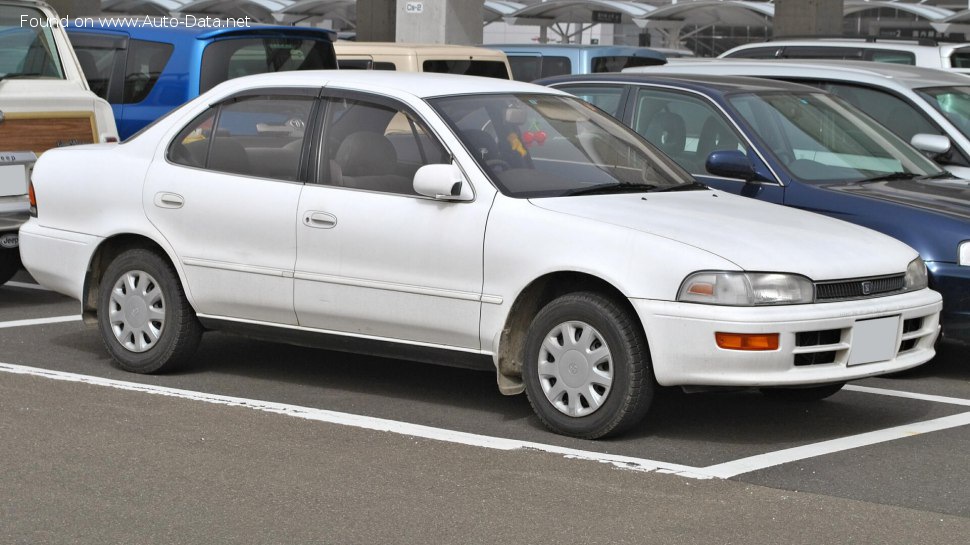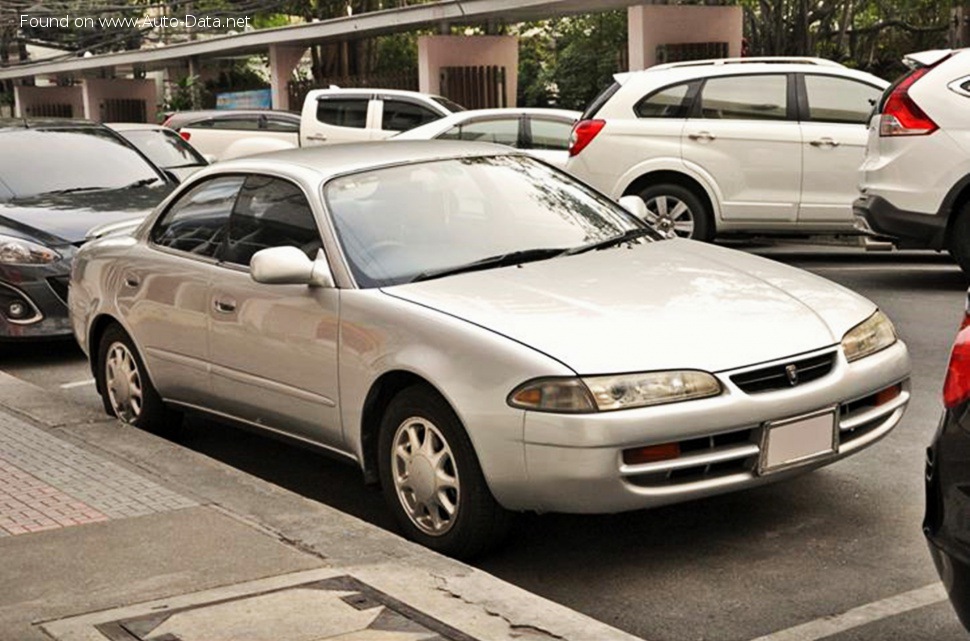
The Toyota Sprinter Marino 1.6i (165 Hp) Automatic stands as a distinctive and performance-oriented offering from Toyota’s Japan Domestic Market (JDM) lineup of the early to mid-1990s. Launched in 1992 and produced until 1997, the Sprinter Marino was not just another compact sedan; it represented a stylish, four-door hardtop variant of the popular Sprinter, itself a twin to the ubiquitous Corolla. This particular generation, often recognized for its sleek, pillarless design, aimed at a youthful and discerning market segment seeking a blend of practicality, aesthetic appeal, and spirited performance. While never officially sold in North America, its reputation as a “four-door coupe” with an enthusiast-favorite engine has garnered a cult following globally, showcasing Toyota’s engineering prowess during a golden era of Japanese automotive innovation.
The Toyota Sprinter Marino: A JDM Icon of the 1990s
In the early 1990s, the Japanese automotive market was a hotbed of innovation and diverse styling trends. Among these was the “hardtop sedan” fad, where manufacturers offered four-door vehicles with frameless windows and no B-pillar, creating a sleek, coupe-like profile when all windows were lowered. The Toyota Sprinter Marino was a prime example of this trend, sharing its platform with the seventh-generation Corolla/Sprinter (E100 series) but distinguishing itself with a unique, more upscale body. Its design prioritized aerodynamics and a low-slung stance, contributing to a sporty aesthetic that contrasted with the more utilitarian appearance of its siblings. Positioned slightly above the standard Sprinter, the Marino appealed to buyers who desired a touch of luxury and performance without sacrificing the convenience of four doors. Its production run from 1992 to 1997 cemented its place as a memorable, albeit niche, model within Toyota’s extensive JDM portfolio, reflecting a period when Japanese manufacturers were pushing boundaries in design and engineering.
Engine and Performance: The Legendary 4A-GE in the Toyota Sprinter Marino 1.6i (165 Hp) Automatic
At the heart of the Toyota Sprinter Marino 1.6i (165 Hp) Automatic lies one of Toyota’s most celebrated engines: the 4A-GE. This specific variant, known for its “redtop” or “silvertop” designations depending on the generation, was a marvel of naturally aspirated engineering for its time. With an engine displacement of 1578 cubic centimeters (96.3 cubic inches), this inline four-cylinder unit was equipped with a Double Overhead Camshaft (DOHC) valvetrain and four valves per cylinder, allowing for exceptional breathing at high RPMs. The multi-port manifold injection system ensured precise fuel delivery, contributing to its impressive output.
The 4A-GE engine in the Sprinter Marino delivered a robust 165 horsepower at a soaring 7800 revolutions per minute. This high-revving nature was a hallmark of Toyota’s performance engines, providing an exhilarating power band that encouraged spirited driving. The power per liter ratio stood at an impressive 104.6 horsepower per liter, a figure typically associated with much larger or forced-induction engines of the era, underscoring the efficiency and advanced design of the 4A-GE. Torque output was rated at 162 Newton-meters (119.49 pound-feet) at 5600 rpm, providing ample mid-range pull to complement its high-end power.
Paired with a 4-speed automatic transmission, the Sprinter Marino 1.6i offered a blend of performance and convenience. While enthusiasts might traditionally prefer a manual gearbox for a performance engine like the 4A-GE, the automatic option catered to the urban driving conditions prevalent in Japan and broadened its appeal. The powertrain architecture featured a front-wheel-drive system, with the internal combustion engine driving the front wheels, a common and efficient layout for compact sedans. This configuration, combined with a remarkably low kerb weight of just 1030 kilograms (2270.76 pounds), resulted in an excellent weight-to-power ratio of 6.2 kg/Hp (160.2 Hp/tonne) and a weight-to-torque ratio of 6.4 kg/Nm (157.3 Nm/tonne). These figures highlight the vehicle’s agility and responsiveness, making it a surprisingly quick and engaging car for its class and intended market, despite the automatic transmission.
Design and Features: The Distinctive Styling of the Sprinter Marino
The design of the Toyota Sprinter Marino was its most distinguishing characteristic, setting it apart from its more conventional Sprinter and Corolla brethren. While officially classified as a sedan, its true identity was that of a four-door hardtop. This meant the absence of a visible B-pillar when the frameless windows were down, creating an expansive, open-air feeling reminiscent of a coupe. The sleek, low-slung profile, coupled with a relatively low height of 51.77 inches (1315 mm), contributed to a dynamic and sporty appearance that was highly fashionable in Japan during the early 1990s.
Measuring 172.64 inches (4385 mm) in length and 66.73 inches (1695 mm) in width, the Sprinter Marino maintained a compact footprint, ideal for navigating crowded Japanese city streets. Its wheelbase of 97.05 inches (2465 mm) provided a stable ride while contributing to its nimble handling, further aided by a minimum turning circle of just 32.15 feet (9.8 meters). The car offered seating for five occupants across its four doors, blending its sporty aspirations with practical family usability.
In terms of chassis and braking, the Sprinter Marino was equipped with ventilated disc brakes at the front, offering effective stopping power for its light weight and performance capabilities. The rear utilized drum brakes, a common and cost-effective solution for compact cars of the era, deemed adequate given the front-biased braking dynamics. The vehicle rode on 13-inch wheels, fitted with 175/70 R13 tires. While these tire dimensions might seem modest by modern standards, they were typical for a compact performance car of the early 90s, offering a balance of ride comfort and handling precision.
Inside, the Sprinter Marino would have featured an interior designed to complement its sporty exterior. While specific details can vary by trim, period Toyota interiors were known for their ergonomic layouts, durable materials, and thoughtful amenities. Given its market positioning, one could expect supportive seating, a driver-focused dashboard, and perhaps optional features like automatic climate control or a premium sound system. Safety features, standard for the era, would likely include three-point seatbelts for all occupants, and potentially driver-side airbags as optional or later standard equipment, reflecting the evolving safety standards of the time. The 50-liter (13.21 US gallons) fuel tank capacity provided a reasonable cruising range for a vehicle of its size and engine type.
Technical Specifications: Toyota Sprinter Marino 1.6i (165 Hp) Automatic
| Brand | Toyota |
| Model | Sprinter |
| Generation | Sprinter Marino |
| Type (Engine) | 1.6i (165 Hp) Automatic |
| Start of production | 1992 year |
| End of production | 1997 year |
| Powertrain Architecture | Internal Combustion engine |
| Body type | Sedan |
| Seats |