
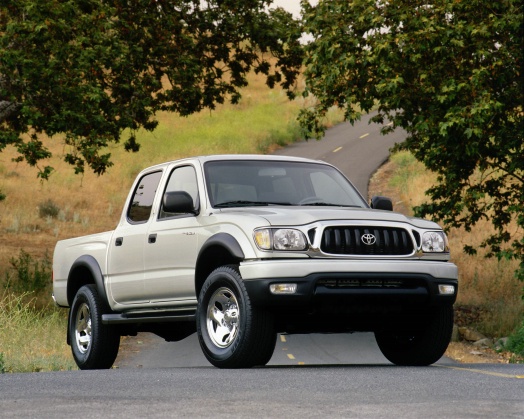
The Toyota Tacoma I Double Cab (facelift 2000) 2.7 represents a significant iteration of Toyota’s popular compact pickup truck, primarily aimed at the North American market. Introduced as part of a mid-cycle refresh, this version of the first-generation Tacoma (1995-2004) offered a unique blend of rugged capability, reliability, and a relatively spacious interior for its class, particularly with the addition of the Double Cab configuration. While not initially designed for the European or Asian markets, the Tacoma quickly gained a reputation for durability and off-road prowess, becoming a staple for both work and recreational use in the United States and Canada. The 2.7-liter engine option provided a balance between fuel economy and sufficient power for everyday tasks and light-duty hauling.
Toyota Tacoma I Double Cab (facelift 2000): A Detailed Overview
The facelifted 2000 Tacoma Double Cab built upon the foundation laid by the original model, addressing some consumer feedback and incorporating updated styling cues. The Double Cab configuration, a key differentiator, offered seating for five passengers, making it a more practical choice for families or those needing to transport more than just a driver and passenger. This model year saw refinements to the exterior design, including revised headlights and a more modern front grille. Mechanically, the Tacoma remained largely unchanged, continuing to rely on its robust body-on-frame construction and proven drivetrain components. The 2.7-liter engine, while not the most powerful option available, provided a dependable and economical powertrain for a wide range of applications.
Engine & Performance
The 2000 Toyota Tacoma I Double Cab 2.7 is powered by the 3RZ-FE 2.7-liter inline-four cylinder gasoline engine. This naturally aspirated engine produces 182 horsepower at 4800 rpm and 240 Newton-meters (177.01 lb.-ft.) of torque at 4000 rpm. The engine features a double overhead camshaft (DOHC) valvetrain with four valves per cylinder, and utilizes a multi-port fuel injection system for efficient fuel delivery. While not a performance-oriented engine, the 3RZ-FE is known for its longevity and reliability. Power is delivered to the rear wheels via a four-speed automatic transmission. The longitudinal engine layout contributes to a balanced weight distribution. The power-to-weight ratio of 67.6 horsepower per liter reflects a focus on practicality rather than outright speed. The engine’s relatively simple design and robust construction contribute to its reputation for requiring minimal maintenance.
Design & Features
The Toyota Tacoma I Double Cab (facelift 2000) is a four-door, five-seat pickup truck with a body-on-frame construction. This design provides a high level of durability and off-road capability. The Double Cab configuration significantly expands the interior space compared to the standard cab models, offering comfortable seating for passengers in both rows. The truck’s exterior styling is characterized by a relatively boxy shape, typical of pickup trucks of that era. The facelifted model features updated headlights, a revised grille, and minor trim changes. Standard features included air conditioning, power steering, and an AM/FM radio. Safety features, while limited by the standards of the time, included seatbelts for all occupants. The Tacoma’s interior was designed with practicality in mind, featuring durable materials and easy-to-clean surfaces. The truck’s bed provides ample cargo space for hauling various loads, and its robust suspension system allows for a comfortable ride even when carrying heavy payloads. The ride height, or ground clearance, of 215 mm (8.46 inches) enhances its off-road capability.
Technical Specifications
| General Information | |
| Brand | Toyota |
| Model | Tacoma |
| Generation | Tacoma I Double Cab (facelift 2000) |
| Type (Engine) | 2.7 (182 Hp) Automatic |
| Start of production | 2000 |
| End of production | 2004 |
| Powertrain Architecture | Internal Combustion engine |
| Body type | Pick-up |
| Seats | 5 |
| Doors | 4 |
| Performance Specs | |
| Fuel Type | Petrol (Gasoline) |
| Power | 182 Hp @ 4800 rpm |
| Power per litre | 67.6 Hp/l |
| Torque | 240 Nm @ 4000 rpm / 177.01 lb.-ft. @ 4000 rpm |
| Engine Specs | |
| Engine layout | Front, Longitudinal |
| Engine Model/Code | 3RZ-FE |
| Engine displacement | 2694 cm3 / 164.4 cu. in. |
| Number of cylinders | 4 |
| Engine configuration | Inline |
| Cylinder Bore | 95 mm / 3.74 in. |
| Piston Stroke | 95 mm / 3.74 in. |
| Compression ratio | 9.5:1 |
| Number of valves per cylinder | 4 |
| Fuel injection system | Multi-port manifold injection |
| Engine aspiration | Naturally aspirated engine |
| Valvetrain | DOHC |
| Engine oil capacity | 5.4 l / 5.71 US qt | 4.75 UK qt |
| Coolant | 8.2 l / 8.66 US qt | 7.21 UK qt |
| Space, Volume and Weights | |
| Max. weight | 1928 kg / 4250.51 lbs |
| Fuel tank capacity | 70 l / 18.49 US gal | 15.4 UK gal |
| Dimensions | |
| Length | 5138 mm / 202.28 in |
| Width | 1781 mm / 70.12 in |
| Height | 1715 mm / 67.52 in |
| Wheelbase | 3096 mm / 121.89 in |
| Front track | 1461 mm / 57.52 in |
| Rear (Back) track | 1455 mm / 57.28 in |
| Ride height (ground clearance) | 215 mm / 8.46 in |
| Drivetrain, Brakes and Suspension Specs | |
| Drivetrain Architecture | The Internal combustion engine (ICE) drives the rear wheels of the vehicle. |
| Drive wheel | Rear wheel drive |
| Number of gears and type of gearbox | 4 gears, automatic transmission |
| Front brakes | Ventilated discs |
| Rear brakes | Drum |
| Tires size | 205/75 R15; 235/55 R16 |
| Wheel rims size | 15; 16 |

