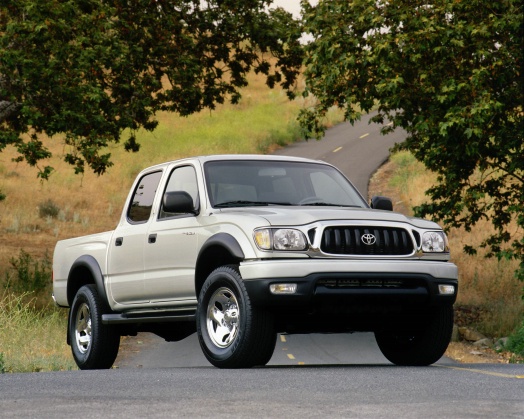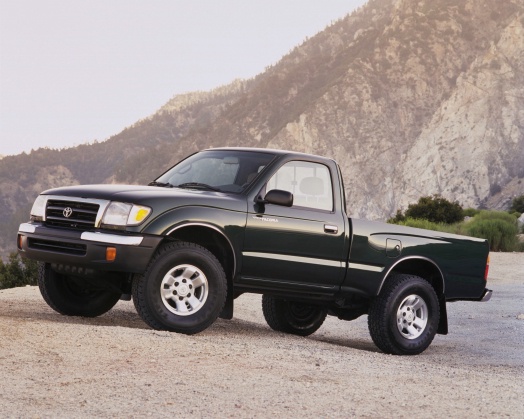
The Toyota Tacoma I Single Cab (facelift 2000) 2.7 represents a significant iteration of Toyota’s popular compact pickup truck, designed primarily for the North American market. Introduced as part of the first-generation Tacoma (1995-2004), the 2000 facelift brought updated styling and refinements to an already successful formula. This model occupied the entry-level segment of the pickup truck market, appealing to buyers seeking a durable, reliable, and affordable vehicle for work or recreational purposes. The Single Cab configuration, with its two-door layout, prioritized utility and affordability over passenger space, making it a popular choice for individuals and small businesses.
Toyota Tacoma I Single Cab (facelift 2000): Overview
The Tacoma’s success stemmed from its blend of Japanese engineering and American truck sensibilities. Unlike some of its domestic competitors, the Tacoma offered a more refined driving experience and a reputation for exceptional reliability. The 2000 facelift aimed to enhance these qualities, addressing minor criticisms and keeping the Tacoma competitive in a rapidly evolving market. This generation of Tacoma established the model as a benchmark in the compact pickup segment, paving the way for its continued success in subsequent generations. The 2.7-liter engine option provided a balance between fuel efficiency and adequate power for typical light-duty tasks.
Engine & Performance
Powering the 2000 Toyota Tacoma I Single Cab is the 3RZ-FE 2.7-liter inline-four cylinder gasoline engine. This naturally aspirated engine produces 182 horsepower at 4800 rpm and 240 Newton-meters (177.01 lb.-ft.) of torque at 4000 rpm. The engine features a double overhead camshaft (DOHC) valvetrain with four valves per cylinder and utilizes a multi-port fuel injection system. This configuration delivers a power-to-weight ratio of 146 horsepower per tonne and a torque-to-weight ratio of 192.5 Nm per tonne, providing reasonable performance for its class. The engine’s longitudinal front-engine layout contributes to balanced handling. The Tacoma was equipped with a 5-speed manual transmission, delivering power to the rear wheels. This drivetrain configuration prioritized simplicity and durability, aligning with the truck’s overall focus on reliability. The weight-to-power ratio of 6.9 kg/Hp further illustrates the engine’s efficiency in moving the vehicle.
Design & Features
The 2000 Toyota Tacoma I Single Cab maintains the classic pickup truck silhouette, characterized by a two-door configuration and a separate bed. The facelift brought subtle styling updates to the front fascia, including a revised grille and headlights, giving the truck a more modern appearance. The interior, while functional, prioritized durability over luxury. The Single Cab configuration offered seating for two passengers, making it ideal for individual use or for those who primarily needed a work truck. The truck’s bed provided ample cargo space for hauling materials or equipment. Safety features for the time included standard anti-lock brakes (ABS) on some trims, and the robust construction of the vehicle itself contributed to occupant protection. Ground clearance of 215 mm (8.46 inches) provided adequate capability for navigating rough terrain. The Tacoma’s relatively compact size made it maneuverable in urban environments and easy to park.
Technical Specifications
| General Information | |
| Brand | Toyota |
| Model | Tacoma |
| Generation | Tacoma I Single Cab (facelift 2000) |
| Type (Engine) | 2.7 (182 Hp) |
| Start of production | 2000 |
| End of production | 2004 |
| Powertrain Architecture | Internal Combustion engine |
| Body type | Pick-up |
| Seats | 2 |
| Doors | 2 |
| Performance Specs | |
| Fuel Type | Petrol (Gasoline) |
| Weight-to-power ratio | 6.9 kg/Hp |
| Hp/tonne | 146 Hp/tonne |
| Weight-to-torque ratio | 5.2 kg/Nm |
| Nm/tonne | 192.5 Nm/tonne |
| Engine Specs | |
| Power | 182 Hp @ 4800 rpm |
| Power per litre | 67.6 Hp/l |
| Torque | 240 Nm @ 4000 rpm / 177.01 lb.-ft. @ 4000 rpm |
| Engine layout | Front, Longitudinal |
| Engine Model/Code | 3RZ-FE |
| Engine displacement | 2694 cm3 / 164.4 cu. in. |
| Number of cylinders | 4 |
| Engine configuration | Inline |
| Cylinder Bore | 95 mm / 3.74 in. |
| Piston Stroke | 95 mm / 3.74 in. |
| Compression ratio | 9.5:1 |
| Number of valves per cylinder | 4 |
| Fuel injection system | Multi-port manifold injection |
| Engine aspiration | Naturally aspirated engine |
| Valvetrain | DOHC |
| Engine oil capacity | 5.4 l / 5.71 US qt | 4.75 UK qt |
| Coolant | 8.2 l / 8.66 US qt | 7.21 UK qt |
| Space, Volume and Weights | |
| Kerb Weight | 1247 kg / 2749.16 lbs |
| Max. weight | 1928 kg / 4250.51 lbs |
| Max load | 681 kg / 1501.35 lbs |
| Fuel tank capacity | 57 l / 15.06 US gal | 12.54 UK gal |
| Dimensions | |
| Length | 4686 mm / 184.49 in. |
| Width | 1689 mm / 66.5 in. |
| Height | 1570 mm / 61.81 in. |
| Wheelbase | 2624 mm / 103.31 in. |
| Front track | 1395 mm / 54.92 in. |
| Rear (Back) track | 1415 mm / 55.71 in. |
| Ride height (ground clearance) | 215 mm / 8.46 in. |
| Drivetrain, Brakes and Suspension Specs | |
| Drivetrain Architecture | The Internal combustion engine (ICE) drives the rear wheels of the vehicle. |
| Drive wheel | Rear wheel drive |
| Number of gears and type of gearbox | 5 gears, manual transmission |
| Front brakes | Ventilated discs |
| Rear brakes | Drum |
| Tires size | 205/75 R15; 235/55 R16 |
| Wheel rims size | 15; 16 |
The Toyota Tacoma I Single Cab (facelift 2000) 2.7 remains a popular choice among enthusiasts and those seeking a reliable and affordable pickup truck. Its blend of durability, practicality, and Toyota’s renowned reliability has cemented its place as a classic in the compact truck segment. While not the most powerful or luxurious option available, the Tacoma’s focus on core values continues to resonate with buyers today.