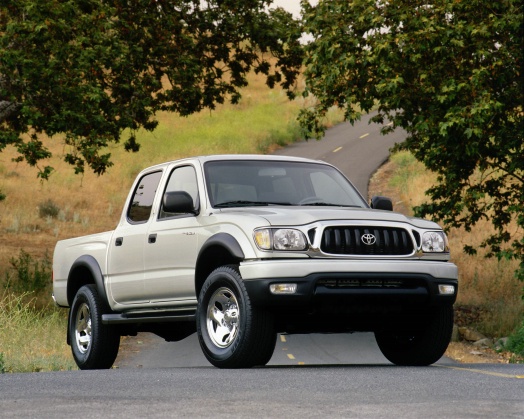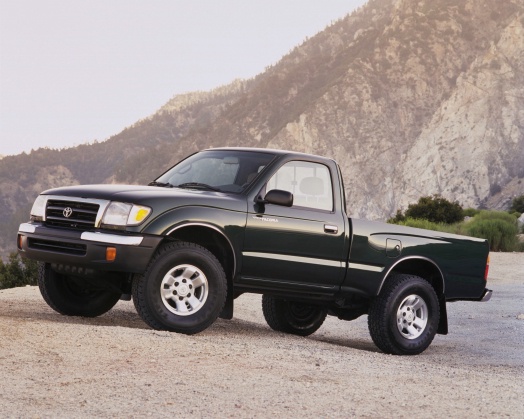
The Toyota Tacoma I Single Cab (facelift 2000) 2.7 represents a significant iteration of Toyota’s popular compact pickup truck, primarily aimed at the North American market. Introduced as part of a mid-cycle refresh, this version of the first-generation Tacoma (1995-2004) offered updated styling, improved features, and a reliable powertrain. While the Tacoma had already established a reputation for durability and off-road capability, the 2000 facelift aimed to enhance its appeal to a broader range of buyers, particularly those seeking a practical and dependable work truck or weekend adventure vehicle. This model occupied the compact pickup segment, competing with vehicles like the Ford Ranger, Nissan Frontier, and Chevrolet S-10.
Toyota Tacoma I Single Cab (facelift 2000): A Detailed Overview
The facelifted 2000 Tacoma Single Cab continued the tradition of offering a rugged and functional vehicle. The single-cab configuration prioritized practicality and affordability, making it a popular choice for commercial use and individuals who didn’t require the space of an extended or double cab. The 2.7-liter engine option provided a balance between fuel efficiency and sufficient power for everyday tasks and light-duty hauling. The availability of a four-wheel-drive system further enhanced its versatility, making it capable of tackling challenging terrain and inclement weather conditions.
Engine & Performance
Powering the 2000 Toyota Tacoma Single Cab was the 3RZ-FE 2.7-liter inline-four cylinder gasoline engine. This naturally aspirated engine produced 182 horsepower at 4800 rpm and 240 Newton-meters (177.01 lb.-ft.) of torque at 4000 rpm. While not a powerhouse, the 3RZ-FE was known for its reliability and longevity. The engine featured a double overhead camshaft (DOHC) valvetrain and multi-port fuel injection, contributing to its relatively smooth operation and decent fuel economy for a pickup truck. The engine’s longitudinal front-engine layout facilitated a traditional rear-wheel-drive configuration, with the option of a part-time four-wheel-drive system. The Tacoma was equipped with a four-speed automatic transmission, providing convenient and relatively smooth gear changes. The combination of the 2.7-liter engine and automatic transmission delivered adequate performance for typical pickup truck duties, including hauling moderate loads and navigating city streets. The power-to-weight ratio, at 67.6 horsepower per liter, was respectable for the era.
Design & Features
The 2000 Toyota Tacoma Single Cab maintained the utilitarian design language of the first generation, with a focus on functionality and durability. The body-on-frame construction provided a robust platform for both on-road and off-road use. The single-cab configuration featured two doors and seating for two passengers. The exterior styling received minor updates with the facelift, including revised front fascia and grille designs. The pickup bed offered ample cargo space for hauling various materials. Inside, the cabin was relatively spartan but functional, with durable materials and a straightforward layout. Standard features typically included air conditioning, an AM/FM radio, and basic instrumentation. Safety features were limited by the standards of the time, but generally included seatbelts and a collapsible steering column. The Tacoma’s relatively compact size made it easy to maneuver in urban environments, while its four-wheel-drive system and high ground clearance (215 mm / 8.46 inches) allowed it to tackle off-road trails with confidence. The vehicle’s dimensions – a length of 4686 mm (184.49 in) and a width of 1689 mm (66.5 in) – positioned it squarely within the compact pickup truck segment.
Technical Specifications
| General Information | |
| Brand | Toyota |
| Model | Tacoma |
| Generation | Tacoma I Single Cab (facelift 2000) |
| Type (Engine) | 2.7 (182 Hp) 4WD Automatic |
| Start of production | 2000 |
| End of production | 2004 |
| Powertrain Architecture | Internal Combustion engine |
| Body type | Pick-up |
| Seats | 2 |
| Doors | 2 |
| Performance Specs | |
| Fuel Type | Petrol (Gasoline) |
| Power | 182 Hp @ 4800 rpm |
| Power per litre | 67.6 Hp/l |
| Torque | 240 Nm @ 4000 rpm / 177.01 lb.-ft. @ 4000 rpm |
| Engine Specs | |
| Engine layout | Front, Longitudinal |
| Engine Model/Code | 3RZ-FE |
| Engine displacement | 2694 cm3 / 164.4 cu. in. |
| Number of cylinders | 4 |
| Engine configuration | Inline |
| Cylinder Bore | 95 mm / 3.74 in. |
| Piston Stroke | 95 mm / 3.74 in. |
| Compression ratio | 9.5:1 |
| Number of valves per cylinder | 4 |
| Fuel injection system | Multi-port manifold injection |
| Engine aspiration | Naturally aspirated engine |
| Valvetrain | DOHC |
| Engine oil capacity | 5.4 l / 5.71 US qt | 4.75 UK qt |
| Coolant | 8.2 l / 8.66 US qt | 7.21 UK qt |
| Space, Volume and Weights | |
| Max. weight | 1928 kg / 4250.51 lbs. |
| Fuel tank capacity | 57 l / 15.06 US gal | 12.54 UK gal |
| Dimensions | |
| Length | 4686 mm / 184.49 in. |
| Width | 1689 mm / 66.5 in. |
| Height | 1570 mm / 61.81 in. |
| Wheelbase | 2624 mm / 103.31 in. |
| Front track | 1395 mm / 54.92 in. |
| Rear (Back) track | 1415 mm / 55.71 in. |
| Ride height (ground clearance) | 215 mm / 8.46 in. |
| Drivetrain, Brakes and Suspension Specs | |
| Drive wheel | All wheel drive (4×4) |
| Number of gears and type of gearbox | 4 gears, automatic transmission |
| Front brakes | Ventilated discs |
| Rear brakes | Drum |
| Tires size | 205/75 R15; 235/55 R16 |
| Wheel rims size | 15; 16 |