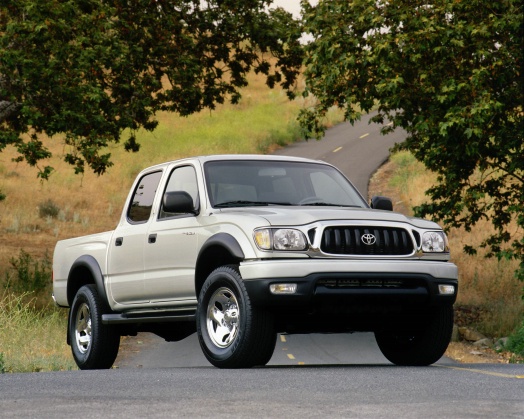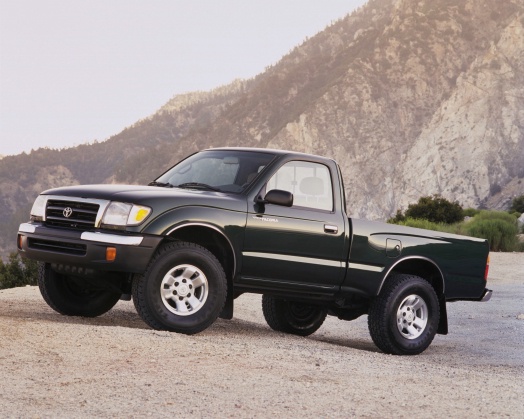
The Toyota Tacoma I Single Cab (facelift 2000) represents a significant iteration of Toyota’s popular compact pickup truck, primarily sold in North America. Introduced as a replacement for the Hilux in the US market, the Tacoma quickly gained a reputation for reliability, durability, and off-road capability. The 2000 facelift brought cosmetic and minor mechanical updates to the first-generation Tacoma, solidifying its position as a leading contender in the competitive mid-size truck segment. This particular model, equipped with a 3.4-liter V6 engine and four-wheel drive, catered to buyers seeking a versatile vehicle for both work and recreational purposes.
Toyota Tacoma I: A Legacy of Reliability
The first-generation Toyota Tacoma, produced from 1995 to 2004, was a pivotal model for Toyota in the North American market. Prior to the Tacoma, Toyota’s pickup offerings were largely based on the globally sold Hilux. The Tacoma was specifically designed to appeal to American truck buyers, offering a more refined driving experience and a wider range of features. The 2000 facelift focused on enhancing the truck’s aesthetics and addressing minor issues identified in earlier models. It retained the core strengths of the original Tacoma – its robust construction, dependable powertrain, and impressive off-road performance. The Single Cab configuration, with its two-door layout and limited seating, was favored by those prioritizing utility and cargo space over passenger comfort.
Engine & Performance
Powering the 2000 Toyota Tacoma I Single Cab is the 5VZ-FE 3.4-liter V6 engine. This naturally aspirated engine produces 190 horsepower at 4800 rpm and 298 Nm (219.79 lb.-ft.) of torque at 3600 rpm. The engine features a longitudinal front-engine layout, multi-port fuel injection, and a double overhead camshaft (DOHC) valvetrain with four valves per cylinder. This configuration delivers a good balance of power and efficiency for a vehicle of its type. The engine’s power-to-weight ratio is 8.5 kg/Hp, and its torque-to-weight ratio is 5.4 kg/Nm. The Tacoma’s four-speed automatic transmission provides smooth and reliable gear changes, contributing to a comfortable driving experience. Fuel economy is rated at 13.8 l/100 km (17 US mpg) in urban conditions and 12.4 l/100 km (19 US mpg) on the highway.
Design & Features
The 2000 Toyota Tacoma I Single Cab is a traditional pick-up truck with a two-door body style and seating for two passengers. Its design emphasizes functionality and ruggedness. The exterior features a relatively simple, utilitarian aesthetic, typical of trucks from this era. The facelifted model received minor styling updates, including revised front fascia and updated interior trim. The truck’s robust frame and suspension system contribute to its impressive off-road capability. The four-wheel-drive system provides enhanced traction in challenging terrain. Safety features, while limited by the standards of the time, included ventilated disc brakes on the front wheels and drum brakes on the rear. The Tacoma’s relatively compact size makes it maneuverable in both urban and off-road environments. The vehicle’s dimensions include a length of 4686 mm (184.49 in), a width of 1689 mm (66.5 in), and a height of 1570 mm (61.81 in). The wheelbase measures 2624 mm (103.31 in), and the ground clearance is a substantial 275 mm (10.83 in).
Technical Specifications
| Brand | Toyota |
| Model | Tacoma |
| Generation | Tacoma I Single Cab (facelift 2000) |
| Type (Engine) | 3.4 V6 (190 Hp) 4WD Automatic |
| Start of production | 2000 |
| End of production | 2004 |
| Powertrain Architecture | Internal Combustion engine |
| Body type | Pick-up |
| Seats | 2 |
| Doors | 2 |
| Fuel consumption (urban) | 13.8 l/100 km (17 US mpg) |
| Fuel consumption (extra urban) | 12.4 l/100 km (19 US mpg) |
| Fuel Type | Petrol (Gasoline) |
| Weight-to-power ratio | 8.5 kg/Hp |
| Weight-to-torque ratio | 5.4 kg/Nm |
| Power | 190 Hp @ 4800 rpm |
| Torque | 298 Nm @ 3600 rpm (219.79 lb.-ft. @ 3600 rpm) |
| Engine layout | Front, Longitudinal |
| Engine Model/Code | 5VZ-FE |
| Engine displacement | 3378 cm3 (206.14 cu. in.) |
| Number of cylinders | 6 |
| Engine configuration | V-engine |
| Cylinder Bore | 93.4 mm (3.68 in.) |
| Piston Stroke | 82.04 mm (3.23 in.) |
| Compression ratio | 9.6:1 |
| Number of valves per cylinder | 4 |
| Fuel injection system | Multi-port manifold injection |
| Engine aspiration | Naturally aspirated |
| Valvetrain | DOHC |
| Kerb Weight | 1606 kg (3540.62 lbs.) |
| Max. weight | 2315 kg (5103.7 lbs.) |
| Max load | 709 kg (1563.08 lbs.) |
| Fuel tank capacity | 57 l (15.06 US gal | 12.54 UK gal) |
| Length | 4686 mm (184.49 in.) |
| Width | 1689 mm (66.5 in.) |
| Height | 1570 mm (61.81 in.) |
| Wheelbase | 2624 mm (103.31 in.) |
| Front track | 1395 mm (54.92 in.) |
| Rear track | 1415 mm (55.71 in.) |
| Ride height (ground clearance) | 275 mm (10.83 in.) |
| Drive wheel | All wheel drive (4×4) |
| Number of gears | 4 |
| Gearbox type | Automatic transmission |
| Front brakes | Ventilated discs |
| Rear brakes | Drum |
| Tires size | 205/75 R15; 235/55 R16 |
| Wheel rims size | 15; 16 |
The Toyota Tacoma I Single Cab (facelift 2000) remains a popular choice among truck enthusiasts and those seeking a reliable and capable work vehicle. Its enduring appeal is a testament to Toyota’s commitment to quality and durability. While newer trucks offer more advanced features and technology, the first-generation Tacoma continues to hold its own as a practical and dependable option.