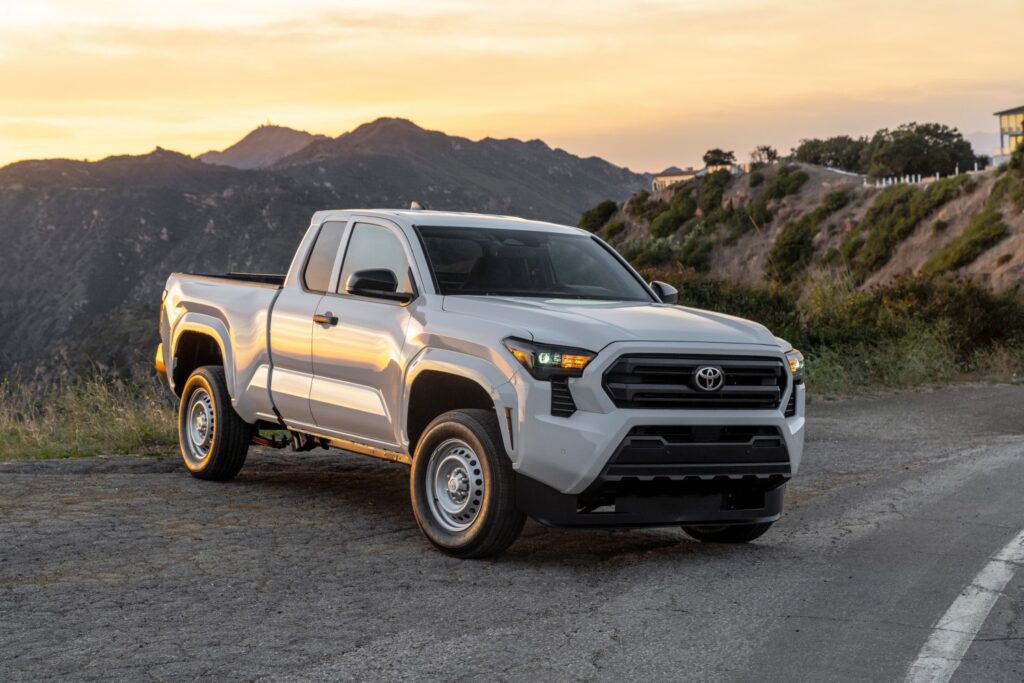
The Toyota Tacoma IV XtraCab 2.4 i-FORCE, introduced in November 2023, represents the latest iteration of Toyota’s immensely popular mid-size pickup truck. As the fourth generation of the Tacoma, this model continues a legacy of rugged reliability and off-road capability, while incorporating modern technology and improved efficiency. Primarily sold in North America, the Tacoma occupies a crucial segment, catering to both recreational users and those requiring a versatile work vehicle. The XtraCab configuration offers a smaller rear seating area and longer bed compared to the Double Cab models, appealing to buyers prioritizing cargo space over passenger comfort. This version is powered by a newly developed 2.4-liter turbocharged four-cylinder engine, marking a significant shift from previous generation powertrains.
Toyota Tacoma IV XtraCab 2.4 i-FORCE: An Overview
The Tacoma has long been a benchmark in the mid-size truck category, known for its strong resale value and durability. The fourth generation builds upon this foundation with a redesigned exterior, a more refined interior, and a suite of advanced driver-assistance systems. The 2.4 i-FORCE trim specifically focuses on delivering a balance of power and fuel economy, utilizing Toyota’s latest engine technology. The XtraCab body style, with its two doors and extended cab, provides a practical solution for those needing a truck bed without the full size of a crew cab. This model is designed to compete with offerings from Chevrolet, Ford, and Nissan in the highly contested North American truck market.
Engine & Performance
At the heart of the Tacoma IV XtraCab 2.4 i-FORCE lies the T24A-FTS 2.4-liter inline four-cylinder engine. This powerplant produces 278 horsepower at 6000 rpm and 430 Nm (317.15 lb.-ft.) of torque at 1700 rpm. The engine employs a twin-scroll turbocharger and intercooler to enhance performance and efficiency. Direct injection and multi-port manifold injection work in concert to optimize combustion. The engine’s power-to-weight ratio is 6.8 kg/Hp, or 147.9 Hp/tonne, while the torque-to-weight ratio stands at 4.4 kg/Nm, or 228.7 Nm/tonne. Power is delivered to the rear wheels via an 8-speed automatic transmission with ECT-i (Electronic Controlled Transmission – intelligent) technology, designed for smooth and responsive shifting. Fuel economy is rated at 10.2-10.7 l/100 km combined (23.1 – 22 US mpg, 27.7 – 26.4 UK mpg, 9.8 – 9.3 km/l), with urban consumption ranging from 11.2-11.8 l/100 km (21 – 19.9 US mpg) and extra urban figures at 9-9.8 l/100 km (26.1 – 24 US mpg).
Design & Features
The 2023 Tacoma XtraCab features a redesigned exterior with a more aggressive stance and modern styling cues. The body-on-frame construction provides a robust platform for both on-road comfort and off-road capability. The XtraCab configuration offers two doors and seating for two, with a longer bed length than the Double Cab models. The interior has been significantly upgraded with a new infotainment system, improved materials, and enhanced ergonomics. Standard features include ABS (Anti-lock braking system) and electric power steering. The truck’s dimensions are substantial, measuring 5410 mm (212.99 in.) in length, 1953-1979 mm (76.89 – 77.91 in.) in width, and 1877-1895 mm (73.9 – 74.61 in.) in height. Ground clearance is a noteworthy 274 mm (10.79 in.), contributing to its off-road prowess. Approach, departure, and breakover angles are 34.4°, 25.5°, and 25.5° respectively. The Tacoma boasts a maximum load capacity of 637-662 kg (1404.34 – 1459.46 lbs.) and a permitted trailer load with brakes of 2948 kg (6499.23 lbs.).
Technical Specifications
| Brand | Toyota |
| Model | Tacoma |
| Generation | Tacoma IV XtraCab |
| Type (Engine) | 2.4 i-FORCE (278 Hp) ECT-i |
| Start of production | November, 2023 |
| Powertrain Architecture | Internal Combustion engine |
| Body type | Pick-up |
| Seats | 2 |
| Doors | 2 |
| Fuel consumption (economy) – urban (EPA) | 11.2-11.8 l/100 km (21 – 19.9 US mpg) |
| Fuel consumption (economy) – extra urban (EPA) | 9-9.8 l/100 km (26.1 – 24 US mpg) |
| Fuel consumption (economy) – combined (EPA) | 10.2-10.7 l/100 km (23.1 – 22 US mpg) |
| Fuel Type | Petrol (Gasoline) |
| Weight-to-power ratio | 6.8 kg/Hp |
| Weight-to-torque ratio | 4.4 kg/Nm |
| Power | 278 Hp @ 6000 rpm |
| Torque | 430 Nm @ 1700 rpm (317.15 lb.-ft. @ 1700 rpm) |
| Engine layout | Front, Longitudinal |
| Engine Model/Code | T24A-FTS |
| Engine displacement | 2393 cm3 (146.03 cu. in.) |
| Number of cylinders | 4 |
| Engine configuration | Inline |
| Cylinder Bore | 87.5 mm (3.44 in.) |
| Piston Stroke | 99.5 mm (3.92 in.) |
| Compression ratio | 11:1 |
| Number of valves per cylinder | 4 |
| Engine oil capacity | 5.3 l (5.6 US qt | 4.66 UK qt) |
| Coolant | 12.1 l (12.79 US qt | 10.65 UK qt) |
| Kerb Weight | 1880-1905 kg (4144.69 – 4199.81 lbs.) |
| Max. weight | 2542 kg (5604.15 lbs.) |
| Max load | 637-662 kg (1404.34 – 1459.46 lbs.) |
| Fuel tank capacity | 69 l (18.23 US gal | 15.18 UK gal) |
| Permitted trailer load with brakes (12%) | 2948 kg (6499.23 lbs.) |
| Permitted towbar download | 295 kg (650.36 lbs.) |
| Length | 5410 mm (212.99 in.) |
| Width | 1953-1979 mm (76.89 – 77.91 in.) |
| Height | 1877-1895 mm (73.9 – 74.61 in.) |
| Wheelbase | 3350 mm (131.89 in.) |
| Front track | 1666 mm (65.59 in.) |
| Rear (Back) track | 1666 mm (65.59 in.) |
| Ride height (ground clearance) | 274 mm (10.79 in.) |
| Minimum turning circle (turning diameter) | 14-14.7 m (45.93 – 48.23 ft.) |
| Front suspension | Double wishbone, Transverse stabilizer |
| Rear suspension | Rigid axle suspension, Leaf spring |
| Front brakes | Ventilated discs, 320 mm |
| Rear brakes | Ventilated discs, 310 mm |
| Number of gears and type of gearbox | 8 gears, automatic transmission ECT-i |
| Tires size | 245/70 R17; 265/70 R17 |
| Wheel rims size | 17 |
The Toyota Tacoma IV XtraCab 2.4 i-FORCE continues the Tacoma’s tradition of being a highly capable and reliable mid-size pickup truck. The combination of a modern turbocharged engine, updated features, and proven durability positions it as a strong contender in its segment.