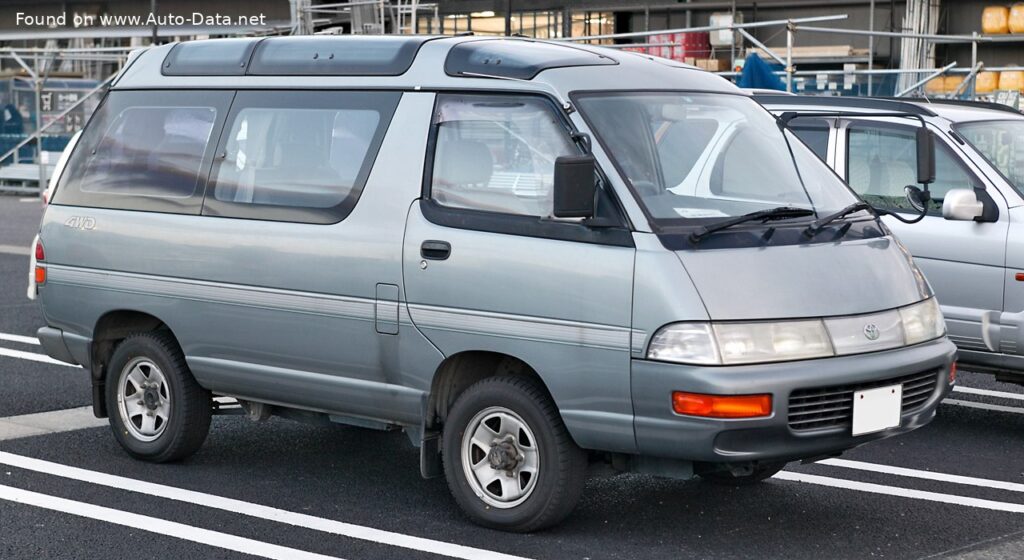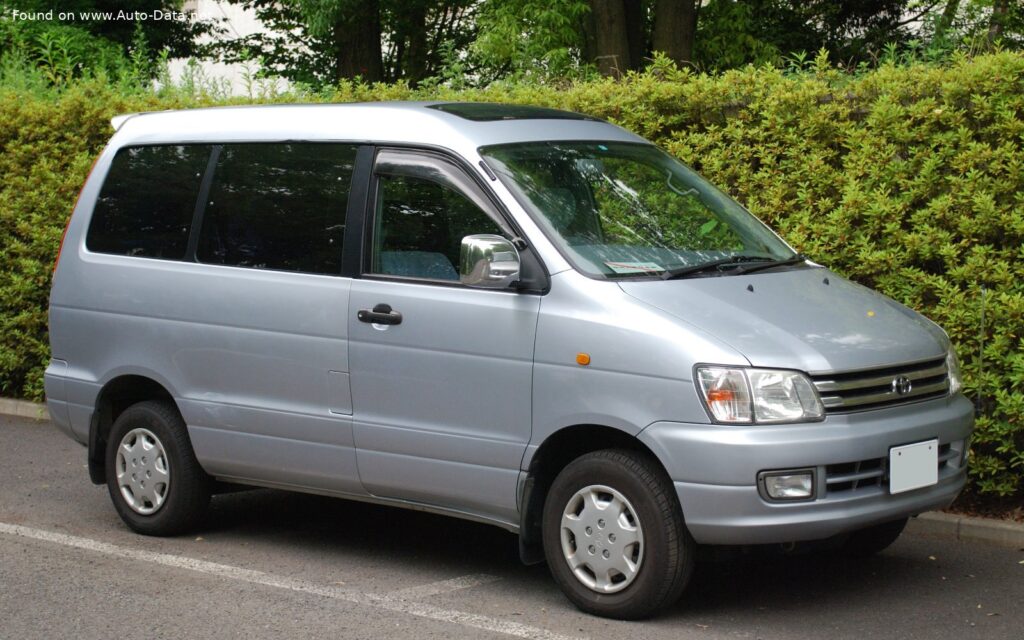
The Toyota Town Ace Noah 2.0 (130 Hp) is a rear-wheel drive minivan produced between 1996 and 2001 as part of the broader Town Ace Noah generation. This variant occupied a mid-range position within the lineup, offering a balance between affordability, practicality, and performance for families and commercial users. The Town Ace Noah series, built on the H10/A20 platform, was known for its spacious interior, configurable seating, and robust mechanicals, making it a popular choice in the Japanese domestic market and export markets throughout Asia and Oceania.
Powertrain & Engine Architecture
The 2.0-liter (1998 cm3, 121.93 cu. in.) engine powering the Town Ace Noah is a naturally aspirated, inline-four cylinder gasoline engine. Designated as a member of Toyota’s 1RZ series, this engine produces 130 horsepower at 5600 rpm and 181 Nm (133.5 lb.-ft.) of torque at 4400 rpm. The engine features a multi-port fuel injection system, providing a balance between fuel efficiency and power delivery. The valvetrain consists of four valves per cylinder (DOHC), contributing to improved breathing and overall engine performance. The engine is longitudinally mounted in the front of the vehicle.
This specific Town Ace Noah variant was exclusively offered with a 5-speed manual transmission. This transmission was chosen for its durability and suitability for both urban and highway driving. The gear ratios were optimized to provide adequate acceleration while maintaining reasonable fuel economy. First gear was relatively low for easy starts from a standstill, while fifth gear was geared for comfortable cruising at highway speeds. The rear-wheel drive configuration, coupled with the manual transmission, provided a more engaging driving experience compared to some of its competitors.
Engine Specifications
The 1RZ-E engine, as found in the Town Ace Noah 2.0, was known for its reliability and relatively simple design. It lacked some of the more advanced features found in contemporary engines, such as variable valve timing, but this simplicity contributed to its longevity. Regular maintenance, including oil changes and timing belt replacements, was crucial for ensuring the engine’s continued operation. The engine’s robust construction made it capable of handling the demands of commercial use, such as transporting goods or passengers.
Driving Characteristics
The Toyota Town Ace Noah 2.0 (130 Hp) with the 5-speed manual transmission offered a reasonably responsive driving experience. While not a performance-oriented vehicle, the 130 hp engine provided sufficient power for everyday driving situations, including merging onto highways and overtaking slower traffic. The manual transmission allowed drivers to maintain greater control over the engine’s power band, optimizing performance for different driving conditions. The rear-wheel drive layout contributed to a balanced feel, although it could be prone to oversteer in slippery conditions.
Compared to other Town Ace Noah variants, the 2.0-liter engine offered a noticeable performance advantage over the smaller 1.8-liter engine. However, it didn’t match the power of larger engine options, such as the 2.4-liter diesel. The manual transmission provided a more engaging driving experience than the available automatic transmissions in other trims. The weight-to-power ratio of 9.8 kg/Hp (101.6 Hp/tonne) and weight-to-torque ratio of 7.1 kg/Nm (141.4 Nm/tonne) reflected a respectable balance between power and weight.
Equipment & Trim Levels
The Town Ace Noah 2.0 (130 Hp) typically came equipped with a range of standard features designed to enhance comfort and convenience. These included power steering, air conditioning, and basic audio system. Interior upholstery was typically cloth, with a durable and practical design. The seating configuration was flexible, with options for seven or eight passengers, and the rear seats could be folded or removed to create additional cargo space. The dashboard layout was functional and straightforward, with easy-to-read gauges and controls.
Optional extras available for this trim included power windows, central locking, and upgraded audio systems. Some models also featured alloy wheels and a sunroof. The level of equipment varied depending on the specific market and the customer’s preferences. The Town Ace Noah was generally considered a well-equipped vehicle for its price point, offering a good value proposition for families and commercial users.
Chassis & Braking
The Town Ace Noah 2.0 (130 Hp) featured a torsion beam front suspension and an independent coil spring rear suspension. This suspension setup provided a comfortable ride quality, absorbing bumps and irregularities in the road surface effectively. The rear suspension’s independent design contributed to improved handling and stability. The vehicle’s kerb weight of 1280 kg (2821.92 lbs) was relatively light for a minivan, which helped to enhance its agility.
The braking system consisted of ventilated discs on the front wheels and drum brakes on the rear wheels. This configuration provided adequate stopping power for most driving situations. The brakes were not particularly powerful, but they were reliable and easy to modulate. The vehicle did not typically feature anti-lock brakes (ABS) as standard equipment, although it may have been available as an option in some markets.
Market Reception & Comparison
The Toyota Town Ace Noah 2.0 (130 Hp) was generally well-received by critics and consumers alike. It was praised for its spacious interior, comfortable ride, and reliable engine. The manual transmission was appreciated by drivers who preferred a more engaging driving experience. However, some critics noted that the engine could feel underpowered when fully loaded or driving uphill. Fuel consumption was rated at 8 l/100 km (29.4 US mpg, 35.3 UK mpg, 12.5 km/l) in urban conditions, which was considered reasonable for a vehicle of its size and type.
Compared to other minivans in its class, the Town Ace Noah offered a compelling combination of practicality, reliability, and affordability. It was a popular alternative to models from Honda and Nissan. The 2.0-liter engine provided a good balance between performance and fuel economy, making it a versatile choice for a wide range of users. The rear-wheel drive layout and manual transmission differentiated it from some of its competitors, appealing to drivers who valued a more traditional driving experience.
Technical Specifications
| Body Type | Minivan, 4 Doors, 6 Seats |
| Engine Size | 2.0 l, 1998 cm3, 121.93 cu. in. |
| Engine Type | Inline-4, Naturally Aspirated |
| Power Output | 130 Hp @ 5600 rpm |
| Torque Output | 181 Nm @ 4400 rpm (133.5 lb.-ft. @ 4400 rpm) |
| Fuel Type | Petrol (Gasoline) |
| Transmission | 5-speed Manual |
| Drive Type | Rear Wheel Drive |
| Kerb Weight | 1280 kg (2821.92 lbs.) |
| Fuel Tank Capacity | 55 l (14.53 US gal | 12.1 UK gal) |
| Length | 4475 mm (176.18 in.) |
| Width | 1695 mm (66.73 in.) |
| Height | 1935 mm (76.18 in.) |
| Wheelbase | 2715 mm (106.89 in.) |
Legacy
The Toyota Town Ace Noah 2.0 (130 Hp) has proven to be a remarkably durable and reliable vehicle. Many examples are still on the road today, testament to the quality of its construction and the robustness of its engine. The 1RZ-E engine is known for its longevity and relatively low maintenance costs. In the used car market, these vehicles are often sought after for their practicality, affordability, and reputation for reliability. While they may not offer the latest features or technology, they remain a viable option for those seeking a dependable and spacious minivan. The Town Ace Noah continues to be a popular choice in regions where durability and practicality are highly valued.