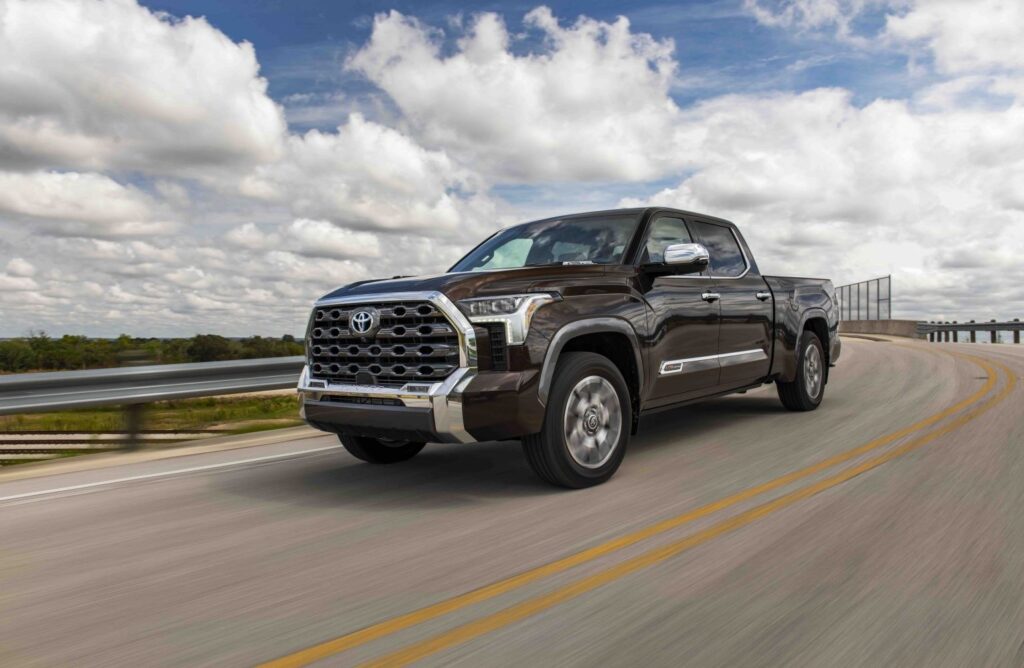
The Toyota Tundra III CrewMax Standard Bed 3.5 V6 i-FORCE (389 Hp) 4×2 ECT-i represents a pivotal entry in the highly competitive North American full-size pickup truck segment. Launched in September 2021, this third-generation Tundra marked a significant departure from its predecessor, introducing a complete redesign from the ground up. It was engineered to redefine Toyota’s presence in a market historically dominated by domestic manufacturers, focusing on enhanced capability, advanced technology, and improved efficiency. The CrewMax configuration, paired with a standard bed, offers a spacious cabin designed for passenger comfort, complementing its robust utility. This particular variant, powered by the formidable 3.5-liter V6 i-FORCE engine and featuring a 4×2 drivetrain with a 10-speed ECT-i automatic transmission, embodies Toyota’s commitment to delivering a powerful yet refined driving experience tailored for both work and leisure.
Powertrain and Performance of the Toyota Tundra III CrewMax Standard Bed
At the heart of the Toyota Tundra III CrewMax Standard Bed 3.5 V6 i-FORCE (389 Hp) 4×2 ECT-i lies a sophisticated and potent powertrain designed to deliver a blend of robust performance and modern efficiency. The 3.5-liter (3445 cm3 or 210.23 cu. in.) V6 i-FORCE engine, identified by the internal code V35A-FTS, is a marvel of contemporary engine design. This V-engine configuration features six cylinders with four valves per cylinder, utilizing a DOHC (Dual Overhead Camshaft) valvetrain system with Dual VVT-i (Variable Valve Timing with intelligence). The engine’s aspiration is handled by a twin-turbocharger setup, further enhanced by an intercooler, ensuring optimal air density for combustion across a wide range of operating conditions. This forced induction system is crucial in generating its impressive power and torque figures from a relatively smaller displacement compared to traditional V8 truck engines.
The i-FORCE engine produces a substantial 389 horsepower at 5200 rpm, translating to a power per liter output of 112.9 Hp/l, showcasing its high-performance tuning. More critically for a pickup truck, it delivers a massive 478.68 lb.-ft. (649 Nm) of torque, which peaks at a remarkably low 2400 rpm. This low-end torque is essential for towing, hauling, and off-the-line acceleration, providing the kind of immediate pulling power that truck owners demand. The fuel injection system is a sophisticated combination of direct injection and multi-port manifold injection, a strategy known as D-4ST by Toyota, which optimizes fuel delivery for both power and efficiency while minimizing emissions. With a compression ratio of 10.4:1, the engine is tuned for premium performance on gasoline fuel, adhering to the stringent LEV-III emission standard.
Power is seamlessly managed by a 10-speed ECT-i (Electronically Controlled Transmission with intelligence) automatic gearbox. This transmission, with its wide gear ratio spread, ensures that the engine operates in its most efficient range whether cruising on the highway or under heavy load. The 4×2 drivetrain architecture means power is sent exclusively to the rear wheels, a common configuration for trucks primarily used for on-road tasks and towing, offering a balance of capability and slightly better fuel economy compared to 4×4 variants. This setup is particularly advantageous for its intended market, where many users prioritize payload and towing over extreme off-road prowess.
In terms of fuel efficiency, the Tundra 3.5 V6 i-FORCE (389 Hp) 4×2 ECT-i demonstrates competitive figures for its class. The combined fuel economy is rated at 19.9 US mpg (11.8 l/100 km), with urban consumption at 18 US mpg (13.1 l/100 km) and extra-urban at 23.1 US mpg (10.2 l/100 km). These figures highlight the benefits of the twin-turbo V6 and the advanced 10-speed transmission. The vehicle’s weight-to-power ratio stands at 6.2 kg/Hp (160.1 Hp/tonne), and its weight-to-torque ratio is 3.7 kg/Nm (267.2 Nm/tonne), underscoring its impressive power-to-weight characteristics for a full-size pickup. Furthermore, the Tundra’s robust construction allows for a substantial permitted trailer load with brakes of 11,270.03 lbs (5112 kg) and a maximum payload capacity ranging from 1635.83 to 1743.86 lbs (742-791 kg), making it a highly capable workhorse for a wide range of demanding tasks.
Design and Key Features
Exterior and Interior Design Philosophy
The third-generation Toyota Tundra, particularly in its CrewMax Standard Bed configuration, boasts a design that is both imposing and thoroughly modern, reflecting its North American market focus. With an overall length of 245.59 inches (6238 mm), a width of 80.2 inches (2037 mm), and a height of 77.99 inches (1981 mm), the Tundra commands a significant presence on the road. The CrewMax body type emphasizes passenger comfort, offering four doors and seating for five adults with ample legroom and head space, making it a viable family vehicle as well as a work truck. The design language is characterized by bold lines, a prominent grille, and muscular fenders, conveying a sense of strength and capability. Despite its rugged appearance, aerodynamic considerations are evident, with a drag coefficient (Cd) of 0.36, which is commendable for a vehicle of this size and shape, contributing to both fuel efficiency and reduced wind noise.
The interior design prioritizes functionality, durability, and contemporary technology. While specific interior features are not detailed in the provided data, the modern Tundra generation is known for integrating large infotainment screens, digital gauge clusters, and advanced driver-assistance systems as standard or available options. The focus is on creating a cabin that can withstand the rigors of a work environment while providing the comfort and connectivity expected in a modern vehicle. Practical elements like ample storage solutions, durable materials, and intuitive controls are hallmarks of its design philosophy. The standard bed offers practical cargo space, balancing the need for passenger room with utility.
Chassis and Capability
Underneath its robust exterior, the Toyota Tundra III CrewMax Standard Bed incorporates a sophisticated chassis designed to enhance both ride comfort and dynamic performance. The front suspension system utilizes a double wishbone setup with a transverse stabilizer, a configuration known for providing precise steering response and excellent wheel control, which is crucial for a vehicle of this size and weight. A significant upgrade for this generation is the move to a rigid axle suspension with coil springs at the rear. This departure from the traditional leaf spring setup found in many pickups dramatically improves ride quality, especially when unladen, and enhances overall handling stability. This modern rear suspension design contributes to a more composed and car-like driving experience without compromising its robust towing and hauling capabilities.
Braking performance is handled by large ventilated discs on both the front and rear axles, measuring 353 mm (front) and 345 mm (rear), respectively. These substantial brakes, coupled with ABS (Anti-lock Braking System) as a standard assisting system, ensure powerful and controlled stopping power, critical for a vehicle with high maximum weight and towing capacity. Steering is managed by a rack and pinion system with electric power steering, providing precise control and reduced effort, particularly at lower speeds for maneuvering. The Tundra’s substantial wheelbase of 157.72 inches (4006 mm) contributes to its stable highway demeanor, while a minimum turning circle of 49.87 ft (15.2 m) indicates decent maneuverability for its class. With a ground clearance of 9.29 inches (236 mm), an approach angle of 21°, and a departure angle of 24°, the Tundra retains a respectable degree of capability for navigating rough terrain or steep inclines, even in its 4×2 configuration. The vehicle is fitted with tire sizes 265/70 R18 or 265/60 R20, mounted on 8J x 18 or 8J x 20 wheel rims, providing a balance of traction, durability, and aesthetic appeal.
Technical Specifications
| Brand | Toyota |
| Model | Tundra |
| Generation | Tundra III CrewMax Standard Bed |
| Type (Engine) | 3.5 V6 i-FORCE (389 Hp) 4×2 ECT-i |
| Start of production | September, 2021 year |
| Powertrain Architecture | Internal Combustion engine |
| Body type | Pick-up |
| Seats | 5 |
| Doors | 4 |
| Fuel consumption (economy) – urban | 13.1 l/100 km (18 US mpg, 21.6 UK mpg, 7.6 km/l) |
| Fuel consumption (economy) – extra urban | 10.2 l/100 km (23.1 US mpg, 27.7 UK mpg, 9.8 km/l) |
| Fuel consumption (economy) – combined | 11.8 l/100 km (19.9 US mpg, 23.9 UK mpg, 8.5 km/l) |
| Fuel Type | Petrol (Gasoline) |
| Emission standard | LEV-III |
| Weight-to-power ratio | 6.2 kg/Hp, 160.1 Hp/tonne |
| Weight-to-torque ratio | 3.7 kg/Nm, 267.2 Nm/tonne |
| Power | 389 Hp @ 5200 rpm |
| Power per litre | 112.9 Hp/l |
| Torque | 649 Nm @ 2400 rpm (478.68 lb.-ft. @ 2400 rpm) |
| Engine layout | Front, Longitudinal |
| Engine Model/Code | V35A-FTS |
| Engine displacement | 3445 cm3 (210.23 cu. in.) |
| Number of cylinders | 6 |
| Engine configuration | V-engine |
| Cylinder Bore | 85.5 mm (3.37 in.) |
| Piston Stroke | 100 mm (3.94 in.) |
| Compression ratio | 10.4:1 |
| Number of valves per cylinder | 4 |
| Fuel injection system | Direct injection and Multi-port manifold injection |
| Engine aspiration | Twin-Turbo, Intercooler |
| Valvetrain | DOHC, Dual VVT-i |
| Engine oil capacity | 7.3 l (7.71 US qt | 6.42 UK qt) |
| Coolant | 12.4 l (13.1 US qt | 10.91 UK qt) |
| Engine systems | Particulate filter |
| Kerb Weight | 2429-2479 kg (5355.03 – 5465.26 lbs.) |
| Max. weight | 3171-3270 kg (6990.86 – 7209.12 lbs.) |
| Max load | 742-791 kg (1635.83 – 1743.86 lbs.) |
| Fuel tank capacity | 85 l (22.45 US gal | 18.7 UK gal) |
| Permitted trailer load with brakes (12%) | 5112 kg (11270.03 lbs.) |
| Permitted towbar download | 519 kg (1144.2 lbs.) |
| Length | 6238 mm (245.59 in.) |
| Width | 2037 mm (80.2 in.) |
| Height | 1981 mm (77.99 in.) |
| Wheelbase | 4006 mm (157.72 in.) |
| Front track | 1737 mm (68.39 in.) |
| Rear (Back) track | 1737 mm (68.39 in.) |
| Ride height (ground clearance) | 236 mm (9.29 in.) |
| Drag coefficient (Cd) | 0.36 |
| Minimum turning circle (turning diameter) | 15.2 m (49.87 ft.) |
| Approach angle | 21° |
| Departure angle | 24° |
| Drivetrain Architecture | The Internal combustion engine (ICE) drives the rear wheels of the vehicle. |
| Drive wheel | Rear wheel drive |
| Number of gears and type of gearbox | 10 gears, automatic transmission ECT-i |
| Front suspension | Double wishbone, Transverse stabilizer |
| Rear suspension | Rigid axle suspension, Coil spring |
| Front brakes | Ventilated discs, 353 mm |
| Rear brakes | Ventilated discs, 345 mm |
| Assisting systems | ABS (Anti-lock braking system) |
| Steering type | Steering rack and pinion |
| Power steering | Electric Steering |
| Tires size | 265/70 R18; 265/60 R20 |
| Wheel rims size | 8J x 18; 8J x 20 |