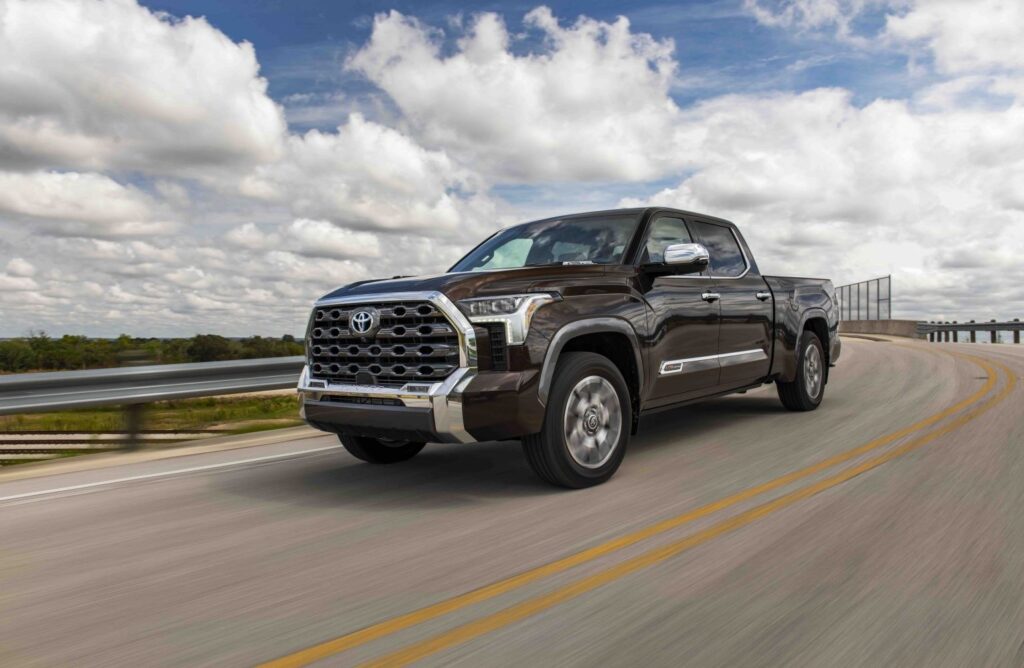
The Toyota Tundra III CrewMax Standard Bed 3.5 V6 i-FORCE MAX (437 Hp) Hybrid 4WD-i ECT-i represents a significant evolution in the full-size pickup truck segment, marking a new era for Toyota’s flagship truck. Introduced in September 2021, this third-generation Tundra, specifically in its CrewMax Standard Bed configuration, embodies a strategic shift towards advanced powertrain technology and enhanced capability within the highly competitive North American market. As a full hybrid electric vehicle (FHEV), it integrates a powerful internal combustion engine with an electric motor, aiming to deliver a compelling balance of robust performance, improved fuel efficiency, and reduced emissions, all while maintaining the rugged durability and utility expected of a Toyota truck. This particular variant, with its potent i-FORCE MAX hybrid system, caters to consumers demanding both high output for towing and hauling, and the benefits of hybrid propulsion in a versatile 4-door, 5-seat pickup platform.
Powertrain and Performance of the Toyota Tundra III CrewMax Standard Bed 3.5 V6 i-FORCE MAX (437 Hp) Hybrid 4WD-i ECT-i
At the heart of the Toyota Tundra III CrewMax Standard Bed 3.5 V6 i-FORCE MAX (437 Hp) Hybrid 4WD-i ECT-i lies its innovative FHEV powertrain architecture. This sophisticated system combines a twin-turbocharged 3.5-liter V6 gasoline engine with an electric motor, meticulously integrated to optimize power delivery and efficiency. The internal combustion engine, designated V35A-FTS, is a front, longitudinally mounted V-engine featuring six cylinders with a displacement of 3445 cm3 (approximately 210.23 cubic inches). It employs a dual overhead camshaft (DOHC) valvetrain with Dual VVT-i (Variable Valve Timing with intelligence), ensuring precise control over valve operation for optimal performance across the rev range. Fuel delivery is handled by a advanced system combining direct injection and multi-port manifold injection, further enhancing combustion efficiency. Bolstered by twin-turbochargers and an intercooler, this V6 unit alone produces a formidable 437 horsepower at 5200 rpm and a substantial 582.67 lb.-ft. of torque at a low 2400 rpm, reflecting its design for strong pulling power and responsiveness.
Complementing the robust gasoline engine is a synchronous electric motor, strategically placed between the combustion engine and the transmission. This electric motor contributes an additional 49 horsepower and a significant 184.39 lb.-ft. of torque, providing immediate assistance and enabling low-speed electric-only driving up to 18.02 mph. The combined output of the i-FORCE MAX system ensures exceptional performance for a full-size pickup. Power is channeled through a highly efficient 10-speed automatic transmission with ECT-i (Electronically Controlled Transmission with intelligence), designed for smooth shifts and optimal gear selection in various driving conditions. The drivetrain architecture is advanced, with the internal combustion engine and electric motor permanently driving the rear wheels, capable of running in full electric or mixed mode. When additional traction is required, an electrically or mechanically controlled clutch engages the front wheels, providing a capable all-wheel-drive (4×4) system for challenging terrains or adverse weather. This hybrid system adheres to the LEV-III emission standard, demonstrating Toyota’s commitment to environmental responsibility.
The Tundra’s performance metrics underscore its capability. With a curb weight ranging from 6095.78 to 6183.97 pounds, the truck boasts a weight-to-power ratio of 6.3 kg/Hp (158 Hp/tonne) and a weight-to-torque ratio of 3.5 kg/Nm (285.7 Nm/tonne). These figures highlight its impressive power delivery relative to its size. The gross battery capacity of 1.87 kWh, utilizing Nickel-metal hydride (NiMH) technology at 288 volts, is optimized for consistent hybrid assistance and regeneration, rather than extensive all-electric range, which is typical for a full hybrid system in a heavy-duty application. The powertrain’s design is focused on delivering a seamless blend of power, efficiency, and the rugged capability that Tundra owners demand, particularly evident in its impressive permitted trailer load with brakes of 11040.75 pounds and a permitted towbar download of 1117.74 pounds, making it a serious contender for heavy-duty tasks.
Design, Dimensions, and Advanced Features
The Toyota Tundra III CrewMax Standard Bed 3.5 V6 i-FORCE MAX (437 Hp) Hybrid 4WD-i ECT-i is engineered not only for power but also for utility, comfort, and a commanding presence. As a CrewMax Standard Bed pickup, it features a spacious four-door cabin designed to comfortably accommodate five occupants, making it ideal for both work crews and families. Its dimensions reflect its full-size truck status: an imposing length of 245.59 inches, a width of 80.2 inches, and a height of 77.99 inches. The substantial wheelbase of 157.72 inches contributes to ride stability, especially when towing or hauling heavy loads. The front and rear tracks both measure 68.39 inches, providing a broad stance that enhances both handling and visual appeal.
For off-road enthusiasts and those navigating rough terrain, the Tundra offers a respectable ride height (ground clearance) of 8.5 inches, complemented by an approach angle of 21 degrees and a departure angle of 24 degrees. While not extreme, these figures indicate a capable platform for light to moderate off-road excursions. Maneuverability in tighter spaces is aided by a minimum turning circle (turning diameter) of 49.87 feet, which is competitive for a vehicle of its size. The exterior design is further optimized with a drag coefficient (Cd) of 0.36, a commendable figure for a large pickup, contributing to improved fuel efficiency and reduced wind noise at highway speeds.
Underneath its robust exterior, the Tundra incorporates a modern chassis and suspension system designed to enhance both ride comfort and capability. The front suspension utilizes a double wishbone setup with a transverse stabilizer, providing precise steering response and excellent wheel articulation. A significant upgrade for the third generation is the adoption of a rigid axle suspension with coil springs at the rear, replacing the traditional leaf springs. This change dramatically improves ride quality, especially when unladen, and contributes to better handling dynamics. Stopping power is assured by large ventilated disc brakes, measuring 353 mm at the front and 345 mm at the rear, which are paired with an Anti-lock Braking System (ABS) for enhanced control during emergency braking. Steering is managed by an electric power steering rack and pinion system, offering light effort at low speeds for easier parking and more feel at higher speeds. The truck rides on 265/60 R20 tires mounted on 8J x 20 wheel rims, a combination that provides a balance of on-road comfort and off-road traction. With a generous fuel tank capacity of 32.23 US gallons, the Tundra offers an impressive cruising range, essential for long hauls and remote job sites. Its maximum payload capacity ranges from 1133.18 to 1596.15 pounds, further solidifying its utility as a versatile workhorse.
Technical Specifications
| Brand | Toyota |
| Model | Tundra |
| Generation | Tundra III CrewMax Standard Bed |
| Type (Engine) | 3.5 V6 i-FORCE MAX (437 Hp) Hybrid 4WD-i ECT-i |
| Start of production | September, 2021 year |
| Powertrain Architecture | FHEV (Full Hybrid Electric Vehicle) |
| Body type | Pick-up |
| Seats | 5 |
| Doors | 4 |
| Fuel Type | Petrol (Gasoline) |
| Emission standard | LEV-III |
| Weight-to-power ratio | 6.3 kg/Hp, 158 Hp/tonne |
| Weight-to-torque ratio | 3.5 kg/Nm, 285.7 Nm/tonne |
| Gross battery capacity | 1.87 kWh |
| Battery voltage | 288 V |
| Battery technology | Nickel-metal hydride (NiMH) |
| Max speed (electric) | 18.02 mph (29 km/h) |
| Electric motor power | 49 Hp |
| Electric motor Torque | 184.39 lb.-ft. (250 Nm) |
| Electric motor location | Between the combustion engine and the transmission |
| Electric motor type | Synchronous |
| Power | 437 Hp @ 5200 rpm. |
| Power per litre | 126.9 Hp/l |
| Torque | 582.67 lb.-ft. @ 2400 rpm. (790 Nm @ 2400 rpm.) |
| Engine layout | Front, Longitudinal |
| Engine Model/Code | V35A-FTS |
| Engine displacement | 3.4 liters (3445 cm3 / 210.23 cu. in.) |
| Number of cylinders | 6 |
| Engine configuration | V-engine |
| Cylinder Bore | 3.37 in. (85.5 mm) |
| Piston Stroke | 3.94 in. (100 mm) |
| Compression ratio | 10.4:1 |
| Number of valves per cylinder | 4 |
| Fuel injection system | Direct injection and Multi-port manifold injection |
| Engine aspiration | Twin-Turbo, Intercooler |
| Valvetrain | DOHC, Dual VVT-i |
| Engine oil capacity | 7.71 US qt (7.3 l) |
| Engine oil specification | Not Available |
| Coolant | 13.1 US qt (12.4 l) |
| Engine systems | Particulate filter |
| Kerb Weight | 6095.78 – 6183.97 lbs. (2765-2805 kg) |
| Max. weight | 7228.96 – 7780.11 lbs. (3279-3529 kg) |
| Max load | 1133.18 – 1596.15 lbs. (514-724 kg) |
| Fuel tank capacity | 32.23 US gal (122 l) |
| Permitted trailer load with brakes (12%) | 11040.75 lbs. (5008 kg) |
| Permitted towbar download | 1117.74 lbs. (507 kg) |
| Length | 245.59 in. (6238 mm) |
| Width | 80.2 in. (2037 mm) |
| Height | 77.99 in. (1981 mm) |
| Wheelbase | 157.72 in. (4006 mm) |
| Front track | 68.39 in. (1737 mm) |
| Rear (Back) track | 68.39 in. (1737 mm) |
| Ride height (ground clearance) | 8.5 in. (216 mm) |
| Drag coefficient (Cd) | 0.36 |
| Minimum turning circle (turning diameter) | 49.87 ft. (15.2 m) |
| Approach angle | 21° |
| Departure angle | 24° |
| Drivetrain Architecture | The Internal combustion engine (ICE) and the electric motor permanently drive the rear wheels of the vehicle, capable of running in full electric or mixed mode, and if necessary through the electrically or mechanically controlled clutch, the front wheels are driven. |
| Drive wheel | All wheel drive (4×4) |
| Number of gears and type of gearbox | 10 gears, automatic transmission ECT-i |
| Front suspension | Double wishbone, Transverse stabilizer |
| Rear suspension | Rigid axle suspension, Coil spring |
| Front brakes | Ventilated discs, 353 mm |
| Rear brakes | Ventilated discs, 345 mm |
| Assisting systems | ABS (Anti-lock braking system) |
| Steering type | Steering rack and pinion |
| Power steering | Electric Steering |
| Tires size | 265/60 R20 |
| Wheel rims size | 8J x 20 |