The Toyota Urban Cruiser I, specifically the 1.4 D-4D (90 Hp) 4×4 variant, represented Toyota’s strategic entry into the burgeoning compact crossover segment in Europe and other select international markets. Launched in March 2008 and produced until 2014, this model was designed to offer the robust appeal of an SUV in a more city-friendly, fuel-efficient package. While never officially sold in the United States, its design ethos and mechanical underpinnings provide an insightful look into global automotive trends, particularly the demand for versatile, small-footprint vehicles capable of handling diverse driving conditions. Positioned below larger SUVs in Toyota’s lineup, the Urban Cruiser I aimed to attract urban dwellers seeking a practical, yet stylish and capable vehicle for both daily commutes and occasional light off-road excursions.
The Toyota Urban Cruiser I: A Compact Crossover for European and Asian Markets
The first generation Toyota Urban Cruiser was a distinctive offering, blending the practicality of a hatchback with the elevated stance and rugged aesthetics of a sport utility vehicle. Its primary target audience resided in regions where compact dimensions and fuel efficiency were paramount, alongside a desire for enhanced traction and a commanding driving position. The vehicle’s name, “Urban Cruiser,” perfectly encapsulated its intended role: a nimble, city-savvy vehicle with the capability to cruise beyond the pavement. This particular variant, the Toyota Urban Cruiser I 1.4 D-4D (90 Hp) 4×4, stood out for its combination of a frugal diesel engine and an all-wheel-drive system, a compelling package for consumers navigating varied climates and road surfaces, from icy European winters to unpaved rural roads in other markets.
Toyota engineered the Urban Cruiser I to be a versatile five-door, five-seat hatchback. Its compact dimensions, measuring 154.72 inches in length, 67.91 inches in width, and 60.63 inches in height, made it adept at maneuvering through congested city streets and fitting into tight parking spaces. Despite its small exterior, the vehicle offered a respectable 10.77 cubic feet of trunk space, expandable for larger cargo needs, underscoring its practical design. The wheelbase of 96.85 inches contributed to its agile handling and a surprisingly tight minimum turning circle of 36.09 feet, further enhancing its urban usability. This balance of compact size, practical interior, and robust exterior styling made the Urban Cruiser I a unique proposition in its segment during its production run.
Engine and Performance: The Toyota Urban Cruiser I 1.4 D-4D (90 Hp) 4×4 Powertrain
The 1.4 D-4D Diesel Engine
At the heart of this particular Urban Cruiser I variant was Toyota’s well-regarded 1.4 D-4D (Direct-injection 4-stroke Common-rail Diesel) engine, identified by the code 1ND-TV. This inline four-cylinder diesel powerplant, positioned transversely at the front, was engineered for a blend of efficiency and adequate power delivery. With an engine displacement of 1364 cubic centimeters (83.24 cubic inches), it featured a bore of 2.87 inches and a piston stroke of 3.21 inches. The engine utilized an OHC (Overhead Camshaft) valvetrain with two valves per cylinder, a configuration known for its simplicity and reliability. Fuel delivery was managed by a sophisticated Diesel Commonrail injection system, which precisely controls fuel atomization for optimal combustion. Further enhancing its performance and efficiency, the engine was equipped with a turbocharger and an intercooler, boosting air intake and thus power output across a wider RPM range. The high compression ratio of 17.8:1 is typical for a diesel engine, contributing to its inherent fuel efficiency.
The 1.4 D-4D engine generated a respectable 90 horsepower at 3800 revolutions per minute, yielding a power per liter figure of 66 Hp/l. More significantly for a compact crossover, it produced a robust 140.14 lb.-ft. of torque, available across a broad and usable band from 1800 to 3000 rpm. This ample torque at lower engine speeds was crucial for the Urban Cruiser’s urban maneuverability and its all-wheel-drive capabilities, providing confident acceleration and pulling power. The engine’s oil capacity was 4.12 US quarts, and the cooling system held 4.97 US quarts of coolant, indicating a well-engineered thermal management system designed for durability.
Performance and Efficiency
The powertrain of the Toyota Urban Cruiser I 1.4 D-4D (90 Hp) 4×4 was mated to a precise 6-speed manual transmission, offering drivers full control over power delivery and contributing to the vehicle’s efficiency. The combination of the diesel engine, manual gearbox, and all-wheel-drive system allowed the Urban Cruiser to achieve a 0-60 mph acceleration in an estimated 11.1 seconds, with a maximum speed of 108.74 mph. While not a performance-oriented vehicle, these figures were more than adequate for its intended use, providing sufficient responsiveness for highway merging and urban driving.
Fuel economy was a major selling point for this diesel variant. The vehicle achieved an impressive combined fuel consumption of 48 US mpg (4.9 l/100 km). In urban driving conditions, it delivered 40.6 US mpg (5.8 l/100 km), and on the extra-urban cycle, it reached an outstanding 53.5 US mpg (4.4 l/100 km). These figures underscored its economic appeal, especially in markets with higher fuel prices. Furthermore, the Urban Cruiser I 1.4 D-4D (90 Hp) 4×4 complied with the Euro 4 emission standard, reflecting its relatively clean operation for its era. The vehicle’s kerb weight of 2733.73 lbs. (1240 kg) contributed to a weight-to-power ratio of 13.8 kg/Hp and a weight-to-torque ratio of 6.5 kg/Nm, indicating a balanced power-to-weight profile for its class.
Design and Features: Urban Practicality and All-Wheel Drive Capability
Exterior and Interior Design
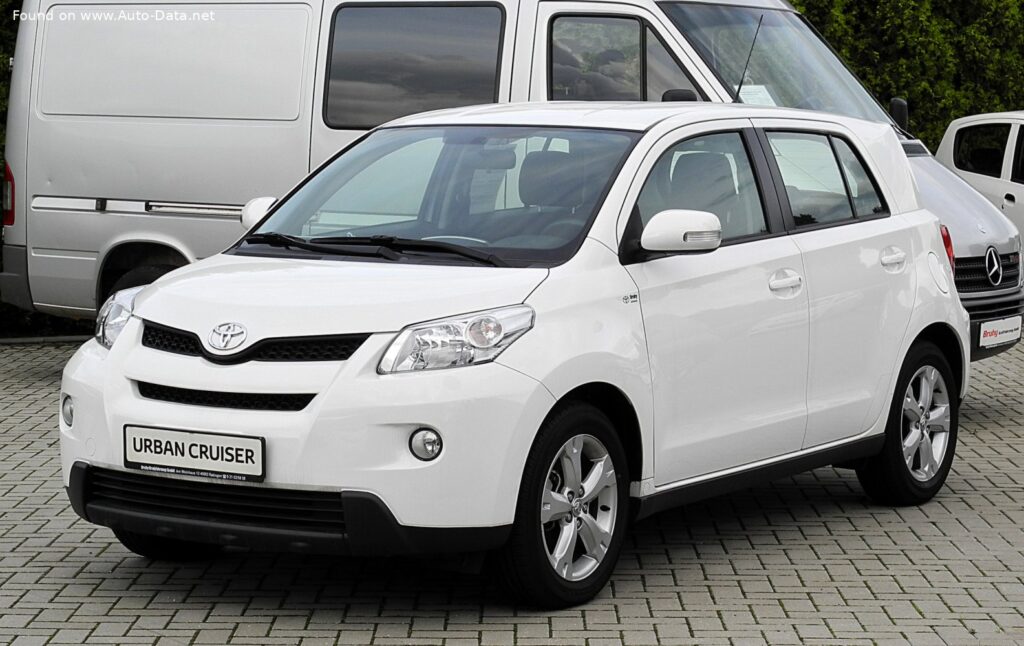
The Toyota Urban Cruiser I presented a distinctive, somewhat boxy yet contemporary design for its time, clearly signaling its crossover identity. Its elevated ground clearance and robust wheel arches, accommodating 195/60 R16 tires on 16-inch wheel rims, gave it a purposeful stance. The exterior styling was characterized by a bold front fascia and a compact rear, embodying a sense of ruggedness without sacrificing urban aesthetic appeal. The five-door hatchback body type offered easy access for both front and rear passengers, and the five-seat configuration provided practical seating for a family or group of friends. Despite its compact footprint, the design aimed to maximize interior space and driver visibility, crucial attributes for city driving.
Inside, the Urban Cruiser I focused on functionality and durability. While specific interior features like infotainment systems would vary by trim level and market, the core design emphasized ergonomics and user-friendliness. The instrument cluster was clear and concise, and controls were intuitively placed. The trunk space of 10.77 cubic feet (305 liters) was practical for grocery runs or weekend luggage, aligning with the needs of its target demographic. The overall design language, both inside and out, reflected Toyota’s commitment to quality and practicality, creating a vehicle that was both appealing and highly functional.
Chassis, Drivetrain, and Safety
The driving dynamics of the Toyota Urban Cruiser I 1.4 D-4D (90 Hp) 4×4 were engineered to provide a comfortable ride and confident handling across various conditions. Its all-wheel-drive (4×4) system was a key differentiator, offering enhanced traction and stability, particularly beneficial in adverse weather or on loose surfaces. The suspension system comprised an independent McPherson type setup at the front, known for its balance of comfort and precise steering, while the rear featured a torsion beam suspension, a common and space-efficient choice for compact vehicles. This combination provided a stable and predictable ride quality.
Braking performance was handled by ventilated discs at the front, providing effective heat dissipation for consistent stopping power, and solid disc brakes at the rear. These were complemented by an Anti-lock Braking System (ABS), a crucial safety feature that prevented wheel lock-up during hard braking, allowing the driver to maintain steering control. Power steering was hydraulic, offering direct feedback to the driver, a characteristic often preferred by enthusiasts over purely electric systems. The robust chassis, combined with the all-wheel-drive system and fundamental safety features like ABS, underscored the Urban Cruiser’s commitment to providing a secure and capable driving experience in its segment.
Technical Specifications
| Brand | Toyota |
| Model | Urban Cruiser |
| Generation | Urban Cruiser I |
| Type (Engine) | 1.4 D-4D (90 Hp) 4×4 |
| Start of production | March, 2008 year |
| End of production | 2014 year |
| Powertrain Architecture | Internal Combustion engine |
| Body type | Hatchback |
| Seats | 5 |
| Doors | 5 |
| Fuel consumption (economy) – urban | 5.8 l/100 km (40.6 US mpg) |
| Fuel consumption (economy) – extra urban | 4.4 l/100 km (53.5 US mpg) |
| Fuel consumption (economy) – combined | 4.9 l/100 km (48 US mpg) |
| Fuel Type | Diesel |
| Acceleration 0 – 60 mph | 11.1 sec |
| Maximum speed | 175 km/h (108.74 mph) |
| Emission standard | Euro 4 |
| Weight-to-power ratio | 13.8 kg/Hp (72.6 Hp/tonne) |
| Weight-to-torque ratio | 6.5 kg/Nm (153.2 Nm/tonne) |
| Power | 90 Hp @ 3800 rpm. |
| Power per liter | 66 Hp/l |
| Torque | 190 Nm @ 1800-3000 rpm (140.14 lb.-ft.) |
| Engine layout | Front, Transverse |
| Engine Model/Code | 1ND-TV |
| Engine displacement | 1364 cm3 (83.24 cu. in.) |
| Number of cylinders | 4 |
| Engine configuration | Inline |
| Cylinder Bore | 73 mm (2.87 in.) |
| Piston Stroke | 81.5 mm (3.21 in.) |
| Compression ratio | 17.8:1 |
| Number of valves per cylinder | 2 |
| Fuel injection system | Diesel Commonrail |
| Engine aspiration | Turbocharger, Intercooler |
| Valvetrain | OHC |
| Engine oil capacity | 3.9 l (4.12 US qt) |
| Coolant | 4.7 l (4.97 US qt) |
| Kerb Weight | 1240 kg (2733.73 lbs.) |
| Max. weight | 1700 kg (3747.86 lbs.) |
| Max load | 460 kg (1014.13 lbs.) |
| Trunk (boot) space – minimum | 305 l (10.77 cu. ft.) |
| Fuel tank capacity | 42 l (11.1 US gal) |
| Length | 3930 mm (154.72 in.) |
| Width | 1725 mm (67.91 in.) |
| Height | 1540 mm (60.63 in.) |
| Wheelbase | 2460 mm (96.85 in.) |
| Front track | 1485 mm (58.46 in.) |
| Rear (Back) track | 1490 mm (58.66 in.) |
| Minimum turning circle (turning diameter) | 11 m (36.09 ft.) |
| Drive wheel | All wheel drive (4×4) |
| Number of gears and type of gearbox | 6 gears, manual transmission |
| Front suspension | Independent type McPherson |
| Rear suspension | Torsion |
| Front brakes | Ventilated discs |
| Rear brakes | Disc |
| Assisting systems | ABS (Anti-lock braking system) |
| Power steering | Hydraulic Steering |
| Tires size | 195/60 R16 |
| Wheel rims size | 16 |