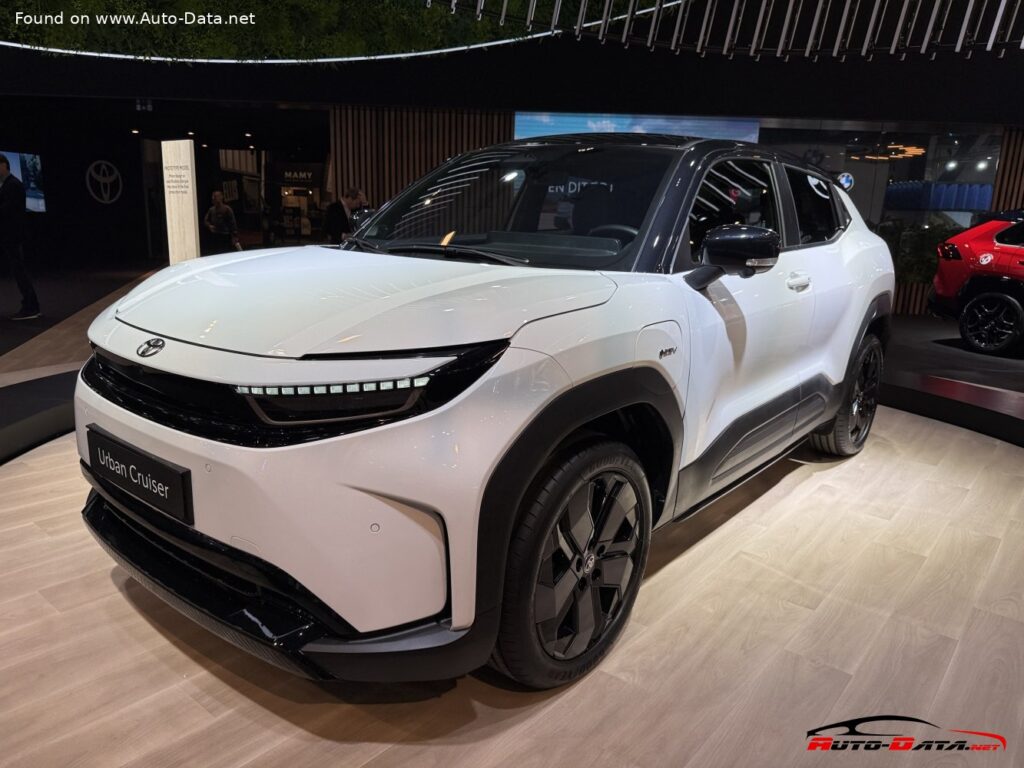
The 2025 Toyota Urban Cruiser III marks a significant evolution in the compact SUV segment, representing Toyota’s continued commitment to electrification and urban mobility solutions. As the third generation of the Urban Cruiser lineup, this model is engineered as a pure Battery Electric Vehicle (BEV), signaling a strategic shift towards sustainable transportation. While the Urban Cruiser nameplate has historically seen varied market presence, this iteration, with its advanced electric powertrain and contemporary SUV design, is poised to cater to the growing demand for efficient and practical electric vehicles in global markets, particularly in Europe and Asia where compact dimensions and zero-emission driving are highly valued. Positioned for the future, the Toyota Urban Cruiser III aims to deliver a blend of performance, range, and everyday usability, embodying Toyota’s vision for accessible electric mobility.
Powertrain and Performance of the Toyota Urban Cruiser III
At the heart of the 2025 Toyota Urban Cruiser III lies a sophisticated all-electric powertrain designed for efficiency and responsive performance. This BEV architecture features a single synchronous electric motor positioned on the front axle, driving the front wheels. The motor delivers a robust 174 horsepower, complemented by a healthy 139.4 lb.-ft. of instant torque. This configuration provides ample power for navigating city streets and maintaining comfortable speeds on highways, all while benefiting from the smooth, silent operation characteristic of electric vehicles.
Performance metrics underscore the Urban Cruiser III’s capability. The vehicle accelerates from 0 to 60 mph in a brisk 8.3 seconds, making it agile and capable of confident overtakes in urban and suburban environments. Its top speed is electronically limited to 93.21 mph, a practical ceiling that prioritizes efficiency and range, aligning with its intended use as an urban and regional commuter. The drive is managed by a single-gear automatic transmission, a common and efficient setup for electric vehicles that eliminates traditional gear shifts, contributing to a seamless and linear acceleration experience.
Energy storage is handled by a 61 kWh gross battery capacity, employing Lithium Iron Phosphate (LiFePO4) technology. This battery chemistry is renowned for its excellent thermal stability, longer cycle life, and inherent safety advantages compared to other lithium-ion variants, making it a reliable choice for a mass-market electric vehicle. Strategically located below the floor, the battery pack contributes to a lower center of gravity, enhancing the vehicle’s stability and handling dynamics while also maximizing interior cabin space. This placement is a hallmark of modern BEV design, optimizing both passenger comfort and driving characteristics.
The range capabilities of the Toyota Urban Cruiser III are impressive for its segment, with an estimated all-electric range (WLTP) of 248.55 miles. Real-world driving conditions suggest a practical range between 242.33 and 260.98 miles, providing sufficient autonomy for most daily commutes and weekend excursions without range anxiety. Energy consumption is highly efficient, rated between 25.75 and 27.36 kWh per 100 miles, translating to an impressive 123 to 131 MPGe. This efficiency is further highlighted by consumption figures of 3.7 to 3.9 miles per kWh, showcasing the Urban Cruiser III’s economical operation and reduced environmental footprint. The vehicle’s weight-to-power ratio stands at 10.6 kg/Hp, indicating a balanced approach to performance and mass, further optimized by its electric powertrain architecture.
Design and Features
The 2025 Toyota Urban Cruiser III adopts a contemporary SUV body type, characterized by its practical five-door and five-seat configuration. This design choice caters directly to families and individuals seeking a versatile vehicle capable of accommodating both passengers and cargo with ease. With an overall length of 168.7 inches, a width of 70.87 inches, and a height of 64.37 inches, the Urban Cruiser III strikes an ideal balance between urban maneuverability and interior spaciousness. Its relatively compact footprint, combined with a tight minimum turning circle of 34.12 feet, makes it exceptionally agile in congested city environments, allowing for effortless parking and navigation through narrow streets.
The vehicle’s wheelbase, measuring 106.3 inches, contributes significantly to a stable ride and generous interior volume, particularly for rear-seat passengers. Despite its exterior dimensions, the Urban Cruiser III offers a respectable minimum trunk (boot) space of 10.95 cubic feet. While this figure represents the minimum capacity, it suggests a well-packaged interior designed to maximize utility for daily errands and luggage. Furthermore, the vehicle boasts a permitted trailer load of 1653.47 lbs. (both with and without brakes), and a permitted towbar download of 165.35 lbs., adding a layer of versatility for those who might need to tow small trailers or carry bike racks.
In terms of chassis and handling, the Urban Cruiser III features a front-wheel-drive architecture, which is a common and cost-effective solution for compact electric vehicles, offering predictable handling characteristics. The steering system utilizes a rack and pinion setup with electric power steering, providing precise control and reduced effort, particularly at low speeds. Safety is a priority, with standard Anti-lock Braking System (ABS) ensuring stable and controlled stopping power in various conditions. The vehicle rides on a choice of 18-inch or 19-inch wheel rims, shod with tires sized 225/55 R18 or 225/50 R19, respectively. These tire choices are designed to offer a balance of grip, comfort, and efficiency, complementing the vehicle’s electric nature.
The kerb weight of the Toyota Urban Cruiser III ranges from 4049.89 to 4127.05 lbs., a typical weight for a modern electric SUV of its size, largely due to the substantial battery pack. However, the careful placement of the battery below the floor helps to distribute this weight evenly and lower the vehicle’s center of gravity, which generally translates to improved handling and a more planted feel on the road. Overall, the design and features of the Urban Cruiser III emphasize practicality, safety, and a user-friendly experience, making it a compelling option for those seeking a modern electric SUV.
Technical Specifications
| Brand | Toyota |
| Model | Urban Cruiser |
| Generation | Urban Cruiser III |
| Type (Engine) | 61 kWh (174 Hp) |
| Start of production | 2025 year |
| Powertrain Architecture | BEV (Electric Vehicle) |
| Body type | SUV |
| Seats | 5 |
| Doors | 5 |
| Fuel Type | Electricity |
| Acceleration 0 – 100 km/h | 8.7 sec |
| Acceleration 0 – 62 mph | 8.7 sec |
| Acceleration 0 – 60 mph (Calculated) | 8.3 sec |
| Maximum speed | 150 km/h (93.21 mph) |
| Weight-to-power ratio | 10.6 kg/Hp (94.7 Hp/tonne) |
| Weight-to-torque ratio | 9.7 kg/Nm (102.9 Nm/tonne) |
| Gross battery capacity | 61 kWh |
| Battery technology | Lithium iron phosphate (LiFePO4) |
| Battery location | Below the floor |
| All-electric range (WLTP) | 400 km (248.55 mi) |
| All-electric range | 390-420 km (242.33 – 260.98 mi) |
| Average Energy consumption | 16-17 kWh/100 km (25.75 – 27.36 kWh/100 mi, 131 – 123 MPGe, 6.3 – 5.9 km/kWh, 3.9 – 3.7 mi/kWh) |
| Electric motor power | 174 Hp |
| Electric motor Torque | 189 Nm (139.4 lb.-ft.) |
| Electric motor location | Front axle, Transverse |
| Electric motor type | Synchronous |
| System power | 174 Hp |
| System torque | 189 Nm (139.4 lb.-ft.) |
| Kerb Weight | 1837-1872 kg (4049.89 – 4127.05 lbs.) |
| Trunk (boot) space – minimum | 310 l (10.95 cu. ft.) |
| Permitted trailer load with brakes (12%) | 750 kg (1653.47 lbs.) |
| Permitted trailer load without brakes | 750 kg (1653.47 lbs.) |
| Permitted towbar download | 75 kg (165.35 lbs.) |
| Length | 4285 mm (168.7 in.) |
| Width | 1800 mm (70.87 in.) |
| Height | 1635 mm (64.37 in.) |
| Wheelbase | 2700 mm (106.3 in.) |
| Minimum turning circle (turning diameter) | 10.4 m (34.12 ft.) |
| Drivetrain Architecture | One electric motor drives the front wheels. |
| Drive wheel | Front wheel drive |
| Number of gears and type of gearbox | 1 gears, automatic transmission |
| Assisting systems | ABS (Anti-lock braking system) |
| Steering type | Steering rack and pinion |
| Power steering | Electric Steering |
| Tires size | 225/55 R18; 225/50 R19 |
| Wheel rims size | 18; 19 |