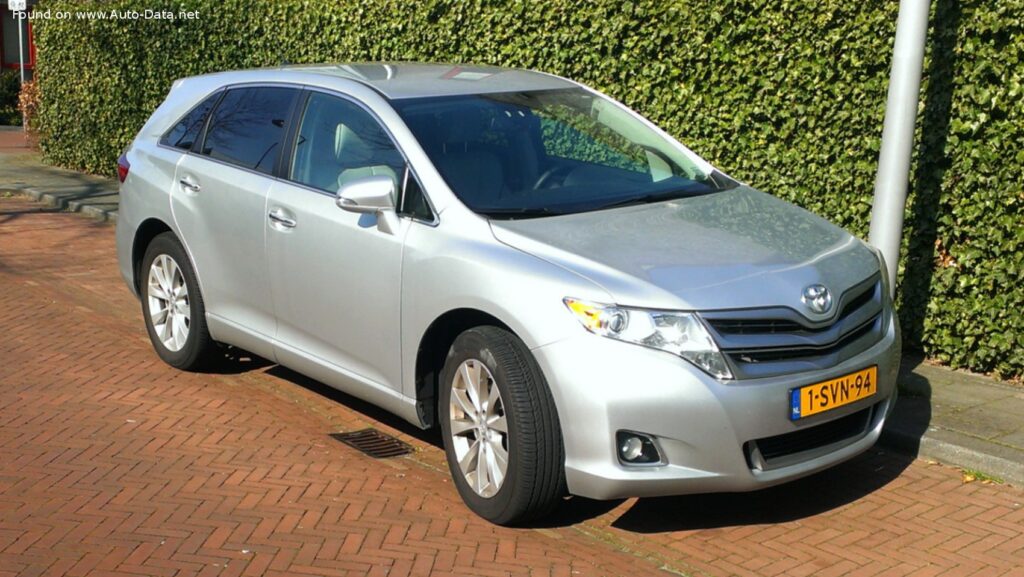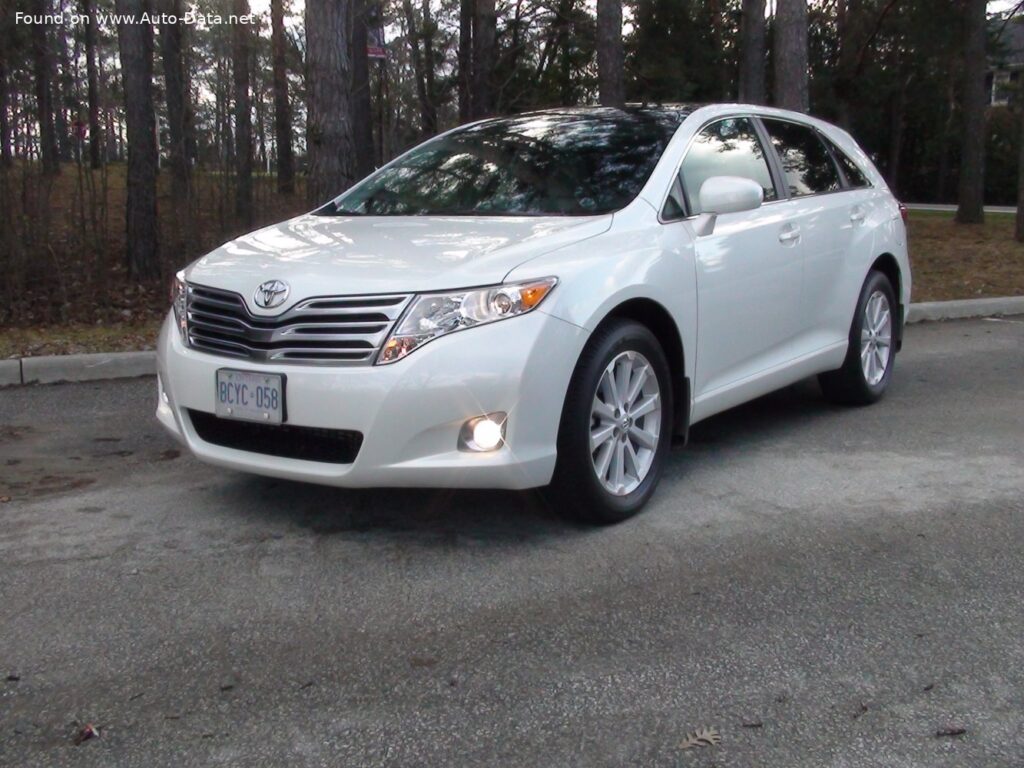
The Toyota Venza I (AV10), specifically the 3.5 (268 Hp) AWD Automatic variant, represented a significant entry into the North American automotive market when it debuted for the 2009 model year. Launched in 2008, this first-generation Venza was conceived as a distinctive crossover utility vehicle (CUV) that aimed to blend the spaciousness and versatility of a sport utility vehicle with the refined driving dynamics and fuel efficiency of a sedan. Positioned by Toyota to bridge the gap between its popular Camry sedan and the larger Highlander SUV, the Venza sought to attract consumers looking for a comfortable, family-friendly vehicle that defied traditional classification. Its production run from 2008 to 2012 saw it carve out a unique niche, appealing to those who desired a more car-like driving experience than a conventional SUV, yet needed more cargo capacity and ground clearance than a typical wagon. This particular iteration, with its potent 3.5-liter V6 engine and all-wheel-drive system, underscored Toyota’s commitment to offering robust performance and enhanced traction, making it a highly capable and versatile option in the competitive mid-size segment.
Engine and Performance of the Toyota Venza I (AV10)
At the heart of the Toyota Venza I (AV10) 3.5 (268 Hp) AWD Automatic model lies Toyota’s renowned 2GR-FE engine, a naturally aspirated 3.5-liter V6 unit known for its smooth power delivery and reliability. This sophisticated powertrain configuration features a V-engine layout with six cylinders, each equipped with four valves, totaling 24 valves, actuated by a Double Overhead Camshaft (DOHC) valvetrain. This design optimizes engine breathing and efficiency across the RPM range. The engine utilizes a multi-port manifold injection system to precisely deliver gasoline to each cylinder, contributing to its robust output.
With a displacement of 3456 cubic centimeters (210.9 cubic inches), the 2GR-FE engine generates a substantial 268 horsepower. This power output, combined with a power-per-liter rating of 77.5 Hp/l, ensures brisk acceleration and confident highway merging. Torque figures are equally impressive, peaking at 246.35 lb.-ft. (334 Nm) at a relatively accessible 4700 rpm. This broad torque band provides excellent responsiveness in various driving conditions, from city commutes to open-road cruising. The vehicle’s weight-to-power ratio stands at 6.8 kg/Hp (or 146 Hp/tonne), while the weight-to-torque ratio is 5.5 kg/Nm (182 Nm/tonne), indicating a well-balanced power-to-weight characteristic for a vehicle of its size and segment.
Power is transmitted to all four wheels through an advanced all-wheel-drive (AWD) system, providing enhanced traction and stability, especially in adverse weather conditions or on unpaved roads. The AWD system works in conjunction with a smooth and efficient 6-speed automatic transmission. This gearbox is precisely calibrated to maximize both performance and fuel economy, executing seamless shifts that contribute to the Venza’s refined driving experience. The combination of the potent V6 engine, the responsive automatic transmission, and the capable AWD system made the Venza 3.5 a compelling choice for consumers seeking a blend of performance, safety, and versatility.
Design and Features of the Toyota Venza I (AV10)
The design philosophy behind the Toyota Venza I (AV10) was to create a vehicle that defied easy categorization, offering a unique blend of styling cues from sedans, SUVs, and traditional station wagons. Officially classified as a station wagon (estate) in its technical specifications, its market positioning in the US was distinctly as a crossover. With five doors and seating for five occupants, the Venza prioritized passenger comfort and cargo flexibility. Its exterior dimensions contributed to its distinctive road presence and spacious interior: a length of 189.02 inches (4801 mm), a width of 75 inches (1905 mm), and a height of 63.39 inches (1610 mm). The wheelbase measured 89.61 inches (2276 mm), which, along with front and rear tracks of 64.21 inches (1631 mm) and 64.41 inches (1636 mm) respectively, provided a stable stance and contributed to its comfortable ride.
From a design perspective, the Venza featured a sleek, aerodynamic profile that was more car-like than many traditional SUVs of its era. Its elevated ride height offered better visibility than a sedan, while its lower roofline and smoother contours differentiated it from bulkier SUVs. Inside, the Venza was designed with practicality and user-friendliness in mind. The cabin offered ample space for five adults, with particular attention paid to legroom and headroom. Storage solutions were integrated throughout the interior, enhancing its utility for families and active individuals. The rear cargo area was generous, and the rear seats typically folded flat to expand carrying capacity, making it suitable for transporting luggage, sports equipment, or groceries.
Safety was a paramount consideration for the Venza, as expected from a modern Toyota. While specific safety features can vary by trim, the Venza typically came equipped with a comprehensive suite of passive and active safety systems, including multiple airbags, anti-lock brakes (ABS), electronic brakeforce distribution (EBD), brake assist (BA), vehicle stability control (VSC), and traction control (TRAC). The suspension system further contributed to the vehicle’s driving dynamics and comfort. The front suspension utilized an independent McPherson strut setup, known for its balance of comfort and handling precision. The rear suspension featured an independent coil spring design, further enhancing ride quality and stability, particularly when carrying passengers or cargo. This combination ensured a compliant ride over varied road surfaces, providing a confident and enjoyable driving experience.
Technical Specifications
| Brand | Toyota |
| Model | Venza |
| Generation | Venza I (AV10) |
| Type (Engine) | 3.5 (268 Hp) AWD Automatic |
| Start of production | 2008 year |
| End of production | 2012 year |
| Powertrain Architecture | Internal Combustion engine |
| Body type | Station wagon (estate) |
| Seats | 5 |
| Doors | 5 |
| Fuel Type | Petrol (Gasoline) |
| Weight-to-power ratio | 6.8 kg/Hp, 146 Hp/tonne |
| Weight-to-torque ratio | 5.5 kg/Nm, 182 Nm/tonne |
| Power | 268 Hp |
| Power per liter | 77.5 Hp/l |
| Torque | 334 Nm @ 4700 rpm. (246.35 lb.-ft. @ 4700 rpm.) |
| Engine layout | Front, Transverse |
| Engine Model/Code | 2GR-FE |
| Engine displacement | 3456 cm3 (210.9 cu. in.) |
| Number of cylinders | 6 |
| Engine configuration | V-engine |
| Number of valves per cylinder | 4 |
| Fuel injection system | Multi-port manifold injection |
| Engine aspiration | Naturally aspirated engine |
| Valvetrain | DOHC |
| Engine oil capacity | 6.1 l (6.45 US qt | 5.37 UK qt) |
| Coolant | 10.3 l (10.88 US qt | 9.06 UK qt) |
| Kerb Weight | 1835 kg (4045.48 lbs.) |
| Fuel tank capacity | 67 l (17.7 US gal | 14.74 UK gal) |
| Length | 4801 mm (189.02 in.) |
| Width | 1905 mm (75 in.) |
| Height | 1610 mm (63.39 in.) |
| Wheelbase | 2276 mm (89.61 in.) |
| Front track | 1631 mm (64.21 in.) |
| Rear (Back) track | 1636 mm (64.41 in.) |
| Drive wheel | All wheel drive (4×4) |
| Number of gears and type of gearbox | 6 gears, automatic transmission |
| Front suspension | Independent type McPherson |
| Rear suspension | Independent coil spring |