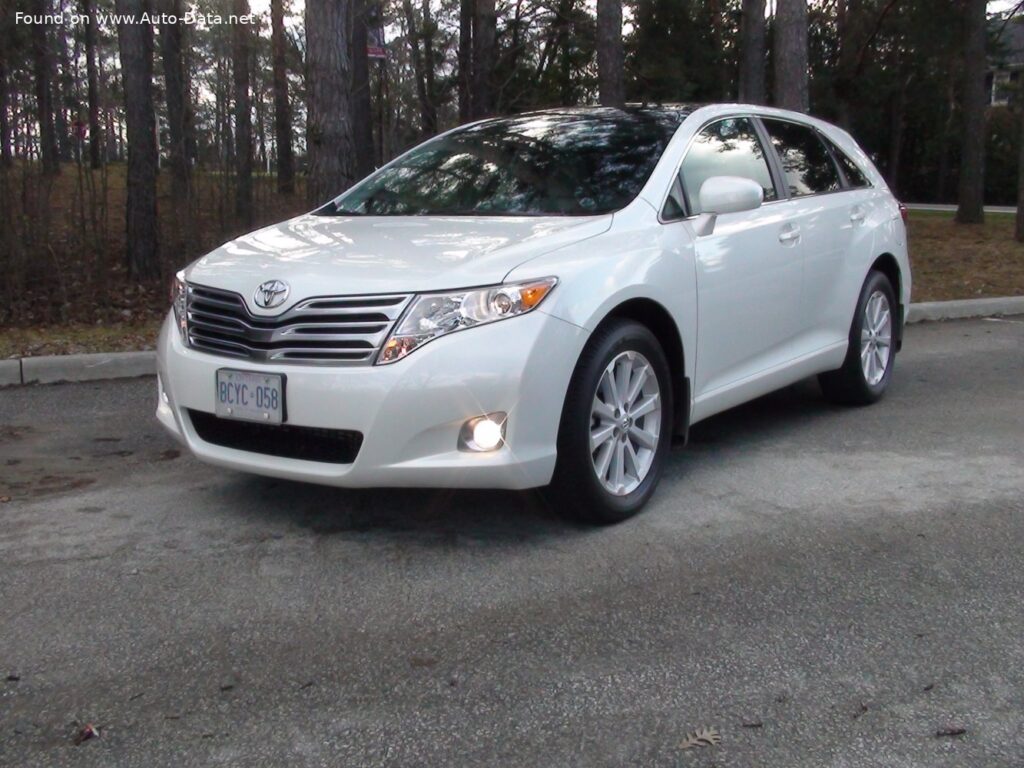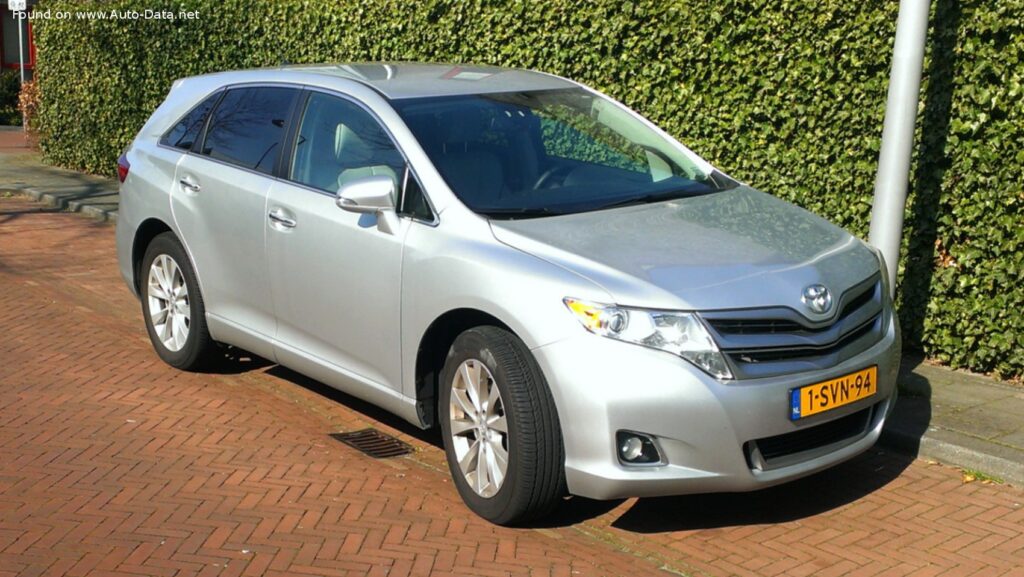
The Toyota Venza I (AV10, facelift 2012) 2.7i (181 Hp) AWD ECT-i represents a distinctive offering from the Japanese automaker, specifically tailored for the North American market where it aimed to bridge the gap between a conventional sedan and a sport utility vehicle (SUV). Launched initially in 2008, this particular iteration, the AV10 generation, received a significant facelift in May 2012, enhancing its aesthetic appeal and refining its feature set to maintain competitiveness. Positioned as a mid-size crossover, though often categorized as a station wagon or estate in global terms due to its car-like ride height and elongated profile, the Venza sought to combine the spaciousness and practicality of a wagon with the elevated driving position and optional all-wheel-drive capability of an SUV. This facelifted model, produced until 2017, became known for its comfortable ride, versatile interior, and a focus on practicality for families and individuals seeking a refined, capable, and efficient daily driver. Its design philosophy emphasized a sleek, car-like appearance, differentiating it from the more rugged, truck-based SUVs prevalent at the time, offering a compelling alternative for consumers prioritizing comfort and ease of use in urban and suburban environments.
Engine and Performance: The Heart of the Toyota Venza I (AV10, facelift 2012)
Powering this iteration of the Toyota Venza I (AV10, facelift 2012) 2.7i (181 Hp) AWD ECT-i is Toyota’s robust 2.7-liter 1AR-FE inline-four engine. This naturally aspirated powerplant delivers a respectable 181 horsepower at 5800 rpm, providing ample thrust for daily commuting and highway cruising. Torque output stands at 247 Nm, or 182.18 lb.-ft., peaking at 4200 rpm, ensuring responsive acceleration and sufficient power for hauling cargo or light towing. The engine’s design incorporates a DOHC (Dual Overhead Camshaft) valvetrain with D-VVT-i (Dual Variable Valve Timing with intelligence), a technology that optimizes valve timing on both intake and exhaust camshafts. This system enhances engine breathing across the rev range, improving both power delivery and fuel efficiency. Fuel is delivered via a multi-port manifold injection system, a proven and reliable method for consistent performance.
Mated to this engine is a sophisticated 6-speed automatic transmission with ECT-i (Electronically Controlled Transmission with intelligence), which provides smooth and seamless gear changes, contributing to a refined driving experience. The Venza’s powertrain architecture is an internal combustion engine, with the engine mounted front and transverse, driving all four wheels through an All-Wheel Drive (AWD) system. This AWD setup provides enhanced traction and stability, particularly beneficial in adverse weather conditions or on unpaved roads, making it a versatile option for various climates and terrains across North America. The vehicle’s weight-to-power ratio is 9.9 kg/Hp (or 101.2 Hp/tonne), and its weight-to-torque ratio is 7.2 kg/Nm (or 138.1 Nm/tonne), indicating a balanced approach to performance and efficiency for its class.
In terms of fuel economy, the 2.7-liter Venza offers competitive figures for a vehicle of its size and capability. Urban driving yields approximately 19.9 US mpg (11.8 l/100 km), while extra-urban (highway) consumption improves to 26.1 US mpg (9 l/100 km). This efficiency is achieved using regular unleaded gasoline, and the vehicle meets the ULEV-II (Ultra-Low Emission Vehicle) emission standard, reflecting its commitment to environmental responsibility. The engine oil capacity is 4.4 liters (4.65 US quarts), and the cooling system requires 7.1 liters (7.5 US quarts) of coolant, ensuring optimal operating temperatures under varying conditions.
Design and Features of the Toyota Venza I (AV10, facelift 2012)
The design of the Toyota Venza I (AV10, facelift 2012) 2.7i (181 Hp) AWD ECT-i is characterized by its blend of sedan-like aesthetics with SUV practicality, making it a versatile “station wagon” in its technical classification, yet marketed as a crossover in the US. The facelift introduced in 2012 brought subtle yet significant updates to its exterior, including revised front and rear styling, new grille designs, and updated lighting elements, all contributing to a more contemporary and sophisticated appearance. With an overall length of 189.02 inches (4801 mm), a width of 75 inches (1905 mm), and a height of 63.39 inches (1610 mm), the Venza strikes an imposing yet refined stance on the road. Its generous wheelbase of 109.29 inches (2776 mm) contributes to a stable ride and a spacious cabin for all occupants.
The Venza offers a comfortable and practical interior designed to accommodate five passengers across two rows. The five-door body style ensures easy access for both front and rear passengers, while the expansive cargo area is one of its standout features. With the rear seats in place, the trunk provides a minimum of 34.4 cubic feet (974 liters) of storage space. Folding the rear seats down dramatically expands this capacity to an impressive 70.21 cubic feet (1988 liters), making the Venza exceptionally capable for carrying luggage, sports equipment, or larger items. The kerb weight of the vehicle is 3944.07 lbs (1789 kg), with a maximum permissible weight of 5161.02 lbs (2341 kg), allowing for a maximum load of 1216.95 lbs (552 kg). Furthermore, it boasts a permitted trailer load with brakes of 1000.9 lbs (454 kg), adding to its utility.
Underneath its stylish exterior, the Venza is equipped with a robust chassis designed for comfort and confident handling. It features an independent McPherson strut suspension system at both the front and rear axles, complete with coil springs and an anti-roll bar at the front, which helps to minimize body roll during cornering. Braking performance is strong, with large 325 mm ventilated disc brakes at the front and 297 mm disc brakes at the rear, complemented by an Anti-lock Braking System (ABS) for enhanced safety and control during emergency stops. Steering is managed by an electric power steering system operating a rack and pinion setup, providing precise and effortless maneuverability, especially at lower speeds. The Venza rides on 19-inch wheels fitted with 245/55 R19 103S tires, providing a good balance of grip and ride comfort. With a ground clearance of 8.11 inches (206 mm), the Venza offers a slight advantage over sedans when navigating uneven terrain or deep snow, further solidifying its crossover appeal. Its minimum turning circle of 40.68 feet (12.4 meters) ensures reasonable agility in urban settings.
Technical Specifications
| Brand | Toyota |
| Model | Venza |
| Generation | Venza I (AV10, facelift 2012) |
| Type (Engine) | 2.7i (181 Hp) AWD ECT-i |
| Start of production | May, 2012 year |
| End of production | 2017 year |
| Powertrain Architecture | Internal Combustion engine |
| Body type | Station wagon (estate) |
| Seats | 5 |
| Doors | 5 |
| Fuel consumption (economy) – urban | 11.8 l/100 km (19.9 US mpg) |
| Fuel consumption (economy) – extra urban | 9 l/100 km (26.1 US mpg) |
| Fuel Type | Petrol (Gasoline) |
| Emission standard | ULEV-II |
| Weight-to-power ratio | 9.9 kg/Hp (101.2 Hp/tonne) |
| Weight-to-torque ratio | 7.2 kg/Nm (138.1 Nm/tonne) |
| Power | 181 Hp @ 5800 rpm. |
| Power per litre | 67.7 Hp/l |
| Torque | 247 Nm @ 4200 rpm (182.18 lb.-ft.) |
| Engine layout | Front, Transverse |
| Engine Model/Code | 1AR-FE |
| Engine displacement | 2672 cm3 (163.06 cu. in.) |
| Number of cylinders | 4 |
| Engine configuration | Inline |
| Number of valves per cylinder | 4 |
| Fuel injection system | Multi-port manifold injection |
| Engine aspiration | Naturally aspirated engine |
| Valvetrain | DOHC, D-VVT-i |
| Engine oil capacity | 4.4 l (4.65 US qt) |
| Coolant | 7.1 l (7.5 US qt) |
| Kerb Weight | 1789 kg (3944.07 lbs.) |
| Max. weight | 2341 kg (5161.02 lbs.) |
| Max load | 552 kg (1216.95 lbs.) |
| Trunk (boot) space – minimum | 974 l (34.4 cu. ft.) |
| Trunk (boot) space – maximum | 1988 l (70.21 cu. ft.) |
| Fuel tank capacity | 67 l (17.7 US gal) |
| Permitted trailer load with brakes (12%) | 454 kg (1000.9 lbs.) |
| Length | 4801 mm (189.02 in.) |
| Width | 1905 mm (75 in.) |
| Height | 1610 mm (63.39 in.) |
| Wheelbase | 2776 mm (109.29 in.) |
| Front track | 1631 mm (64.21 in.) |
| Rear (Back) track | 1636 mm (64.41 in.) |
| Ride height (ground clearance) | 206 mm (8.11 in.) |
| Minimum turning circle (turning diameter) | 12.4 m (40.68 ft.) |
| Drive wheel | All wheel drive (4×4) |
| Number of gears and type of gearbox | 6 gears, automatic transmission ECT-i |
| Front suspension | Independent, type McPherson with coil spring and anti-roll bar |
| Rear suspension | McPherson |
| Front brakes | Ventilated discs, 325 mm |
| Rear brakes | Disc, 297 mm |
| Assisting systems | ABS (Anti-lock braking system) |
| Steering type | Steering rack and pinion |
| Power steering | Electric Steering |
| Tires size | 245/55 R19 103S |
| Wheel rims size | 19 |