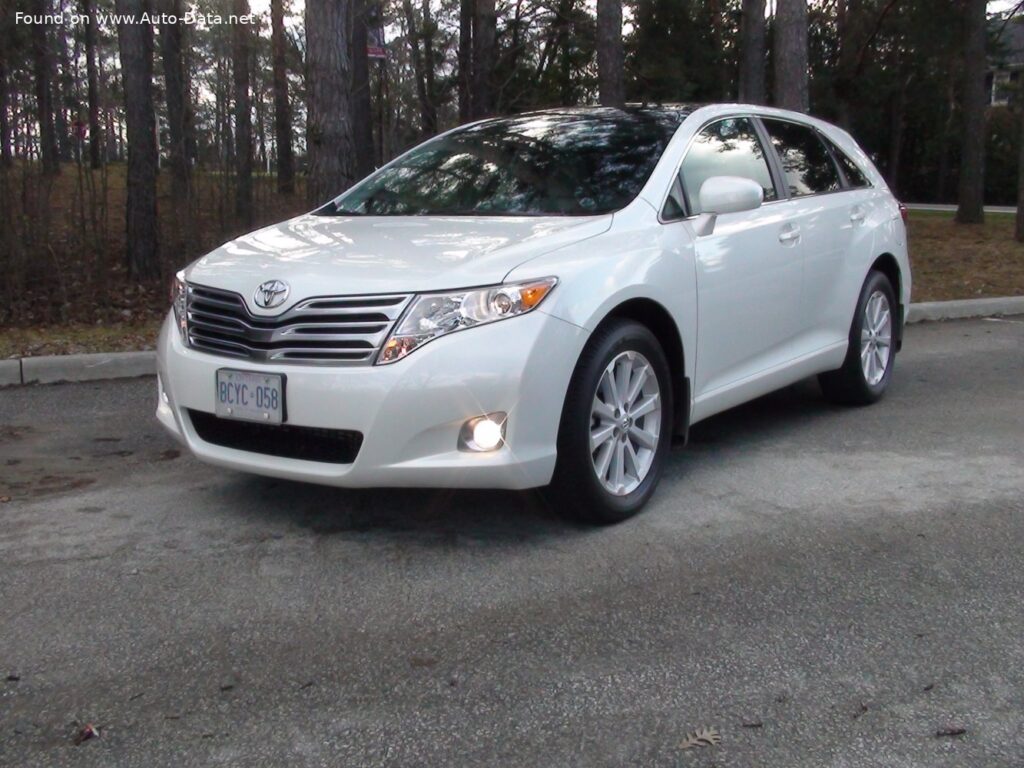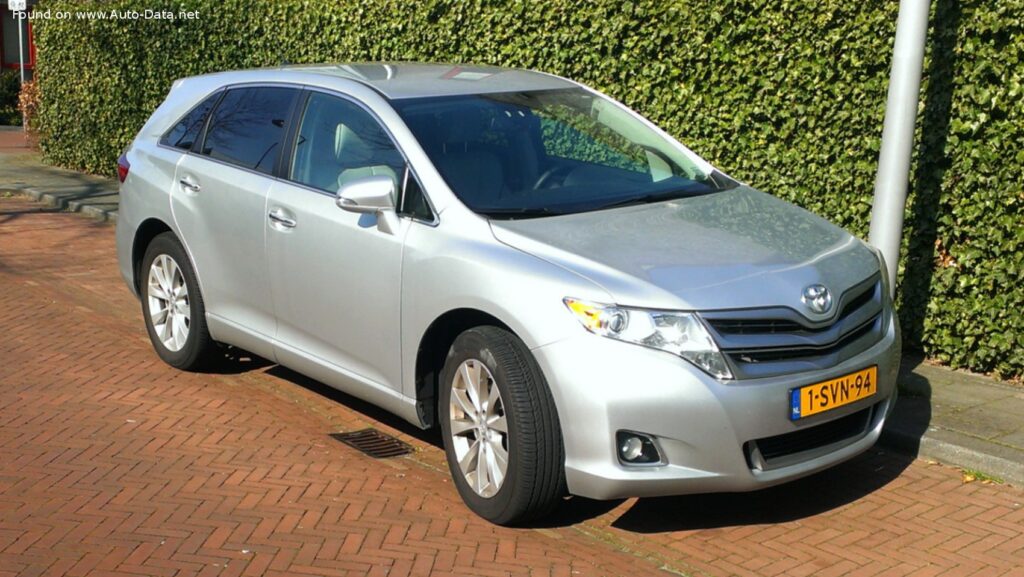
The Toyota Venza I (AV10, facelift 2012) 2.7i (181 Hp) ECT-i represents a distinctive offering in the North American automotive landscape, positioned as a versatile crossover that expertly blended attributes of a sedan, a station wagon, and an SUV. Introduced in May 2012 as a refreshed iteration of its first generation, this particular Venza model continued production through 2017. Designed primarily for the United States and Canadian markets, the Venza aimed to cater to consumers seeking a comfortable, family-friendly vehicle that offered ample cargo space and a higher driving position than a traditional sedan, without the bulky footprint or fuel economy penalties often associated with larger sport utility vehicles. Its unique classification, often referred to as a “crossover” or “mid-size wagon” in North America, allowed it to carve out a niche for buyers prioritizing practicality, reliability, and Toyota’s renowned build quality, all wrapped in a subtly elegant package that eschewed overt ruggedness for refined urban appeal.
The Toyota Venza I (AV10, facelift 2012) 2.7i (181 Hp) ECT-i: A North American Crossover Perspective
The first-generation Toyota Venza, especially in its facelifted AV10 guise from 2012, was a testament to Toyota’s strategy of diversifying its lineup to meet evolving consumer demands in North America. While globally, vehicles often fit neatly into categories, the Venza deliberately blurred lines, offering a compelling alternative to both conventional sedans and traditional SUVs. This 2.7i (181 Hp) ECT-i variant, with its efficient four-cylinder engine and smooth automatic transmission, was a popular choice for its balance of performance and fuel economy. Its design, while categorized as a “station wagon (estate)” in some technical definitions, was marketed and perceived as a modern crossover, appealing to a demographic that valued sophistication and utility in equal measure. The Venza’s thoughtful engineering and practical features solidified its reputation as a reliable and comfortable daily driver, capable of handling diverse family needs from daily commutes to weekend adventures.
Powertrain and Performance Dynamics
The 2.7-liter 1AR-FE Inline-Four Engine
At the heart of the Toyota Venza I (AV10, facelift 2012) 2.7i (181 Hp) ECT-i lies the robust and proven 1AR-FE engine. This naturally aspirated, inline-four cylinder gasoline engine boasts a displacement of 2672 cubic centimeters (163.06 cubic inches), providing a commendable balance of power and efficiency for a vehicle of its size. Engineered for smooth and dependable operation, the 1AR-FE delivers a peak power output of 181 horsepower at 5800 rpm. Torque is equally impressive, reaching 247 Newton-meters (182.18 lb.-ft.) at a accessible 4200 rpm, ensuring responsive acceleration and ample passing power in typical driving conditions. The engine’s design incorporates a DOHC (Double Overhead Camshaft) valvetrain with VVT-i (Variable Valve Timing with intelligence), a signature Toyota technology that optimizes valve timing for improved engine breathing across the rev range, enhancing both power delivery and fuel economy.
Fuel is delivered via a multi-port manifold injection system, a reliable and well-understood technology that ensures precise fuel atomization for efficient combustion. This Venza variant adheres to the ULEV-II (Ultra-Low Emission Vehicle II) standard, reflecting Toyota’s commitment to environmental responsibility even in its larger displacement engines. Power is efficiently transmitted to the front wheels through a sophisticated 6-speed ECT-i (Electronically Controlled Transmission with intelligence) automatic gearbox. This transmission is renowned for its seamless shifts, contributing significantly to the Venza’s refined driving experience and optimizing the engine’s output for various driving scenarios, from city traffic to highway cruising. The vehicle’s powertrain architecture, with the internal combustion engine driving the front wheels, prioritizes fuel efficiency and provides predictable handling characteristics. Despite its substantial curb weight of 3761.09 pounds (1706 kg), the Venza achieves a weight-to-power ratio of 9.4 kg/Hp (106.1 Hp/tonne) and a weight-to-torque ratio of 6.9 kg/Nm (144.8 Nm/tonne), indicating a well-matched engine and chassis for its intended purpose. Fuel economy figures stand at an estimated 19.9 US mpg (11.8 l/100 km) in urban environments and an even more respectable 26.1 US mpg (9 l/100 km) on the highway, making it an economical choice for a mid-size crossover.
Design, Features, and Ergonomics
Exterior and Interior Design Philosophy
The design of the Toyota Venza I (AV10, facelift 2012) was characterized by a sleek, aerodynamic profile that defied conventional segment classifications. While technically a “station wagon (estate),” its elevated stance, generous ground clearance of 8.11 inches (206 mm), and large wheels gave it a commanding presence on the road more akin to an SUV, yet without the ruggedness. The 2012 facelift introduced subtle but effective updates, typically including revised front grilles, updated headlamp and taillamp designs, and new wheel options, enhancing its contemporary appeal. Measuring 189.02 inches (4801 mm) in length, 75 inches (1905 mm) in width, and 63.39 inches (1610 mm) in height, the Venza offered substantial exterior dimensions that translated directly into a spacious and accommodating interior. The substantial 109.29-inch (2776 mm) wheelbase further contributed to a smooth ride and a roomy cabin for all occupants.
Inside, the Venza was designed with comfort and practicality in mind. It featured a 5-door configuration, providing easy access to both front and rear seating areas. The cabin comfortably accommodated five passengers, with ergonomically designed seats and quality materials throughout. A key highlight of the Venza’s interior was its exceptional cargo versatility. With the rear seats in place, it offered a generous minimum trunk space of 34.4 cubic feet (974 liters), ample for daily errands or luggage for a family trip. When the rear seats were folded down, this capacity expanded dramatically to an impressive 70.21 cubic feet (1988 liters), rivaling many larger SUVs and making it ideal for transporting bulkier items. The thoughtful interior layout, combined with a fuel tank capacity of 17.7 US gallons (67 liters), ensured long-distance comfort and practicality. Furthermore, the Venza was rated for a permitted trailer load with brakes of 1000.9 pounds (454 kg), adding another layer of utility for recreational activities.
Chassis, Suspension, and Safety
The driving dynamics of the Toyota Venza I (AV10, facelift 2012) were meticulously engineered to provide a comfortable, stable, and secure ride. Its chassis incorporated a sophisticated suspension system, featuring an independent McPherson strut design with coil springs and an anti-roll bar at the front. This setup is renowned for its ability to absorb road imperfections, providing a smooth and composed ride while maintaining precise steering control. The rear suspension also utilized a McPherson strut configuration, further contributing to the vehicle’s balanced handling characteristics and passenger comfort. This combination ensured a predictable and reassuring driving experience, whether navigating urban streets or cruising on the highway.
Braking performance was equally robust, with ventilated disc brakes measuring 325 mm at the front and solid disc brakes measuring 297 mm at the rear. These potent brakes were complemented by an Anti-lock Braking System (ABS), a crucial active safety feature that helps drivers maintain steering control during emergency braking maneuvers. Steering was managed by an electric power steering system, employing a rack and pinion type. This electric assist not only made the Venza remarkably easy to maneuver in tight spaces, with a minimum turning circle of 40.68 feet (12.4 m), but also contributed to improved fuel efficiency by reducing parasitic drag on the engine compared to traditional hydraulic systems. The Venza came equipped with 245/55 R19 103S tires mounted on 19-inch wheel rims, providing a good balance of grip, ride comfort, and a confident stance. The overall drivetrain architecture, with its front-wheel-drive setup, offered dependable traction and straightforward maintenance, reinforcing the Venza’s reputation as a practical and reliable choice for North American families.
Technical Specifications: Toyota Venza I (AV10, facelift 2012) 2.7i (181 Hp) ECT-i
| Brand | Toyota |
| Model | Venza |
| Generation | Venza I (AV10, facelift 2012) |
| Type (Engine) | 2.7i (181 Hp) ECT-i |
| Start of production | May, 2012 year |
| End of production | 2017 year |
| Powertrain Architecture | Internal Combustion engine |
| Body type | Station wagon (estate) |
| Seats | 5 |
| Doors | 5 |
| Fuel consumption (economy) – urban | 11.8 l/100 km (19.9 US mpg) |
| Fuel consumption (economy) – extra urban | 9 l/100 km (26.1 US mpg) |
| Fuel Type | Petrol (Gasoline) |
| Emission standard | ULEV-II |
| Weight-to-power ratio | 9.4 kg/Hp (106.1 Hp/tonne) |
| Weight-to-torque ratio | 6.9 kg/Nm (144.8 Nm/tonne) |
| Power | 181 Hp @ 5800 rpm |
| Power per litre | 67.7 Hp/l |
| Torque | 247 Nm @ 4200 rpm (182.18 lb.-ft. @ 4200 rpm) |
| Engine layout | Front, Transverse |
| Engine Model/Code | 1AR-FE |
| Engine displacement | 2672 cm3 (163.06 cu. in.) |
| Number of cylinders | 4 |
| Engine configuration | Inline |
| Number of valves per cylinder | 4 |
| Fuel injection system | Multi-port manifold injection |
| Engine aspiration | Naturally aspirated engine |
| Valvetrain | DOHC, VVT-i |
| Engine oil capacity | 4.4 l (4.65 US qt) |
| Coolant | 7.1 l (7.5 US qt) |
| Kerb Weight | 1706 kg (3761.09 lbs) |
| Max. weight | 2250 kg (4960.4 lbs) |
| Max load | 544 kg (1199.31 lbs) |
| Trunk (boot) space – minimum | 974 l (34.4 cu. ft.) |
| Trunk (boot) space – maximum | 1988 l (70.21 cu. ft.) |
| Fuel tank capacity | 67 l (17.7 US gal) |
| Permitted trailer load with brakes (12%) | 454 kg (1000.9 lbs) |
| Length | 4801 mm (189.02 in.) |
| Width | 1905 mm (75 in.) |
| Height | 1610 mm (63.39 in.) |
| Wheelbase | 2776 mm (109.29 in.) |
| Front track | 1631 mm (64.21 in.) |
| Rear (Back) track | 1641 mm (64.61 in.) |
| Ride height (ground clearance) | 206 mm (8.11 in.) |
| Minimum turning circle (turning diameter) | 12.4 m (40.68 ft.) |
| Drivetrain Architecture | The Internal combustion engine (ICE) drives the front wheels of the vehicle. |
| Drive wheel | Front wheel drive |
| Number of gears and type of gearbox | 6 gears, automatic transmission ECT-i |
| Front suspension | Independent, type McPherson with coil spring and anti-roll bar |
| Rear suspension | McPherson |
| Front brakes | Ventilated discs, 325 mm |
| Rear brakes | Disc, 297 mm |
| Assisting systems | ABS (Anti-lock braking system) |
| Steering type | Steering rack and pinion |
| Power steering | Electric Steering |
| Tires size | 245/55 R19 103S |
| Wheel rims size | 19 |