
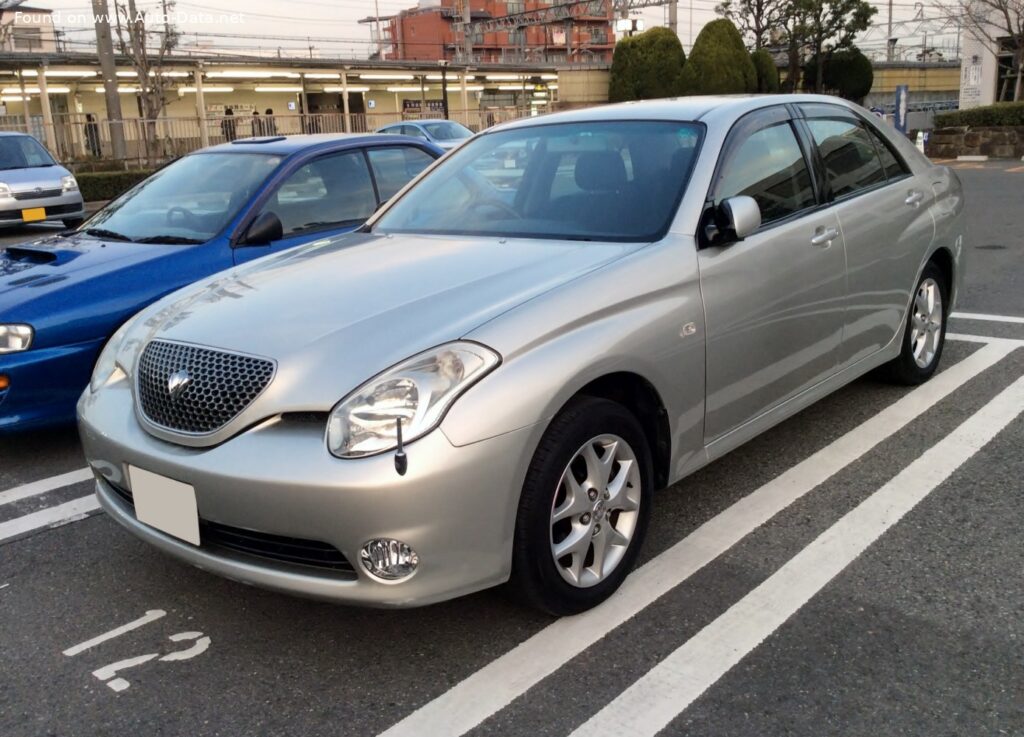
The Toyota Verossa 2.0 i 24V (160 Hp) represents a distinctive chapter in Toyota’s history, specifically tailored for the discerning Japanese Domestic Market (JDM). Launched in 2001, the Verossa was positioned as a premium sport sedan, intended to succeed the popular Chaser and Cresta models, alongside its more conservatively styled sibling, the Mark II. It was a vehicle designed to appeal to a younger, more style-conscious demographic, offering a blend of traditional Toyota reliability and engineering prowess with a bold, somewhat avant-garde aesthetic. This generation of the Toyota Verossa, produced until January 2004, was a four-door, five-seater sedan that embraced a rear-wheel-drive powertrain architecture, a hallmark of Toyota’s performance and luxury offerings in its home market. Its existence underscores Toyota’s willingness to experiment with design within its established vehicle segments, aiming to capture niche markets with specialized offerings that often did not make it to international shores, thus maintaining its status as a unique and sought-after model among enthusiasts of JDM vehicles.
Engine and Performance of the Toyota Verossa
At the heart of the Toyota Verossa 2.0 i 24V (160 Hp) lies the venerable 1G-FE engine, a naturally aspirated inline-six powerplant renowned for its smoothness, durability, and refined operation. This engine, with a displacement of 1988 cubic centimeters (approximately 2.0 liters or 121.32 cubic inches), was engineered to deliver a balanced blend of performance and efficiency suitable for daily driving and comfortable cruising. The inline-six configuration inherently provides superior balance compared to V6 or inline-four designs, resulting in a remarkably quiet and vibration-free driving experience, a characteristic highly valued in the premium sedan segment. The engine features a sophisticated Double Overhead Camshaft (DOHC) valvetrain with 24 valves, meaning four valves per cylinder, optimizing airflow for enhanced combustion efficiency and power delivery across the rev range. Fuel is supplied via a multi-port manifold injection system, ensuring precise fuel metering for optimal performance and emissions control.
The 1G-FE engine in the Verossa produces a respectable 160 horsepower at 6200 revolutions per minute, translating to a power-per-liter output of 80.5 Hp/l. This output, while not class-leading for a sport sedan, was more than adequate for the vehicle’s intended purpose, providing brisk acceleration and effortless highway cruising. Torque figures stand at 200 Newton meters (147.51 lb.-ft.) delivered at a relatively accessible 4400 rpm, indicating a broad and usable powerband for everyday driving conditions. The engine’s bore and stroke are both 75 mm (2.95 inches), a square design that contributes to its balanced nature and ability to rev smoothly. With a compression ratio of 10:1, the engine efficiently converts fuel into power. The powertrain architecture is a classic front-engine, longitudinal layout, driving the rear wheels, a setup favored for its dynamic handling characteristics and ability to distribute weight more evenly under acceleration. This configuration, paired with a 4-speed automatic transmission, emphasizes a smooth and comfortable driving experience rather than outright raw performance, aligning with its luxury-sport sedan positioning.
Weighing in at a curb weight of 1380 kg (3042.38 lbs.), the Toyota Verossa 2.0 i 24V boasts a weight-to-power ratio of 8.6 kg/Hp (115.9 Hp/tonne) and a weight-to-torque ratio of 6.9 kg/Nm (144.9 Nm/tonne). These figures suggest a vehicle designed for comfortable and confident progress, rather than track-focused agility. The engine oil capacity is 4 liters (4.23 US quarts), and the cooling system holds 6.5 liters (6.87 US quarts) of coolant, indicative of a robust and well-engineered thermal management system. The Verossa’s powertrain, therefore, is a testament to Toyota’s engineering philosophy of creating reliable, refined, and durable vehicles, even when venturing into more distinctive stylistic territories.
Design and Features of the Toyota Verossa
The design of the Toyota Verossa was arguably its most defining characteristic, setting it apart from its more conventional stablemates. While sharing its platform with the X110 series Mark II, the Verossa adopted a dramatically different exterior aesthetic. Its body type is a traditional four-door sedan, providing seating for five occupants, a standard configuration for its segment. However, its styling was a departure from Toyota’s typical conservative approach, featuring a distinctive front fascia with elongated, vertically stacked headlights and a prominent grille that gave it a unique, somewhat polarizing appearance. The overall silhouette was sleek and aerodynamic, with flowing lines that aimed to convey a sense of motion and modernity. With a length of 4705 mm (185.24 inches), a width of 1760 mm (69.29 inches), and a height of 1450 mm (57.09 inches), the Verossa occupied a substantial footprint on the road, contributing to its commanding presence and spacious interior.
Underneath its distinctive skin, the Verossa was built on a solid and well-engineered chassis. Its wheelbase measured 2780 mm (109.45 inches), providing a stable ride and generous interior room. The front track was 1495 mm (58.86 inches) and the rear track was 1475 mm (58.07 inches), contributing to its planted stance and handling stability. The suspension system, critical for both ride comfort and dynamic performance, featured a double wishbone setup at both the front and rear axles. This sophisticated independent suspension design allows for precise wheel control, enhancing both ride quality over varied surfaces and handling prowess during spirited driving. Braking performance was handled by ventilated discs at the front and solid discs at the rear, providing confident stopping power, further augmented by an Anti-lock Braking System (ABS) for improved safety under emergency braking conditions. The steering system was a hydraulic rack and pinion type, offering direct and communicative feedback to the driver, a desirable trait for a sport-oriented sedan.
The Verossa was equipped with 205/55 R16 V-rated tires, providing a good balance of grip, comfort, and durability. Inside, while specific features are not detailed in the data, as a premium JDM sedan of its era, it would have offered a high level of comfort and convenience. This typically included automatic climate control, power windows, mirrors, and seats, a sophisticated audio system, and high-quality interior materials. The emphasis would have been on creating a refined cabin environment conducive to long-distance travel and urban commuting alike. The maximum load capacity was 275 kg (606.27 lbs.), and the fuel tank capacity of 70 liters (18.49 US gallons) ensured a respectable cruising range. The Toyota Verossa, therefore, combined a visually striking exterior with a technically sound and comfortable interior, embodying Toyota’s vision for a unique luxury-sport sedan in the early 2000s Japanese market.
Technical Specifications
| Brand | Toyota |
| Model | Verossa |
| Generation | Verossa |
| Type (Engine) | 2.0 i 24V (160 Hp) |
| Start of production | 2001 year |
| End of production | January, 2004 year |
| Powertrain Architecture | Internal Combustion engine |
| Body type | Sedan |
| Seats | 5 |
| Doors | 4 |
| Fuel Type | Petrol (Gasoline) |
| Weight-to-power ratio | 8.6 kg/Hp, 115.9 Hp/tonne |
| Weight-to-torque ratio | 6.9 kg/Nm, 144.9 Nm/tonne |
| Power | 160 Hp @ 6200 rpm. |
| Power per liter | 80.5 Hp/l |
| Torque | 200 Nm @ 4400 rpm. (147.51 lb.-ft. @ 4400 rpm.) |
| Engine layout | Front, Longitudinal |
| Engine Model/Code | 1G-FE |
| Engine displacement | 1988 cm3 (121.32 cu. in.) |
| Number of cylinders | 6 |
| Engine configuration | Inline |
| Cylinder Bore | 75 mm (2.95 in.) |
| Piston Stroke | 75 mm (2.95 in.) |
| Compression ratio | 10:1 |
| Number of valves per cylinder | 4 |
| Fuel injection system | Multi-port manifold injection |
| Engine aspiration | Naturally aspirated engine |
| Valvetrain | DOHC |
| Engine oil capacity | 4 l (4.23 US qt | 3.52 UK qt) |
| Coolant | 6.5 l (6.87 US qt | 5.72 UK qt) |
| Kerb Weight | 1380 kg (3042.38 lbs.) |
| Max. weight | 1655 kg (3648.65 lbs.) |
| Max load | 275 kg (606.27 lbs.) |
| Fuel tank capacity | 70 l (18.49 US gal | 15.4 UK gal) |
| Length | 4705 mm (185.24 in.) |
| Width | 1760 mm (69.29 in.) |
| Height | 1450 mm (57.09 in.) |
| Wheelbase | 2780 mm (109.45 in.) |
| Front track | 1495 mm (58.86 in.) |
| Rear (Back) track | 1475 mm (58.07 in.) |
| Drivetrain Architecture | The Internal combustion engine (ICE) drives the rear wheels of the vehicle. |
| Drive wheel | Rear wheel drive |
| Number of gears and type of gearbox | 4 gears, automatic transmission |
| Front suspension | Double wishbone |
| Rear suspension | Double wishbone |
| Front brakes | Ventilated discs |
| Rear brakes | Disc |
| Assisting systems | ABS (Anti-lock braking system) |
| Steering type | Steering rack and pinion |
| Power steering | Hydraulic Steering |
| Tires size | 205/55 R16 V |

