
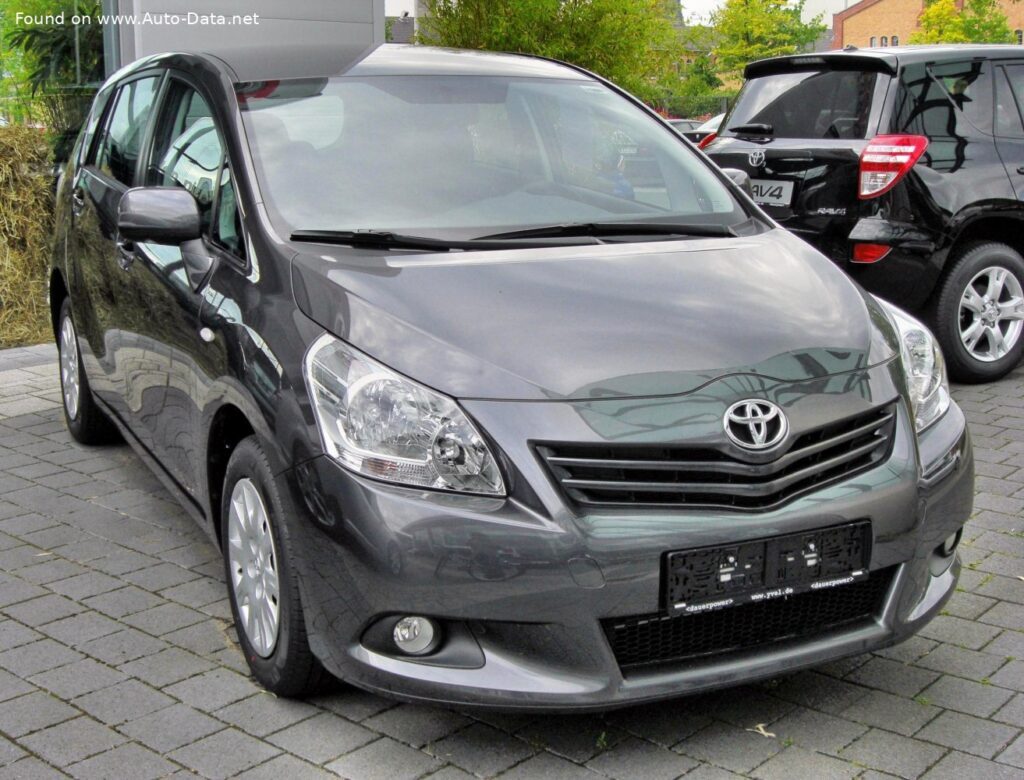
The Toyota Verso 1.6 Valvematic (132 Hp) represents a significant offering within the compact Multi-Purpose Vehicle (MPV) segment, specifically tailored for European and other international markets where such vehicles are highly valued for their practicality and family-friendly design. Launched in April 2009 and produced until January 2013, this iteration of the Verso carved out a niche as a reliable and versatile family transporter. It succeeded the popular Corolla Verso, establishing itself as a standalone model in Toyota’s lineup, distinct from its Corolla stablemate. The Verso’s design ethos centered on maximizing interior space, flexibility, and fuel efficiency, making it an ideal choice for families requiring adaptable seating and cargo configurations without compromising on Toyota’s renowned build quality and dependability. The 1.6 Valvematic engine variant, with its 132 horsepower output, aimed to strike a balance between adequate performance for daily driving and commendable fuel economy, adhering to the stringent Euro 4 emission standards prevalent during its production run.
Engineering and Performance of the Toyota Verso 1.6 Valvematic (132 Hp)
At the heart of the Toyota Verso 1.6 Valvematic (132 Hp) lies the 1ZR-FAE engine, a naturally aspirated inline four-cylinder gasoline unit designed for efficiency and smooth power delivery. This 1,598 cm³ (97.52 cu. in.) engine incorporates Toyota’s advanced Valvematic technology, a sophisticated variable valve lift and timing system that optimizes intake valve lift and duration continuously. Unlike simpler variable valve timing systems, Valvematic offers a broader range of control, allowing for more precise air intake management, which translates to improved fuel economy and reduced emissions across various engine speeds and loads. This technological advantage contributes significantly to the engine’s performance characteristics, delivering 132 horsepower (Hp) and a peak torque of 118.01 lb.-ft. (160 Nm) at 4400 rpm. The power output per liter stands at a respectable 82.6 Hp/l, showcasing the engine’s efficient design.
The powertrain architecture of the Verso 1.6 Valvematic is a conventional front-engine, front-wheel-drive setup, which is typical for compact MPVs, ensuring predictable handling and efficient packaging. Power is transmitted to the front wheels via a precise 6-speed manual transmission, offering drivers engaging control and allowing for optimal gear selection to maximize either acceleration or fuel efficiency. This combination enables the Verso to accelerate from 0 to 60 mph in a calculated 11.1 seconds, with a 0 to 100 km/h sprint completed in 11.7 seconds, and reach a maximum speed of 114.95 mph (185 km/h). While not designed for outright speed, these figures underscore its capability for comfortable highway cruising and confident urban maneuvering.
Fuel economy was a key consideration for the Verso, reflecting the demands of its target market. The 1.6 Valvematic engine achieves a combined fuel consumption rating of 35.1 US mpg (6.7 l/100 km), which is quite competitive for a vehicle of its size and utility. In urban driving, it delivers 27.4 US mpg (8.6 l/100 km), while extra-urban conditions see this improve to an impressive 42 US mpg (5.6 l/100 km). These figures, combined with CO2 emissions of 158 g/km, highlight Toyota’s commitment to environmental responsibility within the Euro 4 emission standard framework. The fuel tank capacity of 15.85 US gallons (60 liters) ensures a practical driving range, reducing the frequency of fuel stops during longer journeys.
Design, Versatility, and Features
The Toyota Verso is characterized by its MPV body type, featuring five doors and a standard five-seat configuration in this specific variant, though other Verso models offered seven seats. Its design prioritizes functionality and interior space, crucial attributes for a family-oriented vehicle. With an overall length of 174.8 inches (4440 mm), a width of 70.47 inches (1790 mm), and a height of 63.78 inches (1620 mm), the Verso presents a compact yet capacious profile. The generous 109.45-inch (2780 mm) wheelbase contributes significantly to its stable ride quality and, more importantly, to the expansive interior volume available for passengers and cargo.
One of the Verso’s most compelling features is its highly adaptable interior. The minimum trunk (boot) space starts at a substantial 17.09 cu. ft. (484 liters), which can be expanded to an impressive 61.45 cu. ft. (1740 liters) with the rear seats folded down. This flexibility allows owners to easily accommodate a wide range of cargo, from groceries and luggage to sports equipment or furniture, underscoring its utility as a true multi-purpose vehicle. The practical design extends to a maximum roof load capacity of 220.46 lbs. (100 kg) and a permitted trailer load with brakes of 2866.01 lbs. (1300 kg), further enhancing its versatility for active lifestyles. The vehicle’s maximum gross weight is rated at 4684.82 lbs. (2125 kg), allowing for substantial payloads.
In terms of ride and handling, the Verso employs a well-proven suspension setup. The front suspension consists of an independent McPherson type, known for its balance of comfort and precise steering response. At the rear, a torsion beam suspension is utilized, which is compact and cost-effective, helping to maximize interior space while providing a stable and comfortable ride. The steering system is a rack and pinion type, offering direct and responsive feedback to the driver. Safety features for the Verso of this era included standard Anti-lock Braking System (ABS), a crucial active safety component ensuring controlled braking in emergency situations. The vehicle rides on either 205/60 R16 or 215/55 R17 tires, mounted on 6.5J x 16 or 7.0J x 17 wheel rims, respectively, providing a comfortable ride and adequate grip for various driving conditions. The minimum turning circle of 38.06 to 39

