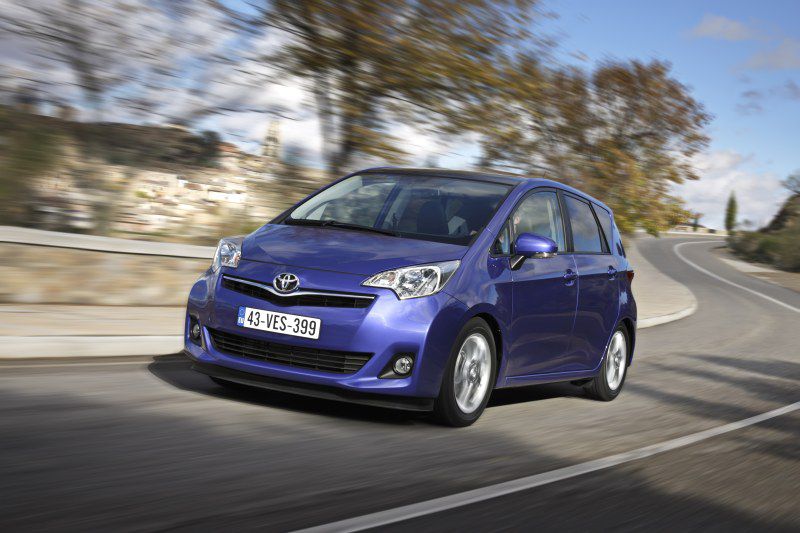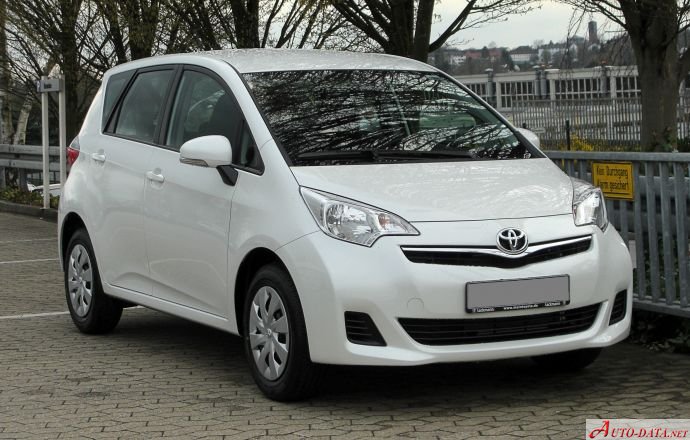
The Toyota Verso-S II 1.33 Dual VVT-i, produced from 2010 to 2015, is a compact multi-purpose vehicle (MPV) primarily aimed at the European market. While not officially sold in the United States, it represents Toyota’s offering in the increasingly popular “mini-MPV” segment, designed to provide family-friendly practicality in a smaller, more fuel-efficient package. The Verso-S II served as a more affordable and maneuverable alternative to larger MPVs, focusing on urban usability and efficient transportation.
Toyota Verso-S II: An Overview
The Verso-S II is the second generation of the Verso-S, building upon the foundation of its predecessor with refinements to styling, efficiency, and features. It’s positioned below the larger Toyota Verso (known as the Sienna in North America) and competes with vehicles like the Renault Modus and Opel Meriva. The vehicle’s design prioritizes interior space and versatility within a relatively small footprint, making it well-suited for navigating crowded city streets and tight parking spaces. The “S” designation stands for “Small” highlighting its compact nature.
Engine & Performance
The Verso-S II 1.33 Dual VVT-i is powered by Toyota’s 1NR-FE 1.329-liter inline-four cylinder gasoline engine. This engine produces 98 horsepower at 6000 rpm and 125 Nm (92.2 lb.-ft.) of torque at 4000 rpm. The engine utilizes Toyota’s Dual VVT-i (Variable Valve Timing-intelligence) technology, optimizing valve timing for improved fuel efficiency and responsiveness across the rev range. Power is delivered to the front wheels via a continuously variable transmission (CVT), prioritizing smooth acceleration and fuel economy over traditional gear changes. Acceleration from 0 to 100 km/h (0-62 mph) takes 13.7 seconds, with a top speed of 165 km/h (102.53 mph). The engine’s power-to-weight ratio is 11 kg/Hp, and the torque-to-weight ratio is 8.6 kg/Nm.
Design & Features
The Toyota Verso-S II is a five-door MPV with seating for five passengers. Its design emphasizes practicality and a modern aesthetic. The exterior features a relatively high roofline to maximize interior headroom, and a short, stubby profile that aids maneuverability. Inside, the Verso-S II offers a surprisingly spacious cabin for its size, with a focus on flexible seating arrangements. The rear seats can be folded flat or even removed entirely to create a larger cargo area. Trunk space ranges from 430 liters (15.19 cu. ft.) with all seats in place to 623 liters (22 cu. ft.) with the rear seats folded. Safety features included ABS (Anti-lock Braking System) as standard. The Verso-S II was designed to meet Euro 5 emission standards, reflecting Toyota’s commitment to environmental responsibility. The vehicle’s compact dimensions (3990 mm length, 1695 mm width, 1595 mm height) make it easy to park and navigate in urban environments.
Technical Specifications
| Brand | Toyota |
| Model | Verso-S |
| Generation | Verso-S II |
| Type (Engine) | 1.33 Dual VVT-i (98 Hp) CVT |
| Start of production | 2010 |
| End of production | 2015 |
| Powertrain Architecture | Internal Combustion engine |
| Body type | MPV |
| Seats | 5 |
| Doors | 5 |
| Fuel consumption (urban) | 5.7 l/100 km (41.3 US mpg, 49.6 UK mpg, 17.5 km/l) |
| Fuel consumption (extra urban) | 4.7 l/100 km (50 US mpg, 60.1 UK mpg, 21.3 km/l) |
| Fuel consumption (combined) | 5 l/100 km (47 US mpg, 56.5 UK mpg, 20 km/l) |
| Fuel Type | Petrol (Gasoline) |
| Acceleration 0 – 100 km/h | 13.7 sec |
| Acceleration 0 – 62 mph | 13.7 sec |
| Acceleration 0 – 60 mph | 13 sec |
| Maximum speed | 165 km/h (102.53 mph) |
| Emission standard | Euro 5 |
| Weight-to-power ratio | 11 kg/Hp |
| Weight-to-torque ratio | 8.6 kg/Nm |
| Power | 98 Hp @ 6000 rpm |
| Torque | 125 Nm @ 4000 rpm (92.2 lb.-ft. @ 4000 rpm) |
| Engine layout | Front, Transverse |
| Engine Model/Code | 1NR-FE |
| Engine displacement | 1329 cm3 (81.1 cu. in.) |
| Number of cylinders | 4 |
| Engine configuration | Inline |
| Cylinder Bore | 72.5 mm (2.85 in.) |
| Piston Stroke | 80.5 mm (3.17 in.) |
| Compression ratio | 11.5:1 |
| Number of valves per cylinder | 4 |
| Fuel injection system | Multi-port manifold injection |
| Engine aspiration | Naturally aspirated engine |
| Valvetrain | DOHC – Dual VVT-i |
| Engine oil capacity | 3.4 l (3.59 US qt | 2.99 UK qt) |
| Coolant | 4.8 l (5.07 US qt | 4.22 UK qt) |
| Kerb Weight | 1075 kg (2369.97 lbs.) |
| Max. weight | 1550 kg (3417.17 lbs.) |
| Max load | 475 kg (1047.2 lbs.) |
| Trunk (boot) space – minimum | 430 l (15.19 cu. ft.) |
| Trunk (boot) space – maximum | 623 l (22 cu. ft.) |
| Length | 3990 mm (157.09 in.) |
| Width | 1695 mm (66.73 in.) |
| Height | 1595 mm (62.8 in.) |
| Wheelbase | 2550 mm (100.39 in.) |
| Front track | 1470 mm (57.87 in.) |
| Rear track | 1460 mm (57.48 in.) |
| Minimum turning circle | 10.8 m (35.43 ft.) |
| Drivetrain Architecture | Front wheel drive |
| Number of gears and type of gearbox | 7 gears, automatic transmission (CVT) |
| Front suspension | Independent, type McPherson with coil spring and anti-roll bar |
| Rear suspension | Torsion |
| Front brakes | Ventilated discs |
| Rear brakes | Drum |
The Toyota Verso-S II 1.33 Dual VVT-i, while not a vehicle commonly found in the US market, represents a practical and efficient option for families seeking a compact and versatile MPV. Its focus on fuel economy, maneuverability, and interior space made it a popular choice in Europe, demonstrating Toyota’s ability to cater to diverse market needs.