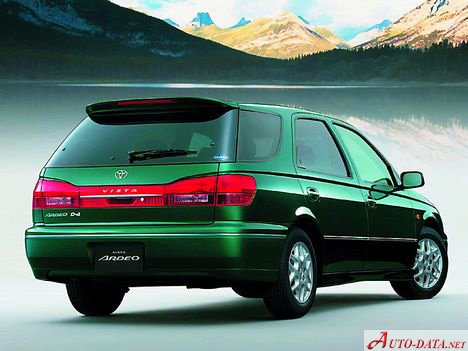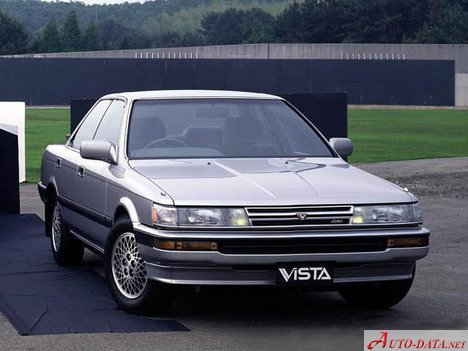
The Toyota Vista (V20) is a compact sedan produced by Toyota from 1986 to 1990. While not officially sold in the United States, the Vista held a significant position in the Japanese domestic market (JDM) as a more upscale and comfortable alternative to the Corolla and Sprinter. It was marketed towards buyers seeking a slightly larger, more refined vehicle within the compact class. The V20 generation represented a notable step forward in Toyota’s design and engineering, offering a blend of practicality, reliability, and a relatively modern feature set for its time. The 1.8-liter engine variant, producing 90 horsepower, was a popular choice, balancing fuel efficiency with adequate performance for everyday driving.
Toyota Vista (V20) 1.8: A Detailed Overview
The Vista occupied a unique niche in Toyota’s lineup. It wasn’t intended to compete directly with larger sedans like the Camry, but rather to provide a more premium experience within the compact segment. This was achieved through improved interior appointments, a more sophisticated suspension setup, and a generally higher level of refinement compared to its more mainstream counterparts. The V20 generation was part of a broader trend in the 1980s towards offering consumers a wider range of choices within each vehicle class, catering to diverse preferences and budgets.
Engine & Performance
The heart of the Toyota Vista (V20) 1.8 was the 1S inline four-cylinder engine. Displacing 1.8 liters (1832 cm3 or 111.8 cubic inches), this naturally aspirated engine produced 90 horsepower at 5200 rpm and 142 Nm (104.73 lb.-ft.) of torque at 3400 rpm. While not a performance powerhouse, the 1S engine provided sufficient power for comfortable cruising and everyday commuting. The engine featured multi-port fuel injection and a double overhead camshaft (DOHC) valvetrain, contributing to its relatively smooth operation and decent fuel economy. The engine’s power-to-weight ratio was 74.4 horsepower per tonne, and its torque-to-weight ratio was 117.4 Nm per tonne. The engine was longitudinally mounted and drove the front wheels through a five-speed manual transmission. This configuration was typical for front-wheel-drive vehicles of the era, offering a balance between packaging efficiency and driving dynamics.
Design & Features
The Toyota Vista (V20) was a traditional four-door sedan with a relatively conservative design. Its styling was typical of the mid-1980s, characterized by clean lines, a boxy silhouette, and a focus on practicality. The interior was designed with comfort in mind, offering seating for five passengers. While not lavishly equipped by modern standards, the Vista offered features such as cloth upholstery, a basic audio system, and power steering. Safety features were relatively limited compared to contemporary vehicles, but typically included seatbelts and a collapsible steering column. The Vista’s dimensions – 4520 mm (177.95 inches) in length, 1690 mm (66.54 inches) in width, and 1370 mm (53.94 inches) in height – positioned it squarely within the compact sedan segment. The wheelbase measured 2600 mm (102.36 inches), providing a reasonably spacious cabin for passengers.
Technological Context
The V20 Vista, while not groundbreaking in terms of technology, represented a solid evolution in automotive engineering for its time. The use of multi-port fuel injection was a significant improvement over earlier carburetor-based systems, resulting in better fuel efficiency and reduced emissions. The DOHC valvetrain further enhanced engine performance. The front-wheel-drive layout, increasingly common in the 1980s, offered improved traction and packaging efficiency compared to rear-wheel-drive configurations. The five-speed manual transmission provided drivers with greater control over the engine’s power delivery. These features, combined with Toyota’s reputation for reliability, made the Vista a popular choice among Japanese buyers.
Technical Specifications
| Brand | Toyota |
| Model | Vista |
| Generation | Vista (V20) |
| Type (Engine) | 1.8 (90 Hp) |
| Start of production | 1986 |
| End of production | 1990 |
| Powertrain Architecture | Internal Combustion engine |
| Body type | Sedan |
| Seats | 5 |
| Doors | 4 |
| Fuel Type | Petrol (Gasoline) |
| Weight-to-power ratio | 13.4 kg/Hp |
| Hp/tonne | 74.4 Hp/tonne |
| Weight-to-torque ratio | 8.5 kg/Nm |
| Nm/tonne | 117.4 Nm/tonne |
| Power | 90 Hp @ 5200 rpm |
| Power per litre | 49.1 Hp/l |
| Torque | 142 Nm @ 3400 rpm |
| Torque (lb.-ft.) | 104.73 lb.-ft. @ 3400 rpm |
| Engine layout | Front, Longitudinal |
| Engine Model/Code | 1S I4 |
| Engine displacement | 1832 cm3 |
| Engine displacement (cu. in.) | 111.8 cu. in. |
| Number of cylinders | 4 |
| Engine configuration | Inline |
| Cylinder Bore | 80.5 mm |
| Cylinder Bore (in.) | 3.17 in. |
| Piston Stroke | 89.9 mm |
| Piston Stroke (in.) | 3.54 in. |
| Compression ratio | 9:1 |
| Number of valves per cylinder | 4 |
| Fuel injection system | Multi-port manifold injection |
| Engine aspiration | Naturally aspirated engine |
| Valvetrain | DOHC |
| Kerb Weight | 1210 kg |
| Kerb Weight (lbs.) | 2667.59 lbs. |
| Length | 4520 mm |
| Length (in.) | 177.95 in. |
| Width | 1690 mm |
| Width (in.) | 66.54 in. |
| Height | 1370 mm |
| Height (in.) | 53.94 in. |
| Wheelbase | 2600 mm |
| Wheelbase (in.) | 102.36 in. |
| Drivetrain Architecture | ICE, Front wheel drive |
| Drive wheel | Front wheel drive |
| Number of gears and type of gearbox | 5 gears, manual transmission |