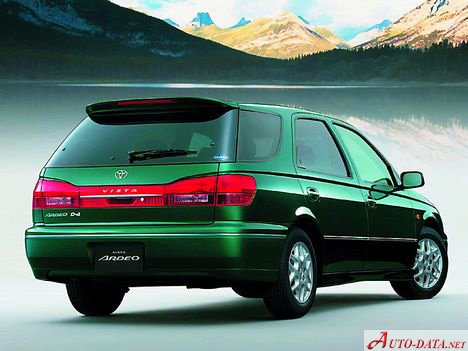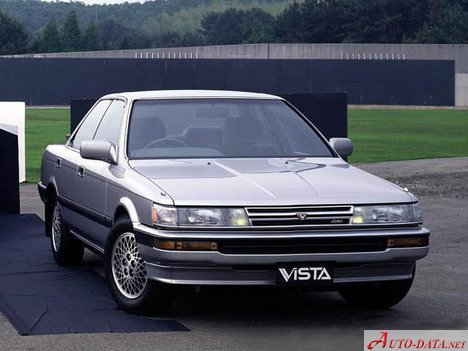
The Toyota Vista (V20) is a compact sedan produced by Toyota from 1986 to 1990. While not officially sold in the United States, the Vista held a significant position in the Japanese domestic market (JDM) as a more upscale and comfortable alternative to the Corolla and Sprinter. It was marketed towards buyers seeking a slightly larger, more refined vehicle within the compact class. The V20 generation represented a notable step forward in Toyota’s design and engineering, offering a blend of practicality, reliability, and a relatively modern feature set for its time. This article details the technical specifications and characteristics of the 1.8-liter, 90 horsepower automatic version of the Vista V20.
Toyota Vista (V20): A Detailed Overview
The Vista, in its various iterations, served as a platform for Toyota to experiment with different styling and comfort features, often previewing technologies that would later appear in globally-sold models. The V20 generation, specifically, aimed to provide a more premium experience compared to its more mainstream counterparts. It competed with other Japanese sedans like the Nissan Sunny and Honda Civic, focusing on providing a comfortable and reliable daily driver. The 1.8-liter engine option, while not the most powerful in the segment, prioritized fuel efficiency and smooth operation, aligning with the needs of Japanese commuters.
Engine & Performance
The Toyota Vista V20 1.8-liter model is powered by the 1S inline four-cylinder engine. This naturally aspirated engine produces 90 horsepower at 5200 rpm and 142 Nm (104.73 lb.-ft.) of torque at 3400 rpm. The engine’s power-to-weight ratio is 74.4 horsepower per tonne, and its torque-to-weight ratio is 117.4 Nm per tonne. The engine displacement is 1832 cm3 (111.8 cu. in.), with a bore of 80.5 mm (3.17 in.) and a stroke of 89.9 mm (3.54 in.). A compression ratio of 9:1 is employed, and the engine features a double overhead camshaft (DOHC) valvetrain with four valves per cylinder. Fuel delivery is managed by a multi-port manifold injection system. This configuration provides a balance between adequate performance for everyday driving and reasonable fuel economy. The engine is longitudinally mounted in the front of the vehicle, driving the front wheels through a four-speed automatic transmission. While not a performance-oriented setup, the powertrain is designed for smooth and reliable operation, typical of Toyota’s engineering philosophy.
Design & Features
The Toyota Vista V20 is a four-door sedan with a relatively conservative, yet modern for its time, design. It offers seating for five passengers. The body dimensions are 4520 mm (177.95 in.) in length, 1690 mm (66.54 in.) in width, and 1370 mm (53.94 in.) in height. The wheelbase measures 2600 mm (102.36 in.). The V20’s design emphasized practicality and comfort. Interior features, while not lavish, were geared towards providing a pleasant driving experience. Standard features likely included cloth upholstery, basic instrumentation, and a radio. Safety features for the era were relatively limited, but would have included seatbelts and potentially a collapsible steering column. The Vista’s appeal lay in its understated elegance and reputation for reliability, making it a popular choice for families and commuters in Japan. The kerb weight of the vehicle is 1210 kg (2667.59 lbs.).
Technical Specifications
| Brand | Toyota |
| Model | Vista |
| Generation | Vista (V20) |
| Type (Engine) | 1.8 (90 Hp) Automatic |
| Start of production | 1986 |
| End of production | 1990 |
| Powertrain Architecture | Internal Combustion engine |
| Body type | Sedan |
| Seats | 5 |
| Doors | 4 |
| Fuel Type | Petrol (Gasoline) |
| Weight-to-power ratio | 13.4 kg/Hp |
| Hp/tonne | 74.4 Hp/tonne |
| Weight-to-torque ratio | 8.5 kg/Nm |
| Nm/tonne | 117.4 Nm/tonne |
| Power | 90 Hp @ 5200 rpm |
| Power per litre | 49.1 Hp/l |
| Torque | 142 Nm @ 3400 rpm |
| Torque (lb.-ft.) | 104.73 lb.-ft. @ 3400 rpm |
| Engine layout | Front, Longitudinal |
| Engine Model/Code | 1S I4 |
| Engine displacement | 1832 cm3 |
| Engine displacement (cu. in.) | 111.8 cu. in. |
| Number of cylinders | 4 |
| Engine configuration | Inline |
| Cylinder Bore | 80.5 mm |
| Cylinder Bore (in.) | 3.17 in. |
| Piston Stroke | 89.9 mm |
| Piston Stroke (in.) | 3.54 in. |
| Compression ratio | 9:1 |
| Number of valves per cylinder | 4 |
| Fuel injection system | Multi-port manifold injection |
| Engine aspiration | Naturally aspirated engine |
| Valvetrain | DOHC |
| Kerb Weight | 1210 kg |
| Kerb Weight (lbs.) | 2667.59 lbs. |
| Length | 4520 mm |
| Length (in.) | 177.95 in. |
| Width | 1690 mm |
| Width (in.) | 66.54 in. |
| Height | 1370 mm |
| Height (in.) | 53.94 in. |
| Wheelbase | 2600 mm |
| Wheelbase (in.) | 102.36 in. |
| Drivetrain Architecture | ICE drives front wheels |
| Drive wheel | Front wheel drive |
| Number of gears and type of gearbox | 4 gears, automatic transmission |
In conclusion, the Toyota Vista V20 1.8 Automatic represented a solid and reliable offering in the Japanese compact sedan market. While not a high-performance vehicle, it prioritized comfort, fuel efficiency, and Toyota’s renowned build quality. Its significance lies in its role as a stepping stone for Toyota’s design and engineering advancements, and its appeal to a broad range of Japanese car buyers seeking a practical and dependable vehicle.