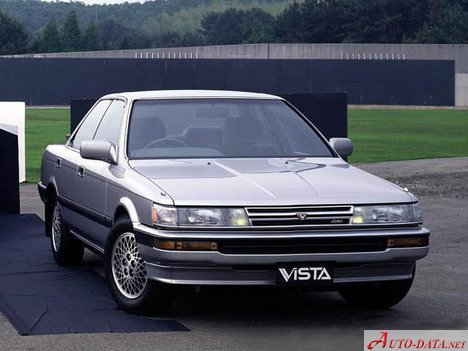
The Toyota Vista (V20) 2.0i, produced between 1986 and 1990, represents a significant offering from Toyota during a period of evolving automotive design and technology. While not officially sold in the United States, the Vista held a prominent position in the Japanese domestic market (JDM) as a comfortable and reliable mid-size sedan. It was marketed as a more upscale alternative to the Corolla, offering a larger interior and more refined driving experience. The V20 generation, specifically the 2.0i variant, aimed to balance fuel efficiency with adequate performance, catering to the needs of Japanese families and commuters. This model exemplifies Toyota’s commitment to quality and durability, characteristics that would become synonymous with the brand globally.
Toyota Vista (V20) 2.0i: A Detailed Overview
The Toyota Vista, in its various iterations, served as a key model within Toyota’s lineup, bridging the gap between the more economical Corolla and the larger, more luxurious Crown. The V20 generation, launched in 1986, was a comprehensive redesign, incorporating contemporary styling and improved mechanical components. The 2.0i model, equipped with the 3S-FE engine, was positioned as a desirable trim level, offering a step up in performance and features. The Vista’s success in Japan stemmed from its practicality, reliability, and relatively spacious interior, making it a popular choice for both private buyers and fleet operators.
Engine & Performance
The heart of the Toyota Vista 2.0i is the 3S-FE 2.0-liter inline-four cylinder engine. This naturally aspirated engine produces 90 horsepower at 5,600 rpm and 169 Nm (124.65 lb.-ft.) of torque at 4,400 rpm. While not a performance-oriented engine, the 3S-FE provides sufficient power for comfortable everyday driving. The engine’s design prioritized fuel efficiency and reliability, typical of Toyota’s engineering philosophy during this era. The engine’s power-to-weight ratio is 74.4 horsepower per tonne, and a torque-to-weight ratio of 139.7 Nm per tonne. Power per litre is rated at 45 hp/l. The engine is longitudinally mounted in the front of the vehicle, and power is delivered to the front wheels via a four-speed automatic transmission. This configuration contributes to a smooth and predictable driving experience, well-suited for urban and highway conditions. The weight-to-power ratio of 13.4 kg/Hp further illustrates the vehicle’s focus on balanced performance rather than outright speed.
Design & Features
The Toyota Vista V20 is a four-door sedan with a relatively conservative, yet modern for its time, design. Its exterior styling features clean lines and a boxy silhouette, characteristic of 1980s automotive design. The interior is designed with practicality in mind, offering comfortable seating for five passengers. The Vista prioritized passenger comfort and convenience, offering features such as power steering, and an AM/FM radio. Safety features, while not as comprehensive as those found in modern vehicles, included seatbelts and a robust chassis designed to absorb impact energy. The Vista’s interior space was a key selling point, providing ample headroom and legroom for both front and rear occupants. The vehicle’s dimensions – 4520 mm (177.95 in) in length, 1690 mm (66.54 in) in width, and 1370 mm (53.94 in) in height – contribute to its spacious feel. The wheelbase of 2600 mm (102.36 in) provides a stable and comfortable ride.
Technical Specifications
| Brand | Toyota |
| Model | Vista |
| Generation | Vista (V20) |
| Type (Engine) | 2.0i (90 Hp) Automatic |
| Start of production | 1986 |
| End of production | 1990 |
| Powertrain Architecture | Internal Combustion engine |
| Body type | Sedan |
| Seats | 5 |
| Doors | 4 |
| Fuel Type | Petrol (Gasoline) |
| Weight-to-power ratio | 13.4 kg/Hp |
| Hp/tonne | 74.4 Hp/tonne |
| Weight-to-torque ratio | 7.2 kg/Nm |
| Nm/tonne | 139.7 Nm/tonne |
| Power | 90 Hp @ 5600 rpm |
| Power per litre | 45 Hp/l |
| Torque | 169 Nm @ 4400 rpm / 124.65 lb.-ft. @ 4400 rpm |
| Engine layout | Front, Longitudinal |
| Engine Model/Code | 3S-FE |
| Engine displacement | 1998 cm3 / 121.93 cu. in. |
| Number of cylinders | 4 |
| Engine configuration | V-engine |
| Cylinder Bore | 86 mm / 3.39 in. |
| Piston Stroke | 86 mm / 3.39 in. |
| Compression ratio | 9:1 |
| Engine aspiration | Naturally aspirated engine |
| Kerb Weight | 1210 kg / 2667.59 lbs |
| Length | 4520 mm / 177.95 in |
| Width | 1690 mm / 66.54 in |
| Height | 1370 mm / 53.94 in |
| Wheelbase | 2600 mm / 102.36 in |
| Drivetrain Architecture | The Internal combustion engine (ICE) drives the front wheels of the vehicle. |
| Drive wheel | Front wheel drive |
| Number of gears and type of gearbox | 4 gears, automatic transmission |
In conclusion, the Toyota Vista (V20) 2.0i was a well-regarded mid-size sedan in the Japanese market, offering a blend of practicality, reliability, and comfort. While not a high-performance vehicle, its 3S-FE engine provided adequate power for everyday driving, and its spacious interior and comfortable ride made it a popular choice for families and commuters. The Vista’s legacy lies in its contribution to Toyota’s reputation for building durable and dependable vehicles, a reputation that continues to this day.