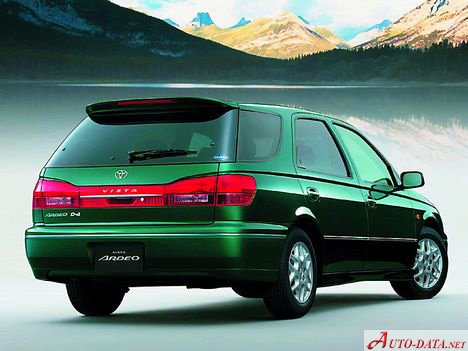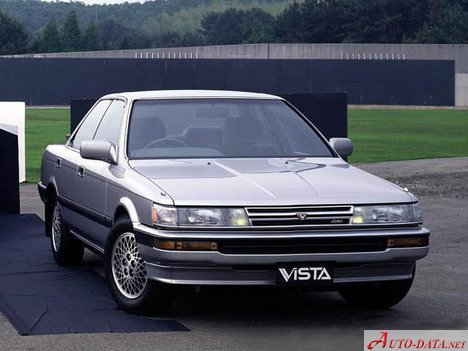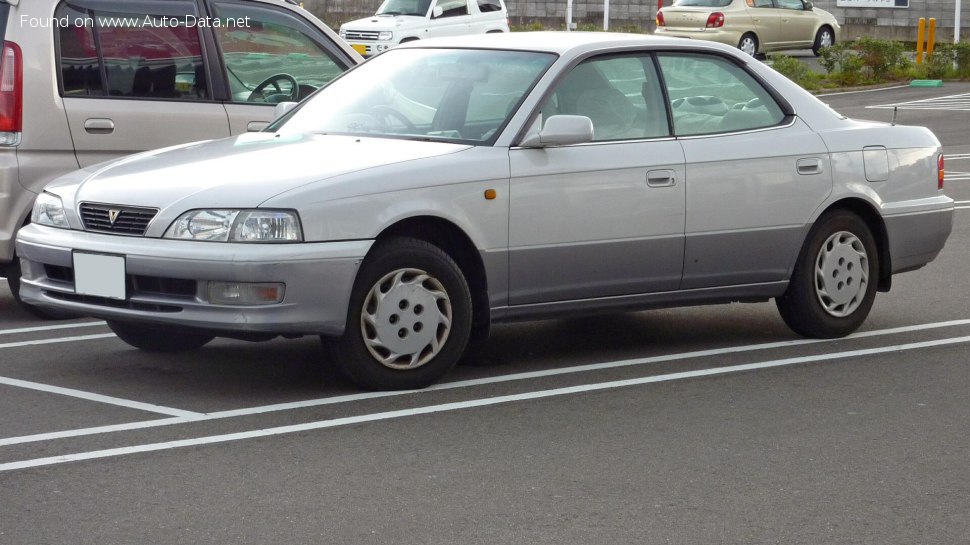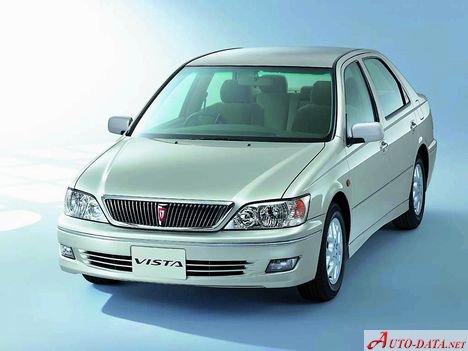
The Toyota Vista (V50), produced between 1998 and 2003, was a compact sedan primarily aimed at the Japanese domestic market (JDM). While not officially sold in the United States, the Vista occupied an important niche in Toyota’s lineup, offering a comfortable and reliable option for families and commuters. It represented a refinement of the earlier Vista models, focusing on improved interior space, enhanced safety features, and a more modern aesthetic. The V50 generation was positioned as a slightly more upscale alternative to the Corolla, offering a more spacious interior and a more refined driving experience. This article details the technical specifications and characteristics of the 1.8 i 16V variant, equipped with a 136 horsepower engine.
Toyota Vista (V50) 1.8 i 16V: An Overview
The Vista, throughout its various generations, served as a platform for Toyota to experiment with different design and engineering approaches. The V50 generation, specifically, showcased Toyota’s commitment to building practical and dependable vehicles. It competed with other Japanese sedans like the Honda Civic and Nissan Sentra, offering a blend of affordability, fuel efficiency, and reliability. The 1.8 i 16V model was a popular choice due to its balance of performance and economy, making it a suitable vehicle for everyday use.
Engine & Performance
The heart of the Toyota Vista (V50) 1.8 i 16V is a 1.8-liter (1794 cm3 or 109.48 cu. in.) inline four-cylinder engine. This naturally aspirated engine produces 136 horsepower at 6000 rpm and 171 Nm (126.12 lb.-ft.) of torque at 4200 rpm. The engine features a multi-port fuel injection system and a double overhead camshaft (DOHC) valvetrain with four valves per cylinder, contributing to its relatively efficient operation and respectable power output. Power per liter is rated at 75.8 hp/l. The engine is transversely mounted at the front of the vehicle.
Power is delivered to the front wheels via a four-speed automatic transmission. This configuration provides smooth and convenient shifting, ideal for urban driving conditions. The Vista 1.8 i 16V achieves a maximum speed of 180 km/h (111.85 mph). The weight-to-power ratio is 8.9 kg/Hp, and the weight-to-torque ratio is 7.1 kg/Nm, indicating a reasonably efficient power delivery for its class. Fuel economy is rated at 11 l/100 km (21.4 US mpg) in urban settings and 7 l/100 km (33.6 US mpg) in extra-urban driving.
Design & Features
The Toyota Vista (V50) is a four-door sedan with a conventional layout, seating five passengers. Its design is characterized by clean lines and a relatively understated aesthetic, typical of Japanese cars from the late 1990s and early 2000s. The vehicle’s dimensions are 4670 mm (183.86 in.) in length, 1695 mm (66.73 in.) in width, and 1510 mm (59.45 in.) in height, with a wheelbase of 2700 mm (106.3 in.).
Safety features for the era included an Anti-lock Braking System (ABS) as standard equipment, enhancing braking performance and stability. The braking system utilizes ventilated discs on the front wheels and drum brakes on the rear. Steering is provided by a hydraulic power steering rack and pinion system, offering responsive and precise control. The Vista rides on 185/70 R14 tires. Interior features focused on comfort and practicality, with a focus on maximizing passenger space. While not lavishly equipped, the Vista offered a comfortable and functional driving environment.
Technical Specifications
| Brand | Toyota |
| Model | Vista |
| Generation | Vista (V50) |
| Type (Engine) | 1.8 i 16V (136 Hp) |
| Start of production | 1998 year |
| End of production | 2003 year |
| Powertrain Architecture | Internal Combustion engine |
| Body type | Sedan |
| Seats | 5 |
| Doors | 4 |
| Fuel consumption (urban) | 11 l/100 km (21.4 US mpg) |
| Fuel consumption (extra urban) | 7 l/100 km (33.6 US mpg) |
| Fuel Type | Petrol (Gasoline) |
| Maximum speed | 180 km/h (111.85 mph) |
| Weight-to-power ratio | 8.9 kg/Hp |
| Weight-to-torque ratio | 7.1 kg/Nm |
| Power | 136 Hp @ 6000 rpm |
| Power per litre | 75.8 Hp/l |
| Torque | 171 Nm @ 4200 rpm (126.12 lb.-ft. @ 4200 rpm) |
| Engine layout | Front, Transverse |
| Engine displacement | 1794 cm3 (109.48 cu. in.) |
| Number of cylinders | 4 |
| Engine configuration | Inline |
| Cylinder Bore | 79 mm (3.11 in.) |
| Piston Stroke | 91.5 mm (3.6 in.) |
| Compression ratio | 10:1 |
| Number of valves per cylinder | 4 |
| Fuel injection system | Multi-port manifold injection |
| Engine aspiration | Naturally aspirated engine |
| Valvetrain | DOHC |
| Kerb Weight | 1210 kg (2667.59 lbs.) |
| Fuel tank capacity | 60 l (15.85 US gal | 13.2 UK gal) |
| Length | 4670 mm (183.86 in.) |
| Width | 1695 mm (66.73 in.) |
| Height | 1510 mm (59.45 in.) |
| Wheelbase | 2700 mm (106.3 in.) |
| Front track | 1475 mm (58.07 in.) |
| Rear track | 1460 mm (57.48 in.) |
| Drivetrain Architecture | Front wheel drive |
| Drive wheel | Front wheel drive |
| Number of gears and type of gearbox | 4 gears, automatic transmission |
| Front suspension | Spring Strut |
| Rear suspension | Coil spring |
| Front brakes | Ventilated discs |
| Rear brakes | Drum |
| Assisting systems | ABS (Anti-lock braking system) |
| Steering type | Steering rack and pinion |
| Power steering | Hydraulic Steering |
| Tires size | 185/70 R14 |
In conclusion, the Toyota Vista (V50) 1.8 i 16V was a well-rounded and dependable sedan that served a valuable role in the Japanese automotive market. While not available in the US, it represented Toyota’s commitment to providing practical, efficient, and reliable transportation for a wide range of customers. Its blend of comfort, fuel economy, and reasonable performance made it a popular choice for families and commuters alike.