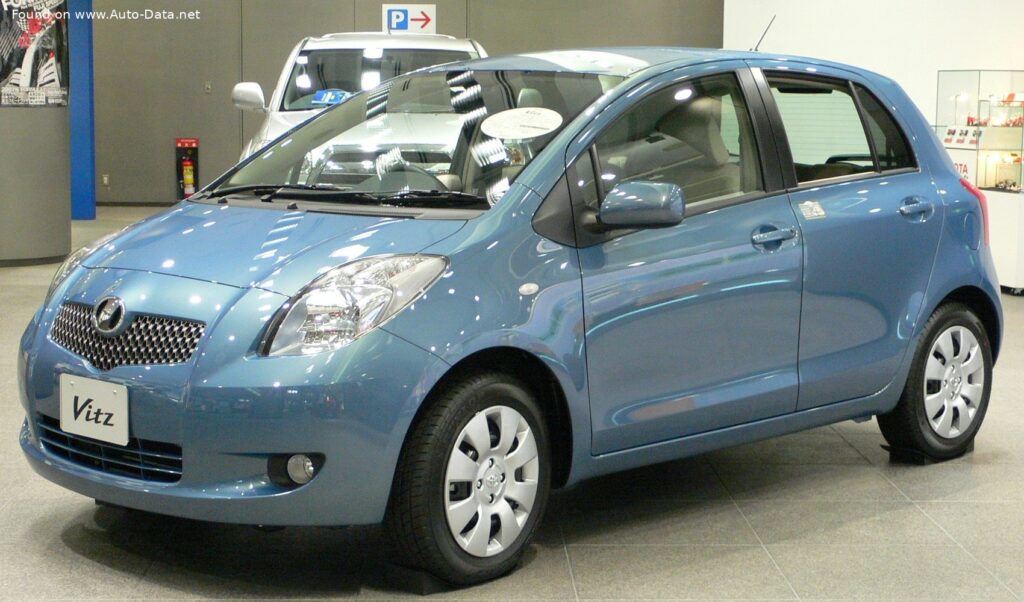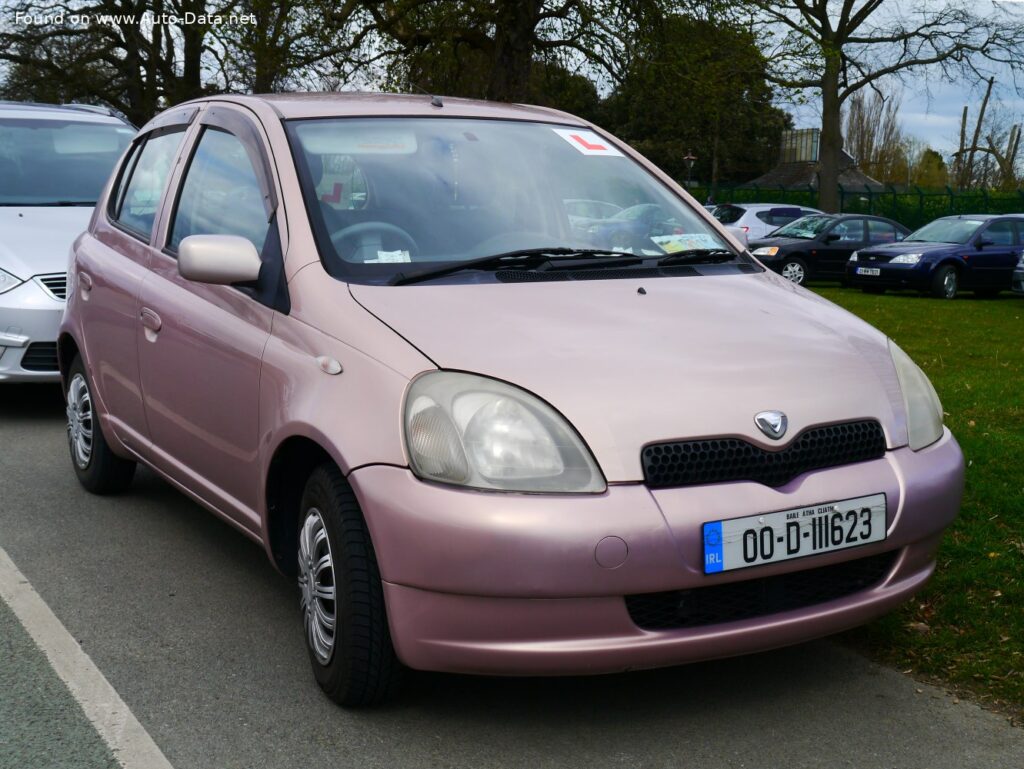
The Toyota Vitz, known as the Toyota Yaris in many global markets including the United States, represents Toyota’s entry into the subcompact hatchback segment. The first generation, produced from 1999 to 2005 (and referred to as the Vitz I), was initially designed for the Japanese domestic market (JDM) as a highly efficient and maneuverable city car. Its success in Japan led to its eventual introduction in Europe and other regions, where it gained a reputation for reliability, fuel economy, and practicality. While not originally sold as the Yaris in the US during this generation, the Vitz I laid the groundwork for the Yaris models that would later become popular in North America. This article details the technical specifications and characteristics of the 1.0i 16V Automatic variant.
Toyota Vitz I: An Overview
The Vitz I was a pivotal model for Toyota, showcasing a shift towards smaller, more fuel-efficient vehicles. Responding to increasing demand for urban mobility, the Vitz prioritized compact dimensions and ease of driving. Available in both 3-door and 5-door configurations, it aimed to maximize interior space within a minimal footprint. The 1.0i 16V Automatic model, equipped with a 997cc engine and a four-speed automatic transmission, was a popular choice for drivers seeking a convenient and economical transportation solution.
Engine & Performance
The heart of the Vitz I 1.0i 16V is a naturally aspirated, inline-four cylinder engine displacing 997 cubic centimeters (60.84 cubic inches). This engine produces 70 horsepower at 6000 rpm and 95 Newton-meters (70.07 lb.-ft.) of torque at 4000 rpm. While not a performance-oriented vehicle, the engine’s design focused on efficiency and drivability. The power-to-weight ratio of 11.6 kg/Hp (86.4 Hp/tonne) and torque-to-weight ratio of 8.5 kg/Nm (117.3 Nm/tonne) reflect its emphasis on practicality over outright speed. The engine utilizes a multi-port fuel injection system and a double overhead camshaft (DOHC) valvetrain, contributing to its relatively smooth operation and fuel efficiency. Fuel economy figures are impressive, achieving 4.6 liters per 100 kilometers (51.1 US mpg, 61.4 UK mpg, 21.7 km/l) in urban driving and 3.3 liters per 100 kilometers (71.3 US mpg, 85.6 UK mpg, 30.3 km/l) on the extra-urban cycle.
Design & Features
The Toyota Vitz I is a compact hatchback, available with either three or five doors. Its design prioritized maximizing interior space within a small exterior footprint. The vehicle’s dimensions – 3610 mm (142.13 in) in length, 1660 mm (65.35 in) in width, and 1500 mm (59.06 in) in height – make it exceptionally maneuverable in congested urban environments. The wheelbase measures 2370 mm (93.31 in).
Inside, the Vitz I offers seating for five passengers. While interior appointments were relatively basic, the focus was on functionality and durability. Safety features for the time included an Anti-lock Braking System (ABS), which was becoming increasingly common in this class of vehicle. The suspension system consists of a wishbone setup at the front and a trailing arm configuration at the rear, providing a comfortable, if not particularly sporty, ride. The steering utilizes a hydraulic power steering rack and pinion system for ease of use. The vehicle rides on 13-inch wheels fitted with 155/80 R13 S tires.
Technical Specifications
| Brand | Toyota |
| Model | Vitz |
| Generation | Vitz I |
| Type (Engine) | 1.0i 16V (70 Hp) Automatic |
| Start of production | 1999 |
| End of production | 2005 |
| Powertrain Architecture | Internal Combustion engine |
| Body type | Hatchback |
| Seats | 5 |
| Doors | 3/5 |
| Fuel consumption (urban) | 4.6 l/100 km (51.1 US mpg, 61.4 UK mpg, 21.7 km/l) |
| Fuel consumption (extra urban) | 3.3 l/100 km (71.3 US mpg, 85.6 UK mpg, 30.3 km/l) |
| Fuel Type | Petrol (Gasoline) |
| Weight-to-power ratio | 11.6 kg/Hp |
| Power | 70 Hp @ 6000 rpm |
| Power per litre | 70.2 Hp/l |
| Torque | 95 Nm @ 4000 rpm (70.07 lb.-ft. @ 4000 rpm) |
| Engine layout | Front, Transverse |
| Engine displacement | 997 cm3 (60.84 cu. in.) |
| Number of cylinders | 4 |
| Engine configuration | Inline |
| Cylinder Bore | 69 mm (2.72 in.) |
| Piston Stroke | 66.7 mm (2.63 in.) |
| Compression ratio | 10:1 |
| Number of valves per cylinder | 4 |
| Fuel injection system | Multi-port manifold injection |
| Engine aspiration | Naturally aspirated |
| Valvetrain | DOHC |
| Kerb Weight | 810 kg (1785.74 lbs.) |
| Max. weight | 1085 kg (2392.02 lbs.) |
| Max load | 275 kg (606.27 lbs.) |
| Fuel tank capacity | 40 l (10.57 US gal | 8.8 UK gal) |
| Length | 3610 mm (142.13 in.) |
| Width | 1660 mm (65.35 in.) |
| Height | 1500 mm (59.06 in.) |
| Wheelbase | 2370 mm (93.31 in.) |
| Front track | 1450 mm (57.09 in.) |
| Rear track | 1430 mm (56.3 in.) |
| Minimum turning circle | 8.6 m (28.22 ft.) |
| Drivetrain Architecture | Front wheel drive, Internal Combustion engine |
| Drive wheel | Front wheel drive |
| Number of gears | 4 |
| Gearbox type | Automatic transmission |
| Front suspension | Wishbone |
| Rear suspension | Trailing arm |
| Front brakes | Ventilated discs |
| Rear brakes | Drum |
| Assisting systems | ABS (Anti-lock braking system) |
| Steering type | Steering rack and pinion |
| Power steering | Hydraulic |
| Tires size | 155/80 R13 S |
| Wheel rims size | 13 |
The Toyota Vitz I 1.0i 16V Automatic, while a relatively simple vehicle by modern standards, represented a significant step forward in compact car design. Its focus on fuel efficiency, maneuverability, and reliability established a strong foundation for the Yaris models that would follow, and cemented Toyota’s reputation for producing high-quality, dependable vehicles.