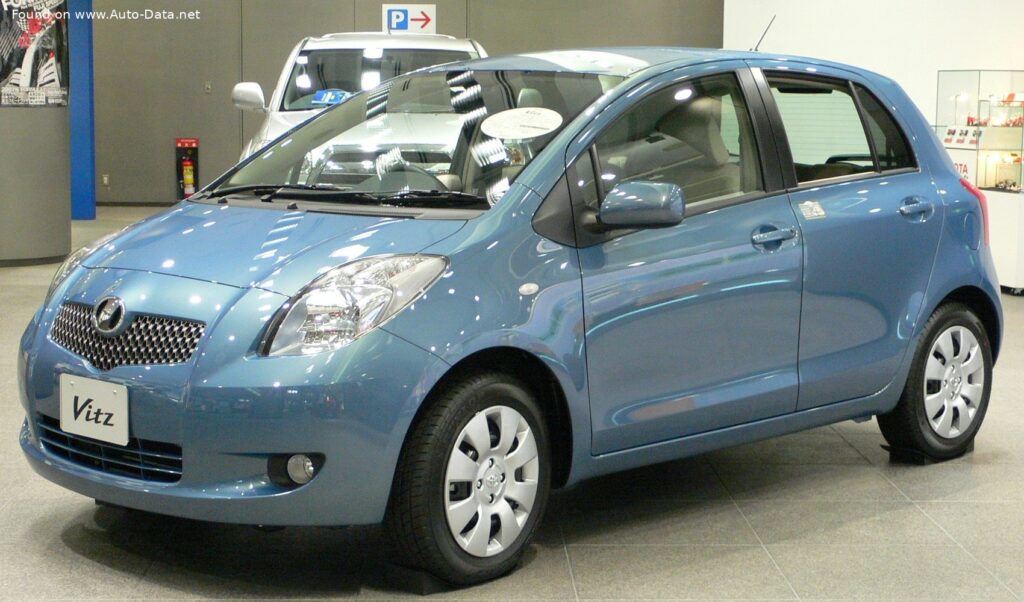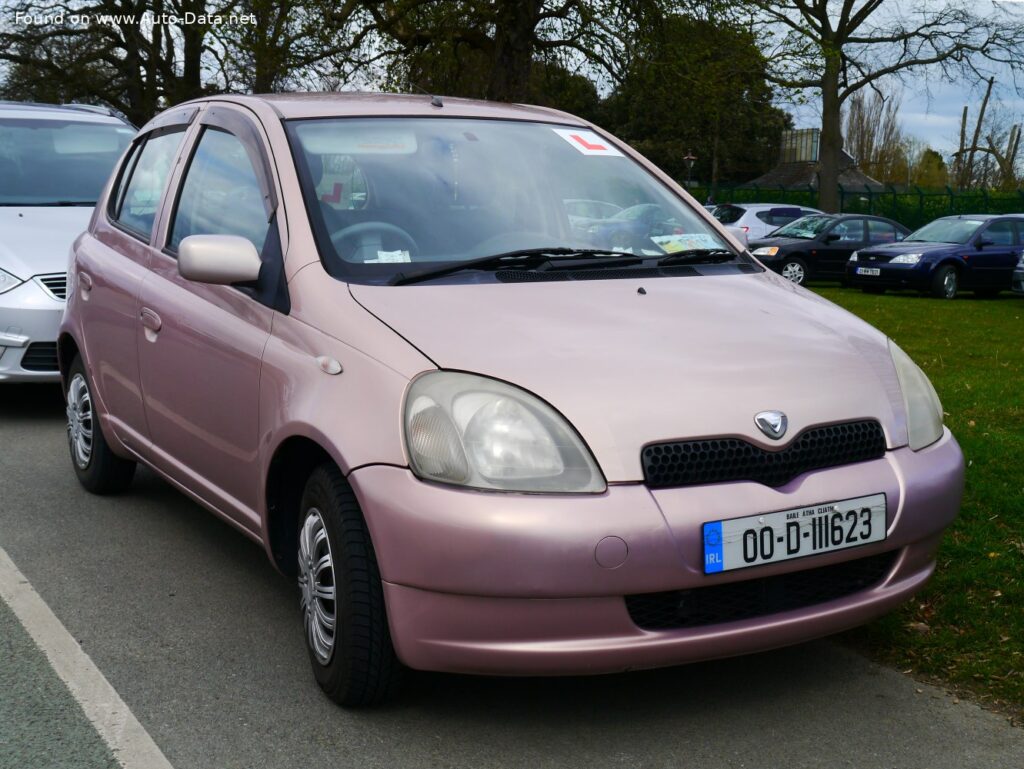
The Toyota Vitz, known as the Toyota Yaris in many global markets including the United States (starting with the second generation), is a subcompact hatchback produced by Toyota Motor Corporation. The first generation, known as the Vitz in Japan and much of Asia, was introduced in 1999 and continued in production through 2005. This initial iteration of the Vitz was a pivotal model for Toyota, representing a shift towards more contemporary styling and a focus on maximizing interior space within a small footprint. It quickly gained popularity in Japan as a practical and economical city car, and its success paved the way for the globally recognized Yaris nameplate.
Toyota Vitz I: A Pioneering Subcompact
The Vitz I was designed to appeal to a younger demographic and urban drivers seeking a nimble and fuel-efficient vehicle. Its distinctive styling, characterized by a rounded silhouette and a relatively tall cabin, set it apart from competitors. Available in both three-door and five-door configurations, the Vitz prioritized interior space and versatility. The vehicle was a key player in Toyota’s strategy to offer a diverse range of vehicles catering to different market segments and consumer needs. While not initially sold in the US market, the Vitz laid the groundwork for the Yaris’s eventual introduction and success in North America.
Engine & Performance
The Vitz I was primarily powered by a range of inline-four cylinder engines, with the 1.5-liter VVT-I 16V engine being a prominent offering. This engine, producing 109 horsepower at 6000 rpm and 143 Nm (105.47 lb-ft) of torque at 4200 rpm, provided a balance of performance and fuel economy. The engine featured Toyota’s Variable Valve Timing-intelligent (VVT-i) technology, which optimized valve timing for improved power delivery and reduced emissions. The powertrain was coupled with either a five-speed manual transmission or a four-speed automatic transmission. The automatic transmission version, as detailed here, offered convenient operation for city driving. The Vitz I’s weight-to-power ratio of 8.6 kg/Hp and weight-to-torque ratio of 6.6 kg/Nm contributed to its responsive driving characteristics. The 1.5L engine delivered 72.9 horsepower per liter, showcasing Toyota’s engineering focus on maximizing efficiency.
Design & Features
The Toyota Vitz I adopted a distinctive hatchback body style, available with either three or five doors. The design emphasized a high roofline and a relatively upright seating position, maximizing headroom and visibility. Interior space was a key design consideration, with a focus on creating a comfortable and functional cabin despite the vehicle’s small overall dimensions. The interior featured a simple, yet durable design, with a focus on practicality. Safety features for the era included an Anti-lock Braking System (ABS) as an available option, enhancing braking performance and stability. The Vitz I’s compact size made it easy to maneuver in congested urban environments, while its relatively large cargo area (for its class) provided ample space for everyday needs. The vehicle’s styling, while unconventional at the time, proved popular with consumers seeking a modern and distinctive subcompact.
Technical Specifications
| General Information | |
| Brand | Toyota |
| Model | Vitz |
| Generation | Vitz I |
| Type (Engine) | 1.5 VVT-I 16V (109 Hp) Automatic |
| Start of production | 1999 |
| End of production | 2005 |
| Powertrain Architecture | Internal Combustion engine |
| Body type | Hatchback |
| Seats | 5 |
| Doors | 3/5 |
| Performance Specs | |
| Fuel Type | Petrol (Gasoline) |
| Weight-to-power ratio | 8.6 kg/Hp |
| Weight-to-torque ratio | 6.6 kg/Nm |
| Engine Specs | |
| Power | 109 Hp @ 6000 rpm |
| Power per litre | 72.9 Hp/l |
| Torque | 143 Nm @ 4200 rpm / 105.47 lb.-ft. @ 4200 rpm |
| Engine layout | Front, Transverse |
| Engine Model/Code | 1NZ-FE |
| Engine displacement | 1496 cm3 / 91.29 cu. in. |
| Number of cylinders | 4 |
| Engine configuration | Inline |
| Cylinder Bore | 75 mm / 2.95 in. |
| Piston Stroke | 84.7 mm / 3.33 in. |
| Compression ratio | 10.5:1 |
| Number of valves per cylinder | 4 |
| Fuel injection system | Multi-port manifold injection |
| Engine aspiration | Naturally aspirated engine |
| Valvetrain | DOHC |
| Space, Volume and Weights | |
| Kerb Weight | 940 kg / 2072.35 lbs |
| Max. weight | 1245 kg / 2744.76 lbs |
| Max load | 305 kg / 672.41 lbs |
| Fuel tank capacity | 45 l / 11.89 US gal | 9.9 UK gal |
| Dimensions | |
| Length | 3630 mm / 142.91 in. |
| Width | 1660 mm / 65.35 in. |
| Height | 1485 mm / 58.46 in. |
| Wheelbase | 2370 mm / 93.31 in. |
| Front track | 1445 mm / 56.89 in. |
| Rear (Back) track | 1420 mm / 55.91 in. |
| Minimum turning circle (turning diameter) | 8.6 m / 28.22 ft. |
| Drivetrain, Brakes and Suspension Specs | |
| Drivetrain Architecture | The Internal combustion engine (ICE) drives the front wheels of the vehicle. |
| Drive wheel | Front wheel drive |
| Number of gears and type of gearbox | 4 gears, automatic transmission |
| Front suspension | Wishbone |
| Rear suspension | Trailing arm |
| Front brakes | Ventilated discs |
| Rear brakes | Disc |
| Assisting systems | ABS (Anti-lock braking system) |
| Steering type | Steering rack and pinion |
| Power steering | Hydraulic Steering |
| Tires size | 185/55 R14 S |
| Wheel rims size | 14 |
The Toyota Vitz I represented a significant step forward for Toyota in the subcompact segment. Its blend of practicality, fuel efficiency, and distinctive styling resonated with consumers, particularly in Japan and Asia. While not initially available in the US, the Vitz’s success laid the foundation for the Yaris, which would eventually become a popular choice for American buyers seeking a reliable and economical city car.