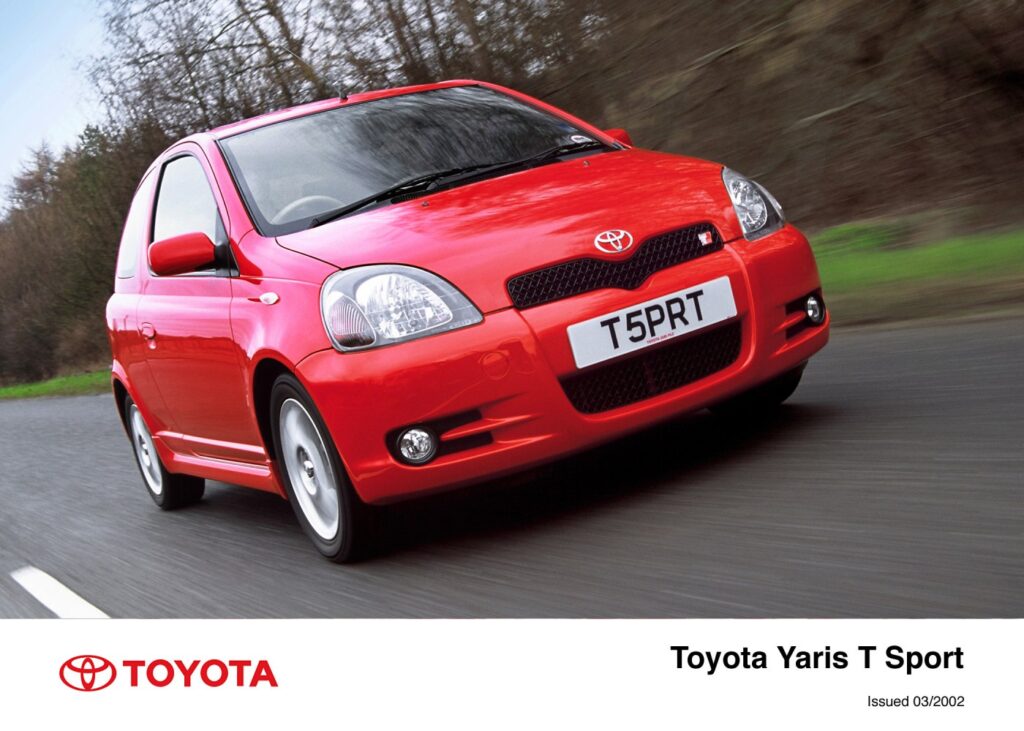
The Toyota Yaris, known in Japan as the Toyota Vitz, is a subcompact hatchback produced by Toyota since 1999. The first generation, known as the Yaris I (codenamed XP10), represented a significant departure for Toyota, aiming to provide an affordable, practical, and stylish vehicle for the increasingly popular subcompact segment. This article focuses on the 3-door version of the Yaris I, specifically the 1.5i 16V model with an automatic transmission, produced between 2001 and 2003. While not initially sold in the United States, the Yaris would eventually arrive in the US market in 2006, building upon the foundation laid by the first generation’s success in Europe and Asia.
Toyota Yaris I: A European and Asian Market Success
The Yaris I was primarily designed for the European and Asian markets, where smaller, fuel-efficient vehicles are highly valued. It replaced the Toyota Starlet and was intended to appeal to a younger demographic seeking a modern and versatile city car. The 3-door configuration, like the one detailed here, offered a sportier aesthetic and was popular with buyers prioritizing maneuverability and ease of parking in urban environments. The Yaris quickly gained recognition for its clever packaging, surprisingly spacious interior for its size, and reliable Toyota engineering.
Engine & Performance
The 1.5i 16V Yaris I is powered by the 1NZ-FE 1.5-liter inline-four cylinder gasoline engine. This naturally aspirated engine produces 106 horsepower at 6000 rpm and 145 Nm (106.95 lb-ft) of torque at 4200 rpm. The engine features a double overhead camshaft (DOHC) valvetrain and multi-port fuel injection. Paired with a four-speed automatic transmission, the Yaris I 1.5i achieves a 0-60 mph time of approximately 8.6 seconds and a top speed of 118.06 mph (190 km/h). The engine’s power-to-weight ratio is 104.4 horsepower per tonne, and its power per liter is 70.8 hp/l. Fuel economy is a strong point, with combined fuel consumption rated at 6.8 l/100 km (34.6 US mpg or 41.5 UK mpg). The transverse engine layout contributes to efficient space utilization within the compact chassis.
Design & Features
The Yaris I 3-door is a classic example of late 1990s/early 2000s hatchback design. Its compact dimensions – 3615 mm (142.32 in) in length, 1660 mm (65.35 in) in width, and 1500 mm (59.06 in) in height – make it exceptionally easy to maneuver in tight spaces. The 3-door body style provides a more youthful and dynamic appearance compared to the 5-door variant. Inside, the Yaris I prioritizes practicality. Despite its small footprint, it comfortably seats five passengers. The rear seats can be folded down to significantly increase cargo capacity, ranging from a minimum of 305 liters (10.77 cu. ft.) to a maximum of 950 liters (33.55 cu. ft.) with the seats folded. Safety features for the time included an Anti-lock Braking System (ABS). The suspension utilizes a spring strut setup at the front and a coil spring arrangement at the rear, providing a comfortable ride quality. Hydraulic power steering assists with maneuverability. The vehicle rides on 15-inch wheels with tire size 185/55 R15 H.
Technical Specifications
| Brand | Toyota |
| Model | Yaris |
| Generation | Yaris I (3-door) |
| Type (Engine) | 1.5i 16V (106 Hp) Automatic |
| Start of production | 2001 |
| End of production | 2003 |
| Powertrain Architecture | Internal Combustion engine |
| Body type | Hatchback |
| Seats | 5 |
| Doors | 3 |
| Fuel consumption (urban) | 8.8 l/100 km (26.7 US mpg, 32.1 UK mpg, 11.4 km/l) |
| Fuel consumption (extra urban) | 5.8 l/100 km (40.6 US mpg, 48.7 UK mpg, 17.2 km/l) |
| Fuel consumption (combined) | 6.8 l/100 km (34.6 US mpg, 41.5 UK mpg, 14.7 km/l) |
| Fuel Type | Petrol (Gasoline) |
| Acceleration 0 – 100 km/h | 9 sec |
| Acceleration 0 – 62 mph | 9 sec |
| Acceleration 0 – 60 mph | 8.6 sec |
| Maximum speed | 190 km/h (118.06 mph) |
| Weight-to-power ratio | 9.6 kg/Hp |
| Weight-to-torque ratio | 7 kg/Nm |
| Power | 106 Hp @ 6000 rpm |
| Torque | 145 Nm @ 4200 rpm (106.95 lb.-ft. @ 4200 rpm) |
| Engine layout | Front, Transverse |
| Engine Model/Code | 1NZ-FE |
| Engine displacement | 1497 cm3 (91.35 cu. in.) |
| Number of cylinders | 4 |
| Engine configuration | Inline |
| Cylinder Bore | 75 mm (2.95 in.) |
| Piston Stroke | 84.7 mm (3.33 in.) |
| Compression ratio | 10.5:1 |
| Number of valves per cylinder | 4 |
| Fuel injection system | Multi-port manifold injection |
| Engine aspiration | Naturally aspirated engine |
| Valvetrain | DOHC |
| Engine oil capacity | 3.7 l (3.91 US qt | 3.26 UK qt) |
| Coolant capacity | 4.4 l (4.65 US qt | 3.87 UK qt) |
| Kerb Weight | 1015 kg (2237.69 lbs.) |
| Max. weight | 1390 kg (3064.43 lbs.) |
| Max load | 375 kg (826.73 lbs.) |
| Trunk (boot) space – minimum | 305 l (10.77 cu. ft.) |
| Trunk (boot) space – maximum | 950 l (33.55 cu. ft.) |
| Fuel tank capacity | 45 l (11.89 US gal | 9.9 UK gal) |
| Length | 3615 mm (142.32 in.) |
| Width | 1660 mm (65.35 in.) |
| Height | 1500 mm (59.06 in.) |
| Wheelbase | 2370 mm (93.31 in.) |
| Front track | 1450 mm (57.09 in.) |
| Rear track | 1430 mm (56.3 in.) |
| Drivetrain Architecture | Front wheel drive |
| Number of gears | 4 |
| Gearbox type | Automatic transmission |
| Front suspension | Spring Strut |
| Rear suspension | Coil spring |
| Front brakes | Ventilated discs |
| Rear brakes | Drum |
| Assisting systems | ABS (Anti-lock braking system) |
| Steering type | Steering rack and pinion |
| Power steering | Hydraulic Steering |
| Tires size | 185/55 R15 H |
| Wheel rims size | 15 |
The Toyota Yaris I 1.5i 16V Automatic, while not initially available in the US market, laid the groundwork for the Yaris’s eventual success in North America. Its blend of affordability, fuel efficiency, practicality, and reliability made it a popular choice for buyers in Europe and Asia, establishing the Yaris as a key player in the subcompact hatchback segment.