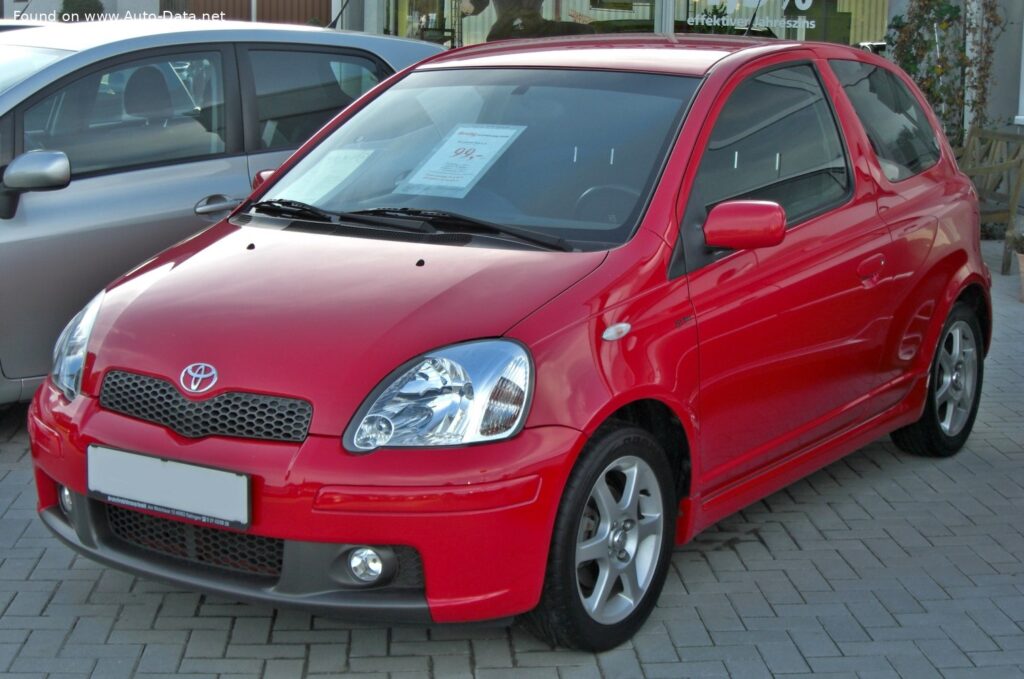
The Toyota Yaris, known in Japan as the Vitz, is a subcompact hatchback produced by Toyota since 1999. The first generation, known as the Yaris I, was a significant departure for Toyota, representing a move towards more contemporary and youthful styling. The facelifted version introduced in 2003 brought refinements to the original design, enhancing both aesthetics and functionality. This iteration of the Yaris, particularly the 3-door 1.0 VVT-i model with its 65 horsepower engine, was primarily aimed at the European market, where the demand for small, fuel-efficient vehicles was high. It quickly gained popularity as an affordable and practical city car.
Toyota Yaris I (Facelift 2003) 1.0 VVT-i: An Overview
The 2003 facelift of the Yaris I represented a key update to Toyota’s entry-level hatchback. Designed to appeal to a younger demographic, the Yaris offered a blend of practicality, fuel efficiency, and a relatively modern design. The 3-door configuration further emphasized its sporty intentions, while the 1.0-liter VVT-i engine provided adequate power for urban driving. The Yaris competed with other subcompact hatchbacks like the Volkswagen Polo, Ford Fiesta, and Renault Clio, offering a compelling alternative with Toyota’s reputation for reliability.
Engine & Performance
The heart of the Yaris I (facelift 2003) 1.0 VVT-i is the 1SZ-FE inline-four cylinder engine, displacing 998 cubic centimeters (60.9 cubic inches). This naturally aspirated engine produces 65 horsepower at 6000 rpm and 90 Newton-meters (66.38 lb.-ft.) of torque at 4100 rpm. While not a performance powerhouse, the engine is characterized by its responsiveness and fuel efficiency. The engine utilizes a multi-port fuel injection system and Toyota’s Variable Valve Timing-intelligent (VVT-i) technology to optimize performance and reduce emissions. Power is delivered to the front wheels via a five-speed manual transmission. Acceleration from 0 to 100 km/h (0-62 mph) takes 13.6 seconds, and the car reaches a maximum speed of 155 km/h (96.31 mph). The weight-to-power ratio of 13.5 kg/Hp contributes to its nimble handling.
Design & Features
The Yaris I (facelift 2003) 3-door is a classic example of late 1990s/early 2000s hatchback design. Its compact dimensions – 3640 mm (143.31 in) in length, 1660 mm (65.35 in) in width, and 1500 mm (59.06 in) in height – make it ideally suited for navigating crowded city streets. The 3-door configuration provides a slightly more sporty aesthetic compared to the 5-door model. Inside, the Yaris offers seating for five passengers, although rear passenger space is somewhat limited. The interior is functional and designed with practicality in mind. Safety features for the time included an Anti-lock Braking System (ABS). The rear seats fold down to expand the trunk space from a minimum of 205 liters (7.24 cu. ft.) to a maximum of 950 liters (33.55 cu. ft.). The drag coefficient of 0.30 contributes to its fuel efficiency.
Technical Specifications
| Brand | Toyota |
| Model | Yaris |
| Generation | Yaris I (facelift 2003) 3-door |
| Type (Engine) | 1.0 VVT-i (65 Hp) |
| Start of production | 2003 |
| End of production | 2005 |
| Powertrain Architecture | Internal Combustion engine |
| Body type | Hatchback |
| Seats | 5 |
| Doors | 3 |
| Fuel consumption (urban) | 6.8 l/100 km (34.6 US mpg, 41.5 UK mpg, 14.7 km/l) |
| Fuel consumption (extra urban) | 4.9 l/100 km (48 US mpg, 57.6 UK mpg, 20.4 km/l) |
| Fuel consumption (combined) | 5.6 l/100 km (42 US mpg, 50.4 UK mpg, 17.9 km/l) |
| CO2 emissions | 134 g/km |
| Fuel Type | Petrol (Gasoline) |
| Acceleration 0 – 100 km/h | 13.6 sec |
| Acceleration 0 – 62 mph | 13.6 sec |
| Acceleration 0 – 60 mph | 12.9 sec |
| Maximum speed | 155 km/h (96.31 mph) |
| Emission standard | Euro 4 |
| Weight-to-power ratio | 13.5 kg/Hp |
| Weight-to-torque ratio | 9.8 kg/Nm |
| Power | 65 Hp @ 6000 rpm |
| Torque | 90 Nm @ 4100 rpm (66.38 lb.-ft. @ 4100 rpm) |
| Engine layout | Front, Transverse |
| Engine Model/Code | 1SZ-FE |
| Engine displacement | 998 cm3 (60.9 cu. in.) |
| Number of cylinders | 4 |
| Engine configuration | Inline |
| Cylinder Bore | 69 mm (2.72 in.) |
| Piston Stroke | 66.7 mm (2.63 in.) |
| Compression ratio | 10:1 |
| Number of valves per cylinder | 4 |
| Fuel injection system | Multi-port manifold injection |
| Engine aspiration | Naturally aspirated engine |
| Valvetrain | DOHC, VVT-i |
| Engine oil capacity | 3.2 l (3.38 US qt | 2.82 UK qt) |
| Coolant | 4.7 l (4.97 US qt | 4.14 UK qt) |
| Kerb Weight | 880-970 kg (1940.07 – 2138.48 lbs.) |
| Max. weight | 1370 kg (3020.33 lbs.) |
| Max load | 400-490 kg (881.85 – 1080.27 lbs.) |
| Trunk (boot) space – minimum | 205 l (7.24 cu. ft.) |
| Trunk (boot) space – maximum | 950 l (33.55 cu. ft.) |
| Fuel tank capacity | 45 l (11.89 US gal | 9.9 UK gal) |
| Permitted trailer load with brakes (12%) | 650 kg (1433 lbs.) |
| Permitted trailer load without brakes | 400 kg (881.85 lbs.) |
| Length | 3640 mm (143.31 in.) |
| Width | 1660 mm (65.35 in.) |
| Height | 1500 mm (59.06 in.) |
| Wheelbase | 2370 mm (93.31 in.) |
| Front track | 1440 mm (56.69 in.) |
| Rear (Back) track | 1420 mm (55.91 in.) |
| Drag coefficient (Cd) | 0.30 |
| Minimum turning circle (turning diameter) | 10.4 m (34.12 ft.) |
| Drivetrain Architecture | Front wheel drive |
| Number of gears and type of gearbox | 5 gears, manual transmission |
| Front suspension | Independent, type McPherson with coil spring and anti-roll bar |
| Rear suspension | Trailing arm, Coil spring, Torsion |
| Front brakes | Ventilated discs, 235 mm |
| Rear brakes | Drum |
| Assisting systems | ABS (Anti-lock braking system) |
| Steering type | Steering rack and pinion |
| Power steering | Electric Steering |
| Tires size | 175/65 R14 |
| Wheel rims size | 5.5J x 14 |
The Toyota Yaris I (facelift 2003) 1.0 VVT-i remains a popular choice for those seeking an economical and reliable city car. Its compact size, fuel efficiency, and Toyota’s renowned build quality have ensured its enduring appeal, particularly in European markets where it established a strong foothold as a practical and affordable transportation solution.