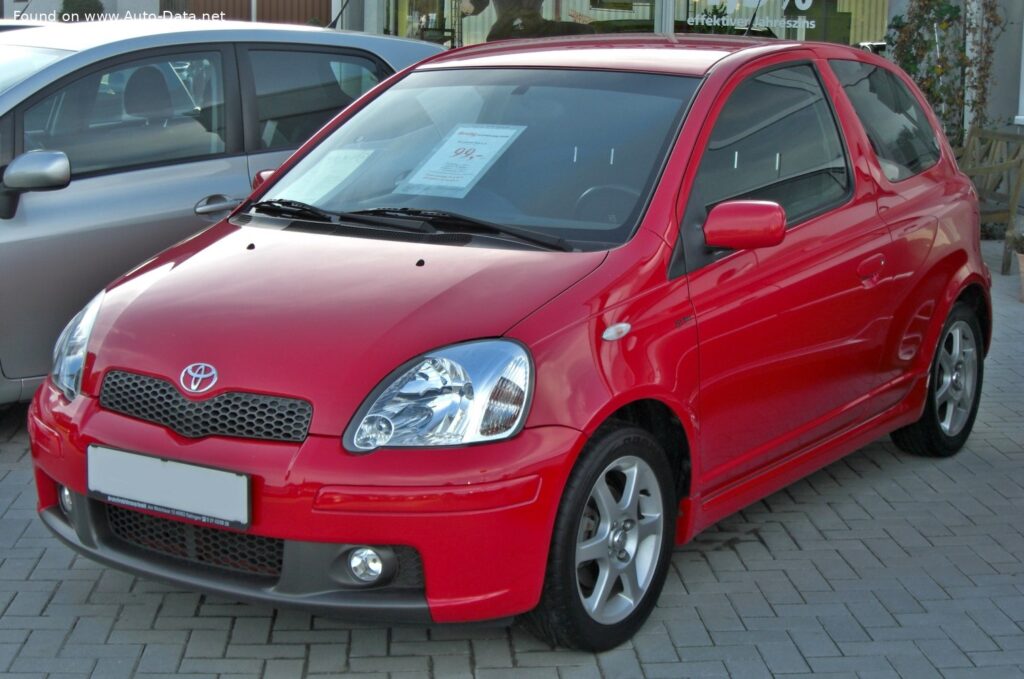
The Toyota Yaris first generation, known as the Yaris I, was produced from 1999 to 2005. The model underwent a significant facelift in 2003, updating its styling and refining its mechanical components. This 3-door hatchback, equipped with a 1.0-liter VVT-i engine producing 65 horsepower, was primarily marketed in Europe and Japan as an affordable and fuel-efficient city car. While not officially sold in the United States during this generation, the Yaris represented Toyota’s entry into the subcompact segment, competing with vehicles like the Fiat Punto and Renault Clio. The facelifted version, detailed here, aimed to enhance the original’s appeal with improved aesthetics and minor mechanical adjustments.
Toyota Yaris I (Facelift 2003) 1.0 VVT-i: Overview
The 2003 facelift of the Toyota Yaris I brought subtle but noticeable changes to the exterior, including revised headlights, a new front grille, and updated bumpers. These alterations gave the car a more modern appearance. The 1.0 VVT-i engine remained the mainstay of the range, offering a balance of economy and usability for urban driving. The “Multi-Mode” transmission option, a type of automated manual gearbox, provided a degree of convenience without the fuel economy penalty of a traditional automatic. This version of the Yaris was designed to appeal to buyers seeking a practical, reliable, and economical vehicle for daily commuting and city use.
Engine & Performance
The Toyota Yaris I (facelift 2003) 1.0 VVT-i is powered by the 1SZ-FE inline-four cylinder engine, displacing 998 cubic centimeters (60.9 cubic inches). This naturally aspirated engine produces 65 horsepower at 6000 rpm and 90 Newton-meters (66.38 lb.-ft.) of torque at 4100 rpm. The engine features Toyota’s Variable Valve Timing-intelligent (VVT-i) system, which optimizes valve timing for improved performance and fuel efficiency. Power is delivered to the front wheels via a 5-speed Multi-Mode transmission, an early form of automated manual transmission. Acceleration from 0 to 100 km/h (0-62 mph) takes 13.6 seconds, while 0 to 60 mph is achieved in 12.9 seconds. The vehicle has a maximum speed of 155 km/h (96.31 mph). The engine’s compact size and lightweight construction contribute to the Yaris’s overall fuel efficiency.
Design & Features
The Yaris I (facelift 2003) is a 3-door hatchback, offering seating for five passengers. Its compact dimensions – 3640 mm (143.31 in) in length, 1660 mm (65.35 in) in width, and 1500 mm (59.06 in) in height – make it well-suited for navigating congested urban environments. The 3-door configuration prioritizes a sporty aesthetic and ease of parking. The interior is designed with practicality in mind, offering a reasonable amount of space for passengers and cargo. Trunk space ranges from 205 liters (7.24 cu. ft.) with the rear seats up to 950 liters (33.55 cu. ft.) with the rear seats folded down. Safety features for this era included an Anti-lock Braking System (ABS) as standard equipment. The drag coefficient of 0.30 contributes to its aerodynamic efficiency. The vehicle’s kerb weight ranges from 880 to 965 kg (1940.07 to 2127.46 lbs.), further enhancing its fuel economy and agility.
Technical Specifications
| Brand | Toyota |
| Model | Yaris |
| Generation | Yaris I (facelift 2003) |
| Type (Engine) | 1.0 VVT-i (65 Hp) Multi-Mode |
| Start of production | 2003 |
| End of production | 2005 |
| Powertrain Architecture | Internal Combustion engine |
| Body type | Hatchback |
| Seats | 5 |
| Doors | 3 |
| Fuel consumption (urban) | 6.4 l/100 km (36.8 US mpg, 44.1 UK mpg, 15.6 km/l) |
| Fuel consumption (extra urban) | 4.9 l/100 km (48 US mpg, 57.6 UK mpg, 20.4 km/l) |
| Fuel consumption (combined) | 5.4 l/100 km (43.6 US mpg, 52.3 UK mpg, 18.5 km/l) |
| CO2 emissions | 129 g/km |
| Fuel Type | Petrol (Gasoline) |
| Acceleration 0 – 100 km/h | 13.6 sec |
| Acceleration 0 – 62 mph | 13.6 sec |
| Acceleration 0 – 60 mph | 12.9 sec |
| Maximum speed | 155 km/h (96.31 mph) |
| Emission standard | Euro 4 |
| Weight-to-power ratio | 13.5 kg/Hp |
| Weight-to-torque ratio | 9.8 kg/Nm |
| Power | 65 Hp @ 6000 rpm |
| Torque | 90 Nm @ 4100 rpm (66.38 lb.-ft. @ 4100 rpm) |
| Engine layout | Front, Transverse |
| Engine Model/Code | 1SZ-FE |
| Engine displacement | 998 cm3 (60.9 cu. in.) |
| Number of cylinders | 4 |
| Engine configuration | Inline |
| Cylinder Bore | 69 mm (2.72 in.) |
| Piston Stroke | 66.7 mm (2.63 in.) |
| Compression ratio | 10:1 |
| Number of valves per cylinder | 4 |
| Fuel injection system | Multi-port manifold injection |
| Engine aspiration | Naturally aspirated |
| Engine oil capacity | 3.2 l (3.38 US qt | 2.82 UK qt) |
| Coolant capacity | 4.7 l (4.97 US qt | 4.14 UK qt) |
| Kerb Weight | 880-965 kg (1940.07 – 2127.46 lbs.) |
| Max. weight | 1370 kg (3020.33 lbs.) |
| Max load | 405-490 kg (892.87 – 1080.27 lbs.) |
| Trunk (boot) space – minimum | 205 l (7.24 cu. ft.) |
| Trunk (boot) space – maximum | 950 l (33.55 cu. ft.) |
| Fuel tank capacity | 45 l (11.89 US gal | 9.9 UK gal) |
| Permitted trailer load with brakes (12%) | 650 kg (1433 lbs.) |
| Permitted trailer load without brakes | 400 kg (881.85 lbs.) |
| Length | 3640 mm (143.31 in.) |
| Width | 1660 mm (65.35 in.) |
| Height | 1500 mm (59.06 in.) |
| Wheelbase | 2370 mm (93.31 in.) |
| Front track | 1440 mm (56.69 in.) |
| Rear track | 1420 mm (55.91 in.) |
| Drag coefficient (Cd) | 0.30 |
| Minimum turning circle | 10.4 m (34.12 ft.) |
| Drive wheel | Front wheel drive |
| Number of gears | 5 gears, automatic transmission Multi-Mode |
| Front suspension | Independent, type McPherson with coil spring and anti-roll bar |
| Rear suspension | Trailing arm, Coil spring, Torsion |
| Front brakes | Ventilated discs, 235 mm |
| Rear brakes | Drum |
| Steering type | Steering rack and pinion |
| Power steering | Electric |
| Tires size | 175/65 R14 |
| Wheel rims size | 5.5J x 14 |
The Toyota Yaris I (facelift 2003) 1.0 VVT-i Multi-Mode remains a popular choice for those seeking an economical and reliable city car, particularly in Europe and Japan. Its compact size, fuel efficiency, and ease of maintenance contribute to its enduring appeal.