The Toyota Yaris, known in Japan as the Toyota Vitz, is a subcompact hatchback produced by Toyota since 1999. The first generation, known as the Yaris I, was a significant departure for Toyota, representing a move towards more contemporary styling and a focus on maximizing interior space within a small footprint. Introduced in Europe and other markets outside of Japan in 2000, the Yaris quickly gained popularity for its practicality, fuel efficiency, and surprisingly agile handling. The 2003 facelift brought subtle styling revisions and refinements to the engine lineup, including the sporty TS 1.5 VVT-i model detailed here. This version was not officially sold in the United States, but the Yaris would eventually arrive in the US market in 2006 as a rebadged version of the second-generation Vitz.
Toyota Yaris I (Facelift 2003) TS 1.5 VVT-i: An Overview
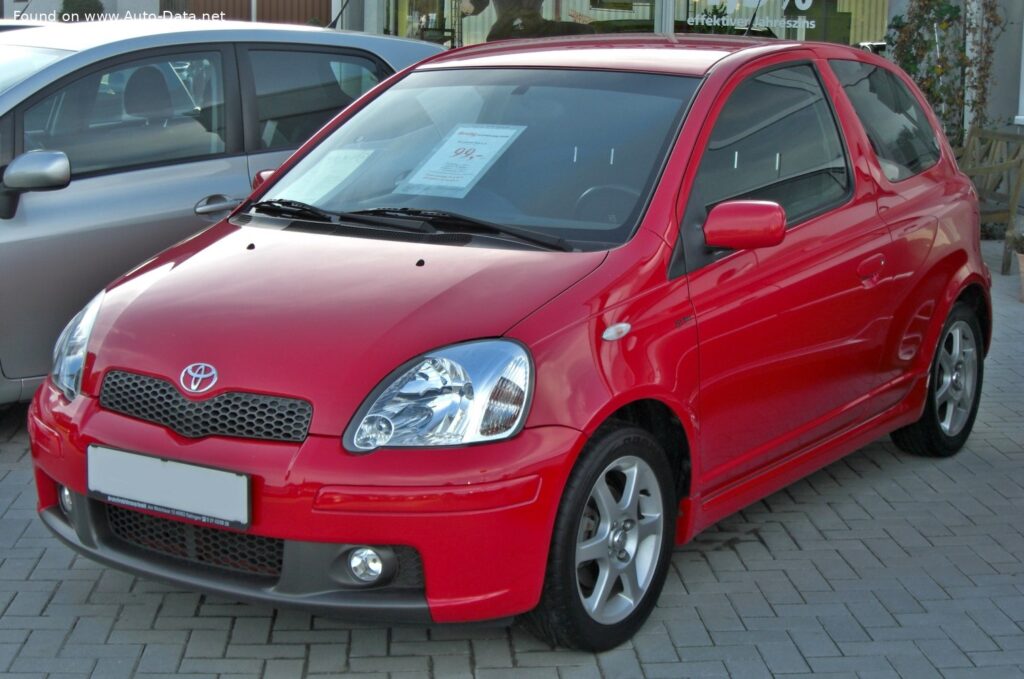
The Yaris I (facelift 2003) 3-door TS 1.5 VVT-i represents the performance-oriented variant of the first-generation Yaris sold primarily in Europe and other international markets. The “TS” designation signified a sportier trim level, featuring a more powerful engine, subtle styling enhancements, and a focus on driver engagement. Positioned within the subcompact segment, the Yaris competed with vehicles like the Renault Clio, Peugeot 206, and Volkswagen Polo, offering a compelling blend of affordability, efficiency, and practicality. The facelift in 2003 brought minor cosmetic changes to the front and rear fascias, along with interior updates, enhancing the car’s overall appeal.
Engine & Performance
The heart of the Yaris TS 1.5 VVT-i is the 1.5-liter 1NZ-FE inline four-cylinder engine. This naturally aspirated powerplant produces 105 horsepower at 6000 rpm and 143 Nm (105.47 lb.-ft.) of torque at 4200 rpm. The Variable Valve Timing-intelligent (VVT-i) system optimizes valve timing for improved performance and fuel efficiency across the engine’s operating range. Power is delivered to the front wheels via a five-speed manual transmission. The Yaris TS achieves a 0-100 km/h (0-62 mph) acceleration time of 9 seconds, and a 0-60 mph time of 8.6 seconds, with a maximum speed of 190 km/h (118.06 mph). Fuel economy is a strong point, with combined cycle consumption rated at 6.8 l/100 km (34.6 US mpg), making it an economical choice for daily commuting. The engine’s power-to-weight ratio of 9 kg/Hp contributes to its responsive feel.
Design & Features
The Yaris I (facelift 2003) is a three-door hatchback, offering a practical and space-efficient design. The 3-door configuration prioritized a slightly sportier aesthetic compared to the five-door model. The car’s compact dimensions – 3660 mm (144.09 in) in length, 1660 mm (65.35 in) in width, and 1485 mm (58.46 in) in height – make it easy to maneuver in urban environments. Inside, the Yaris offers seating for five passengers, although rear passenger space is somewhat limited. The trunk provides 205 liters (7.24 cu. ft.) of cargo space with the rear seats up, expanding to 950 liters (33.55 cu. ft.) when folded down. Safety features for the time included ABS (Anti-lock Braking System). The drag coefficient of 0.32 contributes to its fuel efficiency. The TS trim level typically included features like alloy wheels, sport seats, and upgraded interior trim compared to the base models.
Technical Specifications
| Brand | Toyota |
| Model | Yaris |
| Generation | Yaris I (facelift 2003) |
| Type (Engine) | TS 1.5 VVT-i (105 Hp) |
| Start of production | 2003 |
| End of production | 2005 |
| Powertrain Architecture | Internal Combustion engine |
| Body type | Hatchback |
| Seats | 5 |
| Doors | 3 |
| Fuel consumption (urban) | 8.7 l/100 km (27 US mpg) |
| Fuel consumption (extra urban) | 5.7 l/100 km (41.3 US mpg) |
| Fuel consumption (combined) | 6.8 l/100 km (34.6 US mpg) |
| CO2 emissions | 162 g/km |
| Fuel Type | Petrol (Gasoline) |
| Acceleration 0 – 100 km/h | 9 sec |
| Acceleration 0 – 62 mph | 9 sec |
| Acceleration 0 – 60 mph | 8.6 sec |
| Maximum speed | 190 km/h (118.06 mph) |
| Emission standard | Euro 4 |
| Weight-to-power ratio | 9 kg/Hp |
| Weight-to-torque ratio | 6.6 kg/Nm |
| Power | 105 Hp @ 6000 rpm |
| Torque | 143 Nm @ 4200 rpm (105.47 lb.-ft. @ 4200 rpm) |
| Engine layout | Front, Transverse |
| Engine Model/Code | 1NZ-FE |
| Engine displacement | 1497 cm3 (91.35 cu. in.) |
| Number of cylinders | 4 |
| Engine configuration | Inline |
| Cylinder Bore | 75 mm (2.95 in.) |
| Piston Stroke | 84.7 mm (3.33 in.) |
| Compression ratio | 10.5:1 |
| Number of valves per cylinder | 4 |
| Fuel injection system | Multi-port manifold injection |
| Engine aspiration | Naturally aspirated |
| Valvetrain | DOHC, VVT-i |
| Engine oil capacity | 3.7 l (3.91 US qt | 3.26 UK qt) |
| Coolant capacity | 4.7 l (4.97 US qt | 4.14 UK qt) |
| Kerb Weight | 950-995 kg (2094.39 – 2193.6 lbs.) |
| Max. weight | 1410 kg (3108.52 lbs.) |
| Max load | 415-460 kg (914.92 – 1014.13 lbs.) |
| Trunk (boot) space – minimum | 205 l (7.24 cu. ft.) |
| Trunk (boot) space – maximum | 950 l (33.55 cu. ft.) |
| Fuel tank capacity | 45 l (11.89 US gal | 9.9 UK gal) |
| Permitted trailer load with brakes (12%) | 900 kg (1984.16 lbs.) |
| Permitted trailer load without brakes | 400 kg (881.85 lbs.) |
| Length | 3660 mm (144.09 in.) |
| Width | 1660 mm (65.35 in.) |
| Height | 1485 mm (58.46 in.) |
| Wheelbase | 2370 mm (93.31 in.) |
| Front track | 1445 mm (56.89 in.) |
| Rear track | 1420 mm (55.91 in.) |
| Drag coefficient (Cd) | 0.32 |
| Minimum turning circle | 10.4 m (34.12 ft.) |
| Drivetrain | Front wheel drive |
| Number of gears | 5 |
| Gearbox type | Manual transmission |
| Front suspension | Independent, McPherson with coil spring and anti-roll bar |
| Rear suspension | Trailing arm, Coil spring, Torsion |
| Front brakes | Ventilated discs, 255 mm |
| Rear brakes | Disc, 269 mm |
| Assisting systems | ABS (Anti-lock braking system) |
| Steering type | Steering rack and pinion |
| Power steering | Hydraulic |
| Tires size | 185/55 R15 |
| Wheel rims size | 5.5J x 15 |
The Toyota Yaris I (facelift 2003) TS 1.5 VVT-i remains a popular choice for those seeking an affordable, reliable, and fuel-efficient subcompact hatchback. Its blend of practicality, nimble handling, and relatively low running costs continue to make it a compelling option in the used car market.