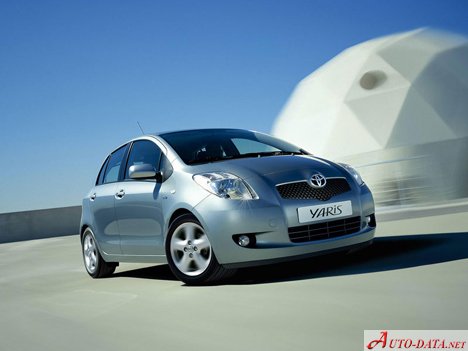
The Toyota Yaris II 1.0 i VVT-i (69 Hp), produced between 2005 and 2011, represents the second generation of Toyota’s globally successful supermini. While not initially a major seller in the United States – the Yaris didn’t gain significant traction in the US market until later iterations – the Yaris II was a crucial model for Toyota in Europe and other international markets. It offered an affordable, fuel-efficient, and practical option in the highly competitive small car segment. This generation built upon the success of the first Yaris, focusing on improved refinement, safety, and interior space. The 1.0 i VVT-i variant, equipped with a 998cc three-cylinder engine, was a popular choice for urban drivers prioritizing economy.
Toyota Yaris II: A Detailed Overview
The Yaris II, known as the XP90 chassis code, was designed to appeal to a broad customer base. Available in both three-door and five-door body styles, it aimed to maximize interior space within a compact footprint. Toyota emphasized versatility, making the Yaris a practical choice for small families and city dwellers. The vehicle’s design incorporated a relatively high roofline, contributing to a surprisingly spacious cabin for its class. The 1.0 i VVT-i model specifically targeted buyers seeking the lowest running costs and a nimble driving experience.
Engine & Performance
The heart of the Yaris II 1.0 i VVT-i is the 1KR-FE engine, a 998cc inline three-cylinder petrol (gasoline) engine. This engine produces 69 horsepower at 6000 rpm and 93 Nm (68.59 lb.-ft.) of torque at 3800 rpm. While not a performance powerhouse, the 1KR-FE is known for its reliability and fuel efficiency. The engine utilizes Toyota’s Variable Valve Timing-intelligent (VVT-i) technology, which optimizes valve timing for improved power delivery and reduced emissions. The engine’s small displacement and lightweight construction contribute to the Yaris’s overall efficiency. Acceleration from 0 to 100 km/h (0-62 mph) takes approximately 15.7 seconds, and it reaches a maximum speed of 155 km/h (96.31 mph). The power-to-weight ratio is 14.2 kg/Hp, and the torque-to-weight ratio is 10.5 kg/Nm. Power per liter is a respectable 69.1 Hp/l. The engine is transversely mounted at the front of the vehicle, driving the front wheels through a five-speed manual transmission.
Design & Features
The Yaris II is a front-wheel-drive hatchback available in both three-door and five-door configurations. Its design is characterized by a relatively tall and upright body, maximizing interior space. The exterior styling is functional rather than overtly sporty, reflecting the car’s focus on practicality. Inside, the Yaris II offers a surprisingly spacious cabin for a supermini. The rear seats can be folded down to increase cargo capacity, providing flexibility for carrying larger items. Safety features, while basic by modern standards, included an Anti-lock Braking System (ABS) as standard equipment. The interior materials are durable and designed for everyday use. The dashboard layout is straightforward and user-friendly. The trunk (boot) space ranges from 272 liters (9.61 cu. ft.) with the rear seats up to 1086 liters (38.35 cu. ft.) with them folded down. The Yaris II’s compact dimensions – a length of 3750 mm (147.64 in.), a width of 1695 mm (66.73 in.), and a height of 1530 mm (60.24 in.) – make it easy to maneuver in urban environments.
Technical Specifications
| Brand | Toyota |
| Model | Yaris |
| Generation | Yaris II |
| Type (Engine) | 1.0 i VVT-i (69 Hp) |
| Start of production | 2005 |
| End of production | 2011 |
| Powertrain Architecture | Internal Combustion engine |
| Body type | Hatchback |
| Seats | 5 |
| Doors | 3/5 |
| Fuel consumption (urban) | 6.4 l/100 km (36.8 US mpg, 44.1 UK mpg, 15.6 km/l) |
| Fuel consumption (extra urban) | 4.9 l/100 km (48 US mpg, 57.6 UK mpg, 20.4 km/l) |
| Fuel consumption (combined) | 5.4 l/100 km (43.6 US mpg, 52.3 UK mpg, 18.5 km/l) |
| Fuel Type | Petrol (Gasoline) |
| Acceleration 0 – 100 km/h | 15.7 sec |
| Acceleration 0 – 62 mph | 15.7 sec |
| Acceleration 0 – 60 mph | 14.9 sec |
| Maximum speed | 155 km/h (96.31 mph) |
| Weight-to-power ratio | 14.2 kg/Hp |
| Weight-to-torque ratio | 10.5 kg/Nm |
| Power | 69 Hp @ 6000 rpm |
| Torque | 93 Nm @ 3800 rpm (68.59 lb.-ft. @ 3800 rpm) |
| Engine layout | Front, Transverse |
| Engine Model/Code | 1KR-FE |
| Engine displacement | 998 cm3 (60.9 cu. in.) |
| Number of cylinders | 3 |
| Engine configuration | Inline |
| Cylinder Bore | 71 mm (2.8 in.) |
| Piston Stroke | 84 mm (3.31 in.) |
| Compression ratio | 10.5:1 |
| Number of valves per cylinder | 4 |
| Fuel injection system | Multi-port manifold injection |
| Engine aspiration | Naturally aspirated |
| Valvetrain | DOHC |
| Engine oil capacity | 3.1 l (3.28 US qt | 2.73 UK qt) |
| Coolant capacity | 4.5 l (4.76 US qt | 3.96 UK qt) |
| Kerb Weight | 980 kg (2160.53 lbs.) |
| Max. weight | 1440 kg (3174.66 lbs.) |
| Max load | 460 kg (1014.13 lbs.) |
| Trunk (boot) space – minimum | 272 l (9.61 cu. ft.) |
| Trunk (boot) space – maximum | 1086 l (38.35 cu. ft.) |
| Fuel tank capacity | 42 l (11.1 US gal | 9.24 UK gal) |
| Length | 3750 mm (147.64 in.) |
| Width | 1695 mm (66.73 in.) |
| Height | 1530 mm (60.24 in.) |
| Wheelbase | 2460 mm (96.85 in.) |
| Front track | 1475 mm (58.07 in.) |
| Rear track | 1460 mm (57.48 in.) |
| Minimum turning circle | 9.4 m (30.84 ft.) |
| Drivetrain | Front wheel drive |
| Number of gears | 5 gears, manual transmission |
| Front suspension | Spring Strut |
| Rear suspension | Torsion |
| Front brakes | Ventilated discs |
| Rear brakes | Drum |
| Assisting systems | ABS (Anti-lock braking system) |
| Steering type | Steering rack and pinion |
| Tires size | 185/60 R15 |
The Toyota Yaris II 1.0 i VVT-i remains a popular choice for those seeking a reliable, economical, and practical city car. Its compact size, fuel efficiency, and ease of maintenance have ensured its continued relevance even after its production run ended in 2011. While not a performance vehicle, it provides a comfortable and dependable driving experience for everyday use.