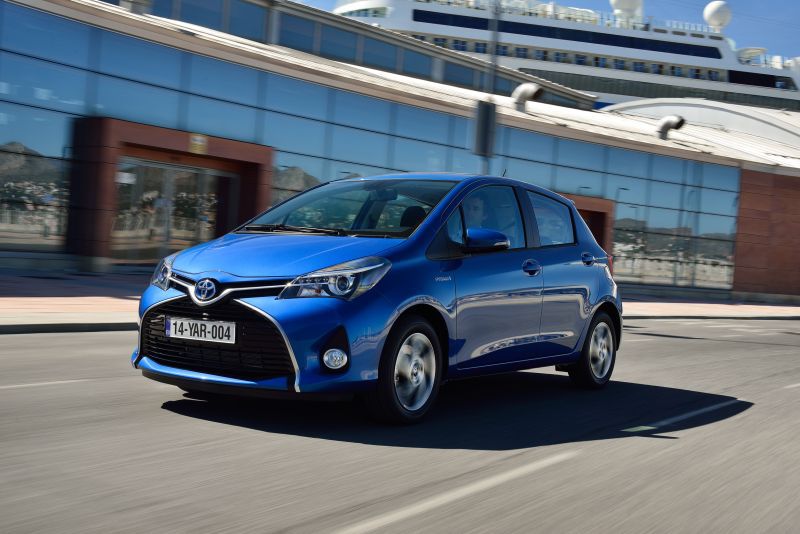
The Toyota Yaris III, particularly the facelifted version introduced in 2014, represents Toyota’s continued commitment to the supermini segment. While the Yaris has been a global model for decades, the third generation (XP90/XP110) and its 2014 refresh were specifically tailored for the European market, where demand for compact, fuel-efficient vehicles is high. This iteration of the Yaris aimed to balance practicality, affordability, and modern technology, offering a compelling alternative to rivals like the Volkswagen Polo, Ford Fiesta, and Renault Clio. The 1.33 Dual VVT-i Multidrive variant, producing 99 horsepower, was a popular choice for buyers prioritizing fuel economy and ease of driving.
Toyota Yaris III (2014-2017) 1.33 Dual VVT-i Multidrive
The 2014 facelift brought subtle but significant changes to the Yaris, including revised front-end styling, interior enhancements, and improvements to the vehicle’s dynamics. The 1.33 Dual VVT-i engine, coupled with Toyota’s Multidrive S continuously variable transmission (CVT), offered a smooth and efficient driving experience. This model year focused on refining an already successful formula, addressing some criticisms of the earlier XP90 models and enhancing the Yaris’s overall appeal.
Engine & Performance
The heart of the Yaris III 1.33 Dual VVT-i is the 1NR-FE 1.329-liter (81.1 cubic inches) inline-four cylinder gasoline engine. This naturally aspirated engine utilizes Toyota’s Dual Variable Valve Timing with intelligence (Dual VVT-i) system, optimizing valve timing for improved performance and fuel efficiency across a wider range of engine speeds. It produces 99 horsepower at 6000 rpm and 125 Nm (92.2 lb-ft) of torque at 4000 rpm. While not a performance-oriented engine, it provides adequate power for everyday driving. The Multidrive S CVT, a key feature of this variant, replaces traditional gear changes with a seamless, stepless transmission. This contributes to improved fuel economy and a more comfortable driving experience. Acceleration from 0 to 100 km/h (0-62 mph) takes 12.6 seconds, with a top speed of 175 km/h (108.74 mph). The engine’s power-to-weight ratio is 10.6 kg/Hp, and the torque-to-weight ratio is 8.4 kg/Nm.
Design & Features
The Yaris III is a five-door hatchback, offering a practical and versatile body style. The 2014 facelift brought a more assertive front grille, redesigned headlights, and a revised bumper, giving the car a more modern appearance. Inside, the cabin was updated with improved materials and a more user-friendly layout. The Yaris prioritizes interior space efficiency, offering comfortable seating for five adults. Standard features typically included air conditioning, power steering, electric front windows, and a basic audio system. Safety features, crucial for this segment, included ABS (Anti-lock Braking System), multiple airbags, and stability control. The trunk (boot) space is a respectable 286 liters (10.1 cubic feet) with the rear seats up. The Yaris’s compact dimensions – a length of 3950 mm (155.51 inches), a width of 1695 mm (66.73 inches), and a height of 1510 mm (59.45 inches) – make it easy to maneuver in urban environments.
Technical Specifications
| General Information | |
| Brand | Toyota |
| Model | Yaris |
| Generation | Yaris III (facelift 2014) |
| Type (Engine) | 1.33 Dual VVT-i (99 Hp) Multidrive |
| Start of production | 2014 |
| End of production | 2017 |
| Powertrain Architecture | Internal Combustion engine |
| Body type | Hatchback |
| Seats | 5 |
| Doors | 5 |
| Performance Specs | |
| Fuel consumption (urban) | 5.7-6.2 l/100 km (41.3 – 37.9 US mpg) |
| Fuel consumption (extra urban) | 4.2 l/100 km (56 US mpg) |
| Fuel consumption (combined) | 5.1 l/100 km (46.1 US mpg) |
| CO2 emissions | 114-119 g/km |
| Fuel Type | Petrol (Gasoline) |
| Acceleration 0 – 100 km/h | 12.6 sec |
| Acceleration 0 – 62 mph | 12.6 sec |
| Acceleration 0 – 60 mph | 12 sec |
| Maximum speed | 175 km/h (108.74 mph) |
| Emission standard | Euro 6 w |
| Weight-to-power ratio | 10.6 kg/Hp |
| Weight-to-torque ratio | 8.4 kg/Nm |
| Engine Specs | |
| Power | 99 Hp @ 6000 rpm |
| Torque | 125 Nm @ 4000 rpm (92.2 lb.-ft. @ 4000 rpm) |
| Engine layout | Front, Transverse |
| Engine Model/Code | 1NR-FE |
| Engine displacement | 1329 cm3 (81.1 cu. in.) |
| Number of cylinders | 4 |
| Engine configuration | Inline |
| Compression ratio | 11.5:1 |
| Number of valves per cylinder | 4 |
| Fuel injection system | Multi-port manifold injection |
| Engine aspiration | Naturally aspirated |
| Valvetrain | DOHC |
| Engine oil capacity | 3.4 l (3.59 US qt | 2.99 UK qt) |
| Coolant capacity | 4.8 l (5.07 US qt | 4.22 UK qt) |
| Space, Volume and Weights | |
| Kerb Weight | 1050-1105 kg (2314.85 – 2436.11 lbs.) |
| Max. weight | 1490-1500 kg (3284.89 – 3306.93 lbs.) |
| Max load | 395-440 kg (870.83 – 970.03 lbs.) |
| Trunk (boot) space – minimum | 286 l (10.1 cu. ft.) |
| Fuel tank capacity | 42 l (11.1 US gal | 9.24 UK gal) |
| Max. roof load | 50 kg (110.23 lbs.) |
| Permitted trailer load with brakes (12%) | 880 kg (1940.07 lbs.) |
| Permitted trailer load without brakes | 550 kg (1212.54 lbs.) |
| Permitted towbar download | 50 kg (110.23 lbs.) |
| Dimensions | |
| Length | 3950 mm (155.51 in.) |
| Width | 1695 mm (66.73 in.) |
| Height | 1510 mm (59.45 in.) |
| Wheelbase | 2510 mm (98.82 in.) |
| Front track | 1460-1485 mm (57.48 – 58.46 in.) |
| Rear track | 1445-1470 mm (56.89 – 57.87 in.) |
| Drag coefficient (Cd) | 0.287 |
| Minimum turning circle | 9.6 m (31.5 ft.) |
| Drivetrain, Brakes and Suspension | |
| Drivetrain Architecture | Front wheel drive |
| Number of gears and type of gearbox | automatic transmission CVT |
| Front suspension | Independent, type McPherson with coil spring and anti-roll bar |
| Rear suspension | Independent coil spring |
| Front brakes | Ventilated discs |
| Rear brakes | Drum |
| Steering type | Steering rack and pinion |
| Power steering | Electric |