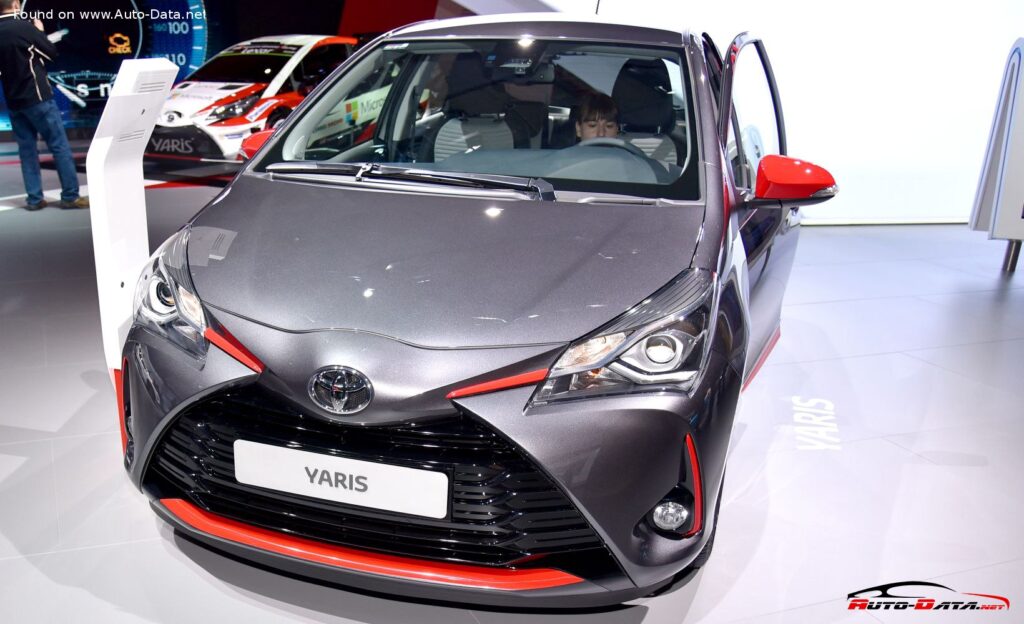
The Toyota Yaris III, particularly the facelifted version introduced in 2017, represents Toyota’s continued commitment to the subcompact hatchback segment. While the Yaris nameplate has a longer history, the third generation, and specifically this 2017-2018 iteration, was primarily aimed at the European market, where demand for small, fuel-efficient vehicles is high. This model offered a blend of practicality, affordability, and Toyota’s reputation for reliability. The 1.5 Dual-VVT-iE variant, producing 111 horsepower, was a popular choice, balancing performance with excellent fuel economy. Though not officially sold in the United States during this generation, understanding its specifications provides insight into the global automotive landscape and Toyota’s engineering approach to efficient transportation.
Toyota Yaris III (Facelift 2017) 1.5 Dual-VVT-iE: An Overview
The Yaris III, launched initially in 2011, received a significant facelift in 2017, bringing updated styling, improved equipment levels, and refinements to the powertrain. This facelift aimed to enhance the Yaris’s appeal in a competitive market segment. The 1.5 Dual-VVT-iE engine was a key component of this update, offering improved efficiency and responsiveness compared to earlier iterations. The Yaris consistently ranked well in European sales charts, appreciated for its compact size, ease of parking, and low running costs. It served as a crucial entry point into the Toyota brand for many buyers.
Engine & Performance
The heart of the 2017 Toyota Yaris III 1.5 Dual-VVT-iE is a 1.5-liter inline four-cylinder gasoline engine, designated the 2NR-FKE. This engine utilizes Toyota’s Dual-VVT-iE (Variable Valve Timing-intelligent with Electric motor) technology, which optimizes valve timing on both the intake and exhaust sides for improved performance and fuel efficiency. The engine produces 111 horsepower (Hp) and 136 Nm of torque (approximately 100.31 lb.-ft.) at 4400 rpm. Power delivery is smooth and linear, making it well-suited for urban driving. The engine is naturally aspirated, meaning it doesn’t rely on a turbocharger or supercharger for forced induction. This contributes to its reliability and predictable performance. Acceleration from 0 to 100 km/h (0-62 mph) takes approximately 11 seconds, while 0-60 mph is achieved in around 10.5 seconds. The Yaris III 1.5 Dual-VVT-iE has a top speed of 175 km/h (108.74 mph). The engine’s relatively small displacement and advanced valve timing contribute to impressive fuel economy figures, ranging from 4.8 to 5.0 liters per 100 kilometers (49-47 US mpg) in combined driving cycles.
Design & Features
The Yaris III is a five-door hatchback, offering a practical and versatile body style. The 2017 facelift brought a more aggressive front fascia with a redesigned grille and headlights, giving the car a more modern appearance. The interior is designed with functionality in mind, offering comfortable seating for five passengers. While not overtly luxurious, the cabin is well-built and features durable materials. Standard features typically included air conditioning, power windows, and a basic audio system. Safety features, crucial in the modern automotive landscape, included ABS (Anti-lock Braking System) and multiple airbags. The Yaris’s compact dimensions make it easy to maneuver in tight urban environments and park in confined spaces. The hatchback configuration provides a reasonable amount of cargo space, further enhancing its practicality. The steering utilizes an electric power steering system, providing light and responsive handling.
Technical Specifications
| Brand | Toyota |
| Model | Yaris |
| Generation | Yaris III (facelift 2017) |
| Type (Engine) | 1.5 Dual-VVT-iE (111 Hp) |
| Start of production | 2017 |
| End of production | 2018 |
| Powertrain Architecture | Internal Combustion engine |
| Body type | Hatchback |
| Seats | 5 |
| Doors | 5 |
| Fuel consumption (urban) | 6.2-6.3 l/100 km (37.9 – 37.3 US mpg) |
| Fuel consumption (extra urban) | 4.0-4.2 l/100 km (58.8 – 56 US mpg) |
| Fuel consumption (combined) | 4.8-5.0 l/100 km (49 – 47 US mpg) |
| CO2 emissions | 109-112 g/km |
| Fuel Type | Petrol (Gasoline) |
| Acceleration 0 – 100 km/h | 11 sec |
| Acceleration 0 – 62 mph | 11 sec |
| Acceleration 0 – 60 mph | 10.5 sec |
| Maximum speed | 175 km/h (108.74 mph) |
| Emission standard | Euro 6 |
| Power | 111 Hp |
| Power per litre | 74.1 Hp/l |
| Torque | 136 Nm @ 4400 rpm (100.31 lb.-ft. @ 4400 rpm) |
| Engine layout | Front, Transverse |
| Engine Model/Code | 2NR-FKE |
| Engine displacement | 1497 cm3 (91.35 cu. in.) |
| Number of cylinders | 4 |
| Engine configuration | Inline |
| Number of valves per cylinder | 4 |
| Fuel injection system | Multi-port manifold injection |
| Engine aspiration | Naturally aspirated engine |
| Valvetrain | DOHC |
| Engine oil capacity | 3.6 l (3.8 US qt | 3.17 UK qt) |
| Coolant | 5.5 l (5.81 US qt | 4.84 UK qt) |
| Length | 3945 mm (155.31 in.) |
| Width | 1695 mm (66.73 in.) |
| Height | 1510 mm (59.45 in.) |
| Drivetrain Architecture | ICE drives front wheels |
| Drive wheel | Front wheel drive |
| Number of gears and type of gearbox | 6 gears, manual transmission |
| Front suspension | Independent, McPherson with coil spring and anti-roll bar |
| Front brakes | Ventilated discs |
| Assisting systems | ABS (Anti-lock braking system) |
| Steering type | Steering rack and pinion |
| Power steering | Electric Steering |
In conclusion, the 2017 Toyota Yaris III 1.5 Dual-VVT-iE represents a well-rounded and efficient subcompact hatchback. While not available in the US market, it exemplifies Toyota’s engineering prowess in creating reliable, fuel-efficient, and practical vehicles for the global automotive landscape. Its blend of affordability, functionality, and modern features made it a popular choice for buyers seeking a compact and economical city car, particularly in Europe.