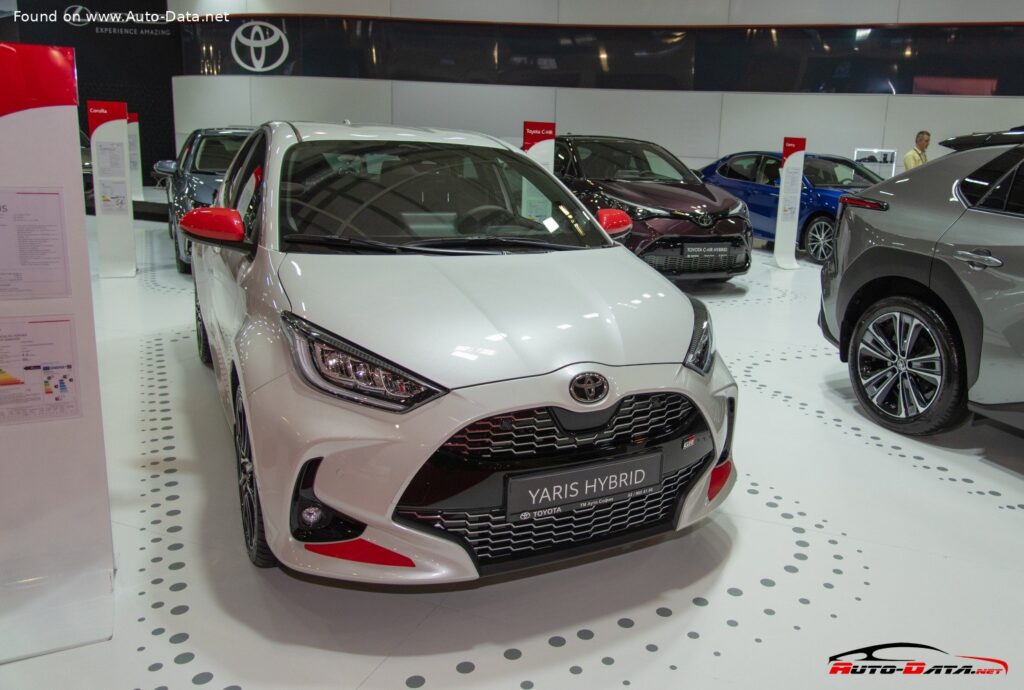
The Toyota Yaris (XP210) 1.5 Hybrid e-CVT, produced from September 2020 to February 2024, represents the fourth generation of Toyota’s globally successful supermini. This particular variant, combining a 1.5-liter gasoline engine with a hybrid-electric system and an electronically controlled continuously variable transmission (e-CVT), occupied a central position within the XP210 lineup, offering a balance of fuel efficiency, practicality, and affordability. It was positioned above the base non-hybrid models and below any potential future performance-oriented trims. The XP210 Yaris was a significant model for Toyota, being the first to utilize the GA-B platform, a derivative of the Toyota New Global Architecture (TNGA), emphasizing improved rigidity, safety, and driving dynamics.
Powertrain & Engine Architecture
The heart of the Yaris 1.5 Hybrid is the 1490 cc (90.93 cu. in.) 15A-FXE inline-3 cylinder engine. This engine utilizes a combination of direct injection and multi-port manifold injection to optimize combustion efficiency and reduce emissions. It boasts a high compression ratio of 14:1, contributing to its thermal efficiency. The engine is naturally aspirated and features a DOHC (Dual Overhead Camshaft) valvetrain with both VVT-iE (Variable Valve Timing – intake) and VVT-i (Variable Valve Timing – exhaust) systems, further enhancing performance and fuel economy. The engine produces 92 hp at 5500 rpm and 120 Nm (88.51 lb-ft) of torque between 3600-4800 rpm.
Crucially, the 1.5 Hybrid isn’t solely reliant on the gasoline engine. It employs a full hybrid (FHEV) system, integrating an electric motor that delivers an additional 80 hp and 141 Nm (104 lb-ft) of torque. This electric motor is integrated directly into the e-CVT. The combined system output is 115 hp at 5500 rpm. The e-CVT isn’t a traditional continuously variable transmission with belts and pulleys; instead, it’s a power-split device that seamlessly blends the power from the engine and electric motor, optimizing efficiency and providing smooth, stepless acceleration. The battery, a lithium-ion unit with a gross capacity of 0.76 kWh and a voltage of 177.6V, is located under the rear seats, minimizing intrusion into passenger or cargo space.
Fuel Injection and Emissions
The sophisticated fuel injection system, combining direct and port injection, allows for precise fuel delivery under various driving conditions. This, coupled with the particulate filter, contributes to the Yaris 1.5 Hybrid meeting stringent Euro 6 AP emission standards, resulting in CO2 emissions ranging from 87-98 g/km.
Driving Characteristics
The Yaris 1.5 Hybrid e-CVT delivers a refined and efficient driving experience. The e-CVT provides smooth, linear acceleration, particularly noticeable in urban environments. While not offering the sporty feel of a traditional automatic or manual transmission, the e-CVT excels at maximizing fuel efficiency. The combined power output of 115 hp allows for a 0-100 km/h (0-62 mph) acceleration time of 9.7 seconds, and a 0-60 mph time of approximately 9.2 seconds. Top speed is electronically limited to 175 km/h (108.74 mph). The hybrid system allows for short periods of electric-only driving at lower speeds, further reducing fuel consumption and emissions. The weight-to-power ratio of 9.7 kg/hp and weight-to-torque ratio of 9.3 kg/Nm contribute to a responsive, albeit not overtly powerful, driving experience.
Equipment & Trim Levels
The Yaris 1.5 Hybrid e-CVT typically came well-equipped, reflecting its position as a mainstream offering. Standard features generally included air conditioning, a touchscreen infotainment system with smartphone integration (Apple CarPlay and Android Auto), Toyota Safety Sense (a suite of active safety features including pre-collision system, lane departure alert, and adaptive cruise control), and power windows and mirrors. Interior upholstery was typically cloth, with options for upgraded materials available on higher trim levels. Dashboard configuration was modern and functional, prioritizing ease of use. Optional extras could include a reversing camera, parking sensors, automatic climate control, and upgraded audio systems. Trim levels varied by market, but generally offered increasing levels of equipment and cosmetic enhancements.
Chassis & Braking
The XP210 Yaris benefits from the GA-B platform’s inherent rigidity, contributing to improved handling and stability. The front suspension utilizes an independent McPherson strut setup, while the rear employs a torsion beam. This configuration provides a good balance between ride comfort and handling precision. Braking duties are handled by ventilated discs on the front wheels and solid discs on the rear. Anti-lock Braking System (ABS) is standard. Steering is via a rack and pinion system with electric power assistance, providing light and precise steering feel. The Yaris 1.5 Hybrid typically rides on 195/55 R16 tires mounted on 6J x 16 inch wheels.
Market Reception & Comparison
The Toyota Yaris 1.5 Hybrid e-CVT was generally well-received by automotive critics, praised for its exceptional fuel economy, comfortable ride, and comprehensive safety features. It consistently outperformed many of its rivals in fuel efficiency tests, achieving combined fuel consumption figures ranging from 3.8 to 4.3 l/100 km (61.9 – 54.7 US mpg). Compared to the non-hybrid Yaris variants, the hybrid offered significantly improved fuel economy, albeit at a slightly higher purchase price. Compared to other hybrid options in the segment, such as the Renault Clio E-Tech, the Yaris often stood out for its refined e-CVT and Toyota’s reputation for reliability. Some critics noted that the engine could feel strained under hard acceleration, and the overall driving experience wasn’t as engaging as some competitors.
Technical Specifications
| Brand | Toyota |
| Model | Yaris |
| Generation | Yaris (XP210) |
| Type (Engine) | 1.5 (115 Hp) Hybrid e-CVT |
| Start of production | September, 2020 |
| End of production | February, 2024 |
| Powertrain Architecture | FHEV (Full Hybrid Electric Vehicle) |
| Body type | Hatchback |
| Seats | 5 |
| Doors | 5 |
| Fuel consumption at Low speed (WLTP) | 2.9-3.5 l/100 km (81.1 – 67.2 US mpg) |
| Fuel consumption at Medium speed (WLTP) | 3-3.5 l/100 km (78.4 – 67.2 US mpg) |
| Fuel consumption at high speed (WLTP) | 3.5-3.9 l/100 km (67.2 – 60.3 US mpg) |
| Fuel consumption at very high speed (WLTP) | 5-5.6 l/100 km (47 – 42 US mpg) |
| Combined fuel consumption (WLTP) | 3.8-4.3 l/100 km (61.9 – 54.7 US mpg) |
| CO2 emissions (WLTP) | 87-98 g/km |
| Fuel Type | Petrol (Gasoline) |
| Acceleration 0 – 100 km/h | 9.7 sec |
| Acceleration 0 – 62 mph | 9.7 sec |
| Acceleration 0 – 60 mph | 9.2 sec |
| Maximum speed | 175 km/h (108.74 mph) |
| Gross battery capacity | 0.76 kWh |
| Battery voltage | 177.6 V |
| Electric motor power | 80 Hp |
| Electric motor Torque | 141 Nm (104 lb.-ft.) |
| System power | 115 Hp @ 5500 rpm |
| Engine Power | 92 Hp @ 5500 rpm |
| Engine Torque | 120 Nm @ 3600-4800 rpm (88.51 lb.-ft. @ 3600-4800 rpm) |
| Engine displacement | 1490 cm3 (90.93 cu. in.) |
| Kerb Weight | 1110-1145 kg (2447.13 – 2524.29 lbs.) |
| Trunk (boot) space – minimum | 286 l (10.1 cu. ft.) |
| Trunk (boot) space – maximum | 947 l (33.44 cu. ft.) |
Legacy
The Toyota Yaris 1.5 Hybrid e-CVT has proven to be a reliable and durable powertrain. Toyota’s hybrid technology is well-established, and the 15A-FXE engine and e-CVT have a good track record for longevity. On the used car market, these models hold their value relatively well, due to their fuel efficiency and Toyota’s reputation for reliability. While some components, such as the hybrid battery, may eventually require replacement, the overall cost of ownership remains competitive. The XP210 Yaris 1.5 Hybrid continues to be a popular choice for buyers seeking an economical and practical supermini.