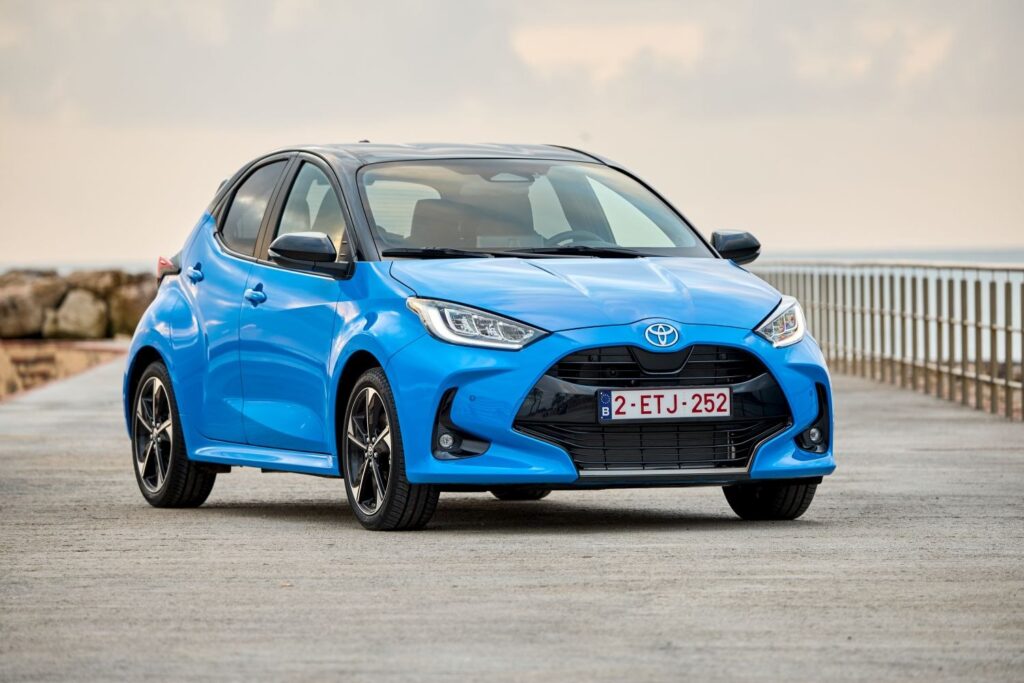
The Toyota Yaris (XP210, facelift 2024) 1.5 (116 Hp) Full Hybrid e-CVT represents a significant iteration of Toyota’s popular supermini, launched in February 2024. This variant occupies a central position within the XP210 facelift range, offering a compelling blend of fuel efficiency, practicality, and modern technology. It builds upon the foundation of the fourth-generation Yaris (XP210) introduced in 2020, incorporating styling updates and refinements to both the exterior and interior. The XP210 generation Yaris is built on the Toyota New Global Architecture (TNGA) platform, specifically the GA-B variant, designed to enhance rigidity, reduce weight, and improve driving dynamics.
Powertrain & Engine Architecture
At the heart of the Yaris 1.5 Full Hybrid lies Toyota’s sophisticated Full Hybrid Electric Vehicle (FHEV) system. The powertrain centers around the 1490 cc (90.93 cu. in.) 1.5-liter three-cylinder gasoline engine, designated the M15A-FXE. This engine produces 92 hp at 5500 rpm and 120 Nm (88.51 lb.-ft.) of torque between 3600-4800 rpm, boasting a power-to-litre ratio of 61.7 hp/l. The engine utilizes a combination of direct injection and multi-port manifold injection for optimized combustion efficiency. It also features a Double Overhead Camshaft (DOHC) valvetrain with both MD-VVT (Multi-Variable Valve Timing) and VVT-i (Variable Valve Timing with intelligence) technologies, further enhancing performance and fuel economy.
Crucially, the internal combustion engine is paired with an electric motor capable of producing 80 hp. This electric motor is integrated directly into the e-CVT (electronically controlled continuously variable transmission). The system combines the output of the engine and motor to deliver a total system output of 116 hp and 141 Nm (104 lb.-ft.) of torque. The e-CVT, unlike traditional CVTs, doesn’t rely on a belt and pulley system; instead, it utilizes a power split device to seamlessly blend power from the engine and electric motor, providing a smooth and linear driving experience. The battery pack, utilizing Lithium-ion technology with a gross capacity of 0.76 kWh and a voltage of 177.6 V, is located beneath the floor and under the rear seats, minimizing intrusion into passenger or cargo space. A Start & Stop system is standard, contributing to reduced emissions and fuel consumption.
Driving Characteristics
The Yaris 1.5 Full Hybrid e-CVT delivers a refined and comfortable driving experience, prioritizing fuel efficiency and ease of use over outright performance. Acceleration from 0 to 100 km/h (0-62 mph) takes 9.7 seconds, while 0-60 mph is achieved in approximately 9.2 seconds. The e-CVT transmission provides seamless acceleration, eliminating the stepped gear changes associated with traditional automatic transmissions. The hybrid system intelligently manages the interplay between the engine and electric motor, often utilizing electric power at lower speeds and during gentle acceleration, resulting in near-silent operation in urban environments. While not a sporty vehicle, the Yaris offers adequate power for everyday driving situations, including highway merging and overtaking. Compared to a hypothetical manual transmission version (not offered in this configuration), the e-CVT prioritizes smoothness and efficiency over driver engagement. The system’s focus on maximizing electric motor usage contributes to significantly improved fuel economy compared to non-hybrid Yaris models.
Equipment & Trim Levels
The 1.5 Full Hybrid e-CVT trim typically represents a mid-range offering within the Yaris lineup. Standard equipment generally includes air conditioning, a touchscreen infotainment system with smartphone integration (Apple CarPlay and Android Auto), Toyota Safety Sense suite of driver-assistance features (including pre-collision system, lane departure alert, and adaptive cruise control), and power windows/locks. Interior upholstery is typically cloth, with options for upgraded materials available. Dashboard configuration is modern and functional, with a focus on ease of use. Optional extras often include a larger touchscreen display, navigation system, premium audio system, automatic climate control, and parking sensors. Exterior features typically include alloy wheels, body-colored door handles and mirrors, and LED headlights.
Chassis & Braking
The Yaris XP210 utilizes a McPherson strut independent suspension system at the front, providing a comfortable ride and responsive handling. The rear suspension employs a torsion beam setup, which is a cost-effective and space-efficient solution. The chassis is designed to be lightweight and rigid, contributing to improved handling and stability. Braking duties are handled by ventilated discs at the front and solid discs at the rear. The vehicle is equipped with ABS (Anti-lock Braking System) as standard, enhancing braking performance and safety. Electric power steering provides light and precise steering feel. Tire sizes vary depending on the trim level, ranging from 185/65 R15 to 215/40 R18.
Market Reception & Comparison
The Toyota Yaris 1.5 Full Hybrid e-CVT has been well-received by critics and consumers alike, praised for its exceptional fuel economy, reliability, and practicality. Fuel consumption figures range from 3.8 to 4.9 l/100 km (61.9 – 48 US mpg, 74.3 – 57.6 UK mpg), making it one of the most fuel-efficient vehicles in its class. Compared to other trims in the Yaris lineup, the 1.5 Hybrid offers a significant advantage in fuel economy, albeit with slightly less outright performance than the 1.5-liter non-hybrid variants. Reliability is a key strength of the Yaris, with Toyota consistently ranking highly in reliability surveys. The hybrid powertrain is known for its durability and longevity. Competitors in the supermini segment include the Volkswagen Polo, Renault Clio, and Honda Jazz, but the Yaris distinguishes itself with its standard hybrid powertrain and strong reputation for reliability.
Technical Specifications
| Brand | Toyota |
| Model | Yaris |
| Generation | Yaris (XP210, facelift 2024) |
| Type (Engine) | 1.5 (116 Hp) Full Hybrid e-CVT |
| Start of production | February, 2024 |
| Powertrain Architecture | FHEV (Full Hybrid Electric Vehicle) |
| Body type | Hatchback |
| Seats | 5 |
| Doors | 5 |
| Combined fuel consumption (WLTP) | 3.8-4.9 l/100 km (61.9 – 48 US mpg, 74.3 – 57.6 UK mpg, 26.3 – 20.4 km/l) |
| CO2 emissions (WLTP) | 87-112 g/km |
| Fuel Type | Petrol (Gasoline) |
| Acceleration 0 – 100 km/h | 9.7 sec |
| Acceleration 0 – 62 mph | 9.7 sec |
| Acceleration 0 – 60 mph | 9.2 sec |
| Maximum speed | 175 km/h (108.74 mph) |
| Emission standard | Euro 6 AP |
| Weight-to-power ratio | 9.4 kg/Hp, 106.9 Hp/tonne |
| Weight-to-torque ratio | 7.7 kg/Nm, 130 Nm/tonne |
| Gross battery capacity | 0.76 kWh |
| Battery voltage | 177.6 V |
| Battery technology | Lithium-ion (Li-Ion) |
| Battery location | Below the floor, under the rear seats |
| Electric motor power | 80 Hp |
| Electric motor location | Integrated into the transmission |
| Electric motor type | Synchronous |
| System power | 116 Hp |
| System torque | 141 Nm (104 lb.-ft.) |
| Engine Power | 92 Hp @ 5500 rpm |
| Engine Torque | 120 Nm @ 3600-4800 rpm (88.51 lb.-ft. @ 3600-4800 rpm) |
| Engine layout | Front, Transverse |
| Engine Model/Code | M15A-FXE |
| Engine displacement | 1490 cm3 (90.93 cu. in.) |
| Number of cylinders | 3 |
| Engine configuration | Inline |
| Number of valves per cylinder | 4 |
| Fuel injection system | Direct injection and Multi-port manifold injection |
| Engine aspiration | Naturally aspirated engine |
| Valvetrain | DOHC, MD-VVT, VVT-I |
| Engine oil capacity | 3.6 l (3.8 US qt | 3.17 UK qt) |
| Coolant capacity | 5 l (5.28 US qt | 4.4 UK qt) |
| Kerb Weight | 1085-1185 kg (2392.02 – 2612.48 lbs.) |
| Max. weight | 1615 kg (3560.47 lbs.) |
| Max load | 430-530 kg (947.99 – 1168.45 lbs.) |
| Trunk (boot) space – minimum | 286 l (10.1 cu. ft.) |
| Fuel tank capacity | 36 l (9.51 US gal | 7.92 UK gal) |
| Length | 3940 mm (155.12 in.) |
| Width | 1745 mm (68.7 in.) |
| Height | 1500 mm (59.06 in.) |
| Wheelbase | 2560 mm (100.79 in.) |
| Front track | 1521-1531 mm (59.88 – 60.28 in.) |
| Rear track | 1518-1528 mm (59.76 – 60.16 in.) |
| Front overhang | 790 mm (31.1 in.) |
| Rear overhang | 590 mm (23.23 in.) |
| Minimum turning circle | 11 m (36.09 ft.) |
| Drivetrain | Front wheel drive. FHEV. |
| Gearbox | automatic transmission e-CVT |
| Front suspension | Independent type McPherson |
| Rear suspension | Torsion |
| Front brakes | Ventilated discs |
| Rear brakes | Disc |
Legacy
The Toyota Yaris 1.5 Full Hybrid e-CVT powertrain is expected to maintain strong reliability and resale value in the used car market. Toyota’s hybrid technology has a proven track record of durability, and the relatively simple design of the powertrain minimizes potential failure points. As with any used vehicle, regular maintenance is crucial to ensure long-term reliability. The increasing demand for fuel-efficient vehicles is likely to further enhance the desirability of this Yaris variant in the years to come, solidifying its position as a practical and economical choice for urban commuters and environmentally conscious drivers.