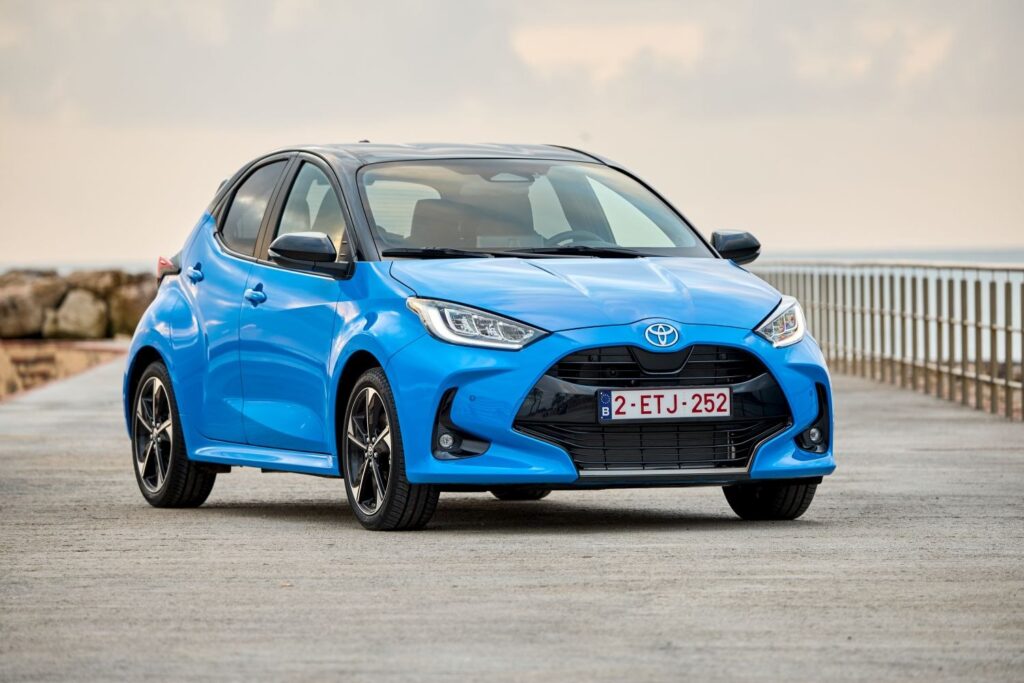
The Toyota Yaris (XP210, facelift 2024) 1.5 Full Hybrid represents a significant evolution in Toyota’s subcompact hatchback offering. Introduced in February 2024, this variant builds upon the fourth generation (XP210) Yaris, incorporating styling updates and refinements to the highly successful hybrid powertrain. Positioned as a mid-range offering within the facelifted Yaris lineup, it slots between the base model and potentially higher-trim, more feature-rich versions. The XP210 Yaris is built on the Toyota New Global Architecture (TNGA) platform, specifically the GA-B variant, designed to enhance rigidity, reduce weight, and improve driving dynamics. This particular 1.5L hybrid model is aimed at buyers seeking fuel efficiency, practicality, and a comfortable driving experience in an urban environment.
Powertrain & Engine Architecture
The heart of the Yaris 1.5 Full Hybrid is the M15A-FXE engine, a 1.490-liter (90.93 cubic inches) inline three-cylinder gasoline engine. This engine utilizes a combination of direct injection and multi-port manifold injection to optimize combustion efficiency and reduce emissions. It features a Dual Overhead Camshaft (DOHC) valvetrain with both MD-VVT (Multi-Variable Valve Timing) and VVT-I (Variable Valve Timing with intelligence) technologies, allowing for precise control of valve timing to maximize power and fuel economy across a wide range of engine speeds. The engine produces 92 horsepower at 5500 rpm and 120 Nm (88.51 lb-ft) of torque between 3600-4800 rpm, resulting in a power-to-liter ratio of 61.7 hp/l.
Crucially, this is a full hybrid (FHEV) system, meaning it incorporates a powerful electric motor and a lithium-ion battery pack. The electric motor, a synchronous type, delivers 84 hp and is integrated directly into the e-CVT (electronically controlled continuously variable transmission). The system combines the output of the gasoline engine and electric motor to achieve a total system output of 131 hp and 185 Nm (136.45 lb-ft) of torque. The 0.76 kWh lithium-ion battery is located under the floor, beneath the rear seats, minimizing intrusion into passenger or cargo space. The e-CVT, unlike traditional automatic transmissions, doesn’t have fixed gear ratios. Instead, it utilizes a planetary gearset and electric motor control to seamlessly vary the gear ratio, optimizing engine efficiency and providing smooth acceleration.
e-CVT Operation and Characteristics
The e-CVT in the Yaris 1.5 Hybrid operates differently than a conventional automatic. It doesn’t have distinct “gears” in the traditional sense. Instead, it uses the electric motor to continuously adjust the effective gear ratio, keeping the gasoline engine operating at its most efficient point. This results in a smooth, linear acceleration feel. The system can operate in several modes: EV mode (electric only, for short distances at low speeds), Hybrid mode (combining engine and electric motor power), and Engine mode (primarily using the gasoline engine). The transition between these modes is generally seamless and imperceptible to the driver.
Driving Characteristics
The Yaris 1.5 Full Hybrid offers a refined and comfortable driving experience, particularly well-suited for urban commuting. Acceleration from 0 to 100 km/h (0-62 mph) takes 9.2 seconds, while 0-60 mph is achieved in approximately 8.7 seconds. While not a performance-oriented vehicle, the combined power output of the hybrid system provides adequate acceleration for everyday driving situations. The e-CVT contributes to a smooth and quiet ride, with minimal engine noise during acceleration. The car’s relatively lightweight construction (1140-1190 kg / 2513.27 – 2623.5 lbs) helps to offset the modest horsepower output. Compared to a Yaris with a traditional gasoline engine and automatic transmission, the hybrid version offers significantly improved fuel economy and reduced emissions. It also provides the benefit of near-silent electric-only operation at low speeds.
Equipment & Trim Levels
The Yaris 1.5 Full Hybrid typically comes standard with a comprehensive suite of features. These generally include air conditioning, a touchscreen infotainment system with smartphone integration (Apple CarPlay and Android Auto), Bluetooth connectivity, and a suite of safety features such as Toyota Safety Sense, which includes pre-collision system with pedestrian detection, lane departure alert with steering assist, and automatic high beams. Interior upholstery is typically cloth, with options for upgraded materials available on higher trim levels. Dashboard configuration is modern and functional, with a focus on ease of use. Optional extras may include a larger touchscreen display, navigation system, premium audio system, automatic climate control, and parking sensors.
Chassis & Braking
The Yaris 1.5 Full Hybrid utilizes an independent McPherson strut suspension at the front and a torsion beam suspension at the rear. This setup provides a good balance between ride comfort and handling. The torsion beam rear suspension is a cost-effective solution that minimizes weight and space requirements. Braking duties are handled by ventilated discs at the front and discs at the rear. The vehicle is equipped with ABS (Anti-lock Braking System) as standard, enhancing braking performance and stability. Electric power steering provides light and precise steering feel. Tire sizes vary depending on the trim level, ranging from 185/65 R15 to 215/40 R18.
Market Reception & Comparison
The Toyota Yaris 1.5 Full Hybrid has been well-received by critics and consumers alike, praised for its exceptional fuel economy, low emissions, and comfortable driving experience. It consistently ranks highly in fuel efficiency comparisons within its segment. Compared to other trims in the Yaris lineup, the hybrid version offers a premium in terms of fuel economy and environmental friendliness, but may come at a slightly higher purchase price. Its reliability is also a strong point, consistent with Toyota’s reputation for building durable and dependable vehicles. The hybrid system’s complexity does introduce potential for more expensive repairs compared to a traditional gasoline engine, but Toyota’s hybrid technology has proven to be remarkably reliable over the long term.
Technical Specifications
| Brand | Toyota |
| Model | Yaris |
| Generation | Yaris (XP210, facelift 2024) |
| Type (Engine) | 1.5 (131 Hp) Full Hybrid e-CVT |
| Start of production | February, 2024 |
| Powertrain Architecture | FHEV (Full Hybrid Electric Vehicle) |
| Body type | Hatchback |
| Seats | 5 |
| Doors | 5 |
| Combined fuel consumption (WLTP) | 3.9-4.3 l/100 km (60.3 – 54.7 US mpg, 72.4 – 65.7 UK mpg, 25.6 – 23.3 km/l) |
| CO2 emissions (WLTP) | 87-98 g/km |
| Fuel Type | Petrol (Gasoline) |
| Acceleration 0 – 100 km/h | 9.2 sec |
| Acceleration 0 – 62 mph | 9.2 sec |
| Acceleration 0 – 60 mph | 8.7 sec |
| Maximum speed | 175 km/h (108.74 mph) |
| Emission standard | Euro 6 AP |
| Weight-to-power ratio | 8.7 kg/Hp, 114.9 Hp/tonne |
| Weight-to-torque ratio | 6.2 kg/Nm, 162.3 Nm/tonne |
| Gross battery capacity | 0.76 kWh |
| Battery voltage | 177.6 V |
| Battery technology | Lithium-ion (Li-Ion) |
| Battery location | Below the floor, under the rear seats |
| Electric motor power | 84 Hp |
| Electric motor location | Integrated into the transmission |
| Electric motor type | Synchronous |
| System power | 131 Hp |
| System torque | 185 Nm (136.45 lb.-ft.) |
| Engine Power | 92 Hp @ 5500 rpm |
| Engine Torque | 120 Nm @ 3600-4800 rpm (88.51 lb.-ft. @ 3600-4800 rpm) |
| Engine layout | Front, Transverse |
| Engine Model/Code | M15A-FXE |
| Engine displacement | 1490 cm3 (90.93 cu. in.) |
| Number of cylinders | 3 |
| Engine configuration | Inline |
| Number of valves per cylinder | 4 |
| Fuel injection system | Direct injection and Multi-port manifold injection |
| Engine aspiration | Naturally aspirated engine |
| Valvetrain | DOHC, MD-VVT, VVT-I |
| Engine oil capacity | 3.6 l (3.8 US qt | 3.17 UK qt) |
| Coolant capacity | 5 l (5.28 US qt | 4.4 UK qt) |
| Kerb Weight | 1140-1190 kg (2513.27 – 2623.5 lbs.) |
| Max. weight | 1615 kg (3560.47 lbs.) |
| Max load | 425-475 kg (936.96 – 1047.2 lbs.) |
| Trunk (boot) space – minimum | 286 l (10.1 cu. ft.) |
| Fuel tank capacity | 36 l (9.51 US gal | 7.92 UK gal) |
| Length | 3940 mm (155.12 in.) |
| Width | 1745 mm (68.7 in.) |
| Height | 1500 mm (59.06 in.) |
| Wheelbase | 2560 mm (100.79 in.) |
| Drive wheel | Front wheel drive |
| Number of gears and type of gearbox | automatic transmission e-CVT |
Legacy
The Toyota Yaris 1.5 Full Hybrid, and the XP210 generation as a whole, represents a significant step forward in hybrid technology accessibility. The M15A-FXE engine and associated hybrid system have proven to be remarkably reliable, with many owners reporting trouble-free operation for extended periods. On the used car market, these models are highly sought after due to their fuel efficiency and low running costs. As hybrid technology continues to evolve, the XP210 Yaris 1.5 Hybrid will likely be remembered as a pivotal model that helped to popularize hybrid vehicles and pave the way for a more sustainable automotive future.