
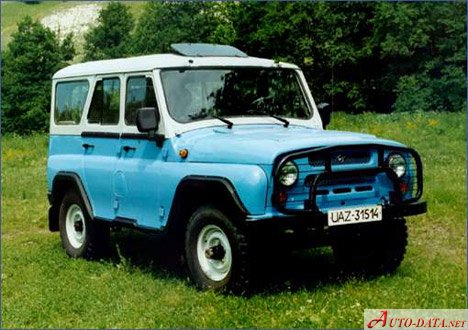
The UAZ 31514 is a classic Soviet-era and post-Soviet off-road vehicle produced by the Ulyanovsky Automobile Plant (UAZ) from 1995 to 2003. A direct descendant of the legendary UAZ-469, itself based on the American Willys Jeep, the 31514 represented a modernization of the original design, offering improved comfort and reliability while retaining the rugged capabilities that made UAZ vehicles popular in Russia and throughout the Eastern Bloc. Unlike many vehicles, the 31514 wasn’t designed for the Western European or North American markets; its primary purpose was to serve as a utilitarian vehicle for military, agricultural, and general transportation needs in challenging terrains. It was a staple for rural communities, government services, and the armed forces in Russia and neighboring countries.
UAZ 31514: A Legacy of Ruggedness
The UAZ 31514 continued the tradition of simple, robust engineering that characterized UAZ vehicles. It was built to withstand harsh conditions, prioritizing functionality over luxury. While not known for its speed or refinement, the 31514 earned a reputation for its exceptional off-road performance, durability, and ease of maintenance. Its design reflected the practical needs of its intended users, emphasizing load-carrying capacity and all-terrain capability. The vehicle’s longevity and continued use even today are testaments to its inherent robustness and the availability of spare parts, even after production ceased.
Engine & Performance
The UAZ 31514 was typically powered by a 2.45-liter inline-four cylinder petrol (gasoline) engine, producing 76 horsepower. This engine, while relatively modest in output by modern standards, provided sufficient power for its intended purpose. The engine featured a carburettor fuel injection system and an overhead camshaft (OHC) valvetrain with two valves per cylinder. Torque output was rated at 189 Nm (139.4 lb.-ft.) at 2200 rpm, providing adequate pulling power for navigating difficult terrain and carrying heavy loads. The engine was longitudinally mounted at the front of the vehicle. The vehicle’s weight-to-power ratio was 23 kg/Hp, and its weight-to-torque ratio was 9.3 kg/Nm. The 31514 had a maximum speed of 110 km/h (68.35 mph). The four-speed manual transmission, coupled with a part-time four-wheel-drive system, allowed drivers to select between two-wheel drive for on-road use and four-wheel drive for enhanced traction off-road.
Design & Features
The UAZ 31514 retained the classic, boxy silhouette of its predecessors, a design heavily influenced by the original Willys Jeep. It’s a five-door, seven-seat off-road vehicle. The body-on-frame construction provided exceptional strength and durability. The vehicle’s high ground clearance and short wheelbase contributed to its impressive off-road capabilities. Interior appointments were spartan, reflecting the vehicle’s utilitarian focus. Features were limited, but typically included basic instrumentation, vinyl upholstery, and a heater. Safety features were minimal by modern standards, consisting primarily of drum brakes on all four wheels and, in later models, an Anti-lock Braking System (ABS). The steering system utilized a worm-reduction unit with hydraulic power steering, providing reasonable maneuverability despite the vehicle’s rugged construction. The fuel tank capacity was a substantial 78 liters (20.61 US gal), providing a long driving range. The vehicle’s dimensions were 4025 mm (158.46 in) in length, 1785 mm (70.28 in) in width, and 2020 mm (79.53 in) in height, with a wheelbase of 2380 mm (93.7 in).
Technical Specifications
| Brand | UAZ |
| Model | 31514 |
| Generation | 31514 |
| Type (Engine) | 2.45 (76 Hp) |
| Start of production | 1995 |
| End of production | 2003 |
| Powertrain Architecture | Internal Combustion engine |
| Body type | Off-road vehicle |
| Seats | 7 |
| Doors | 5 |
| Fuel Type | Petrol (Gasoline) |
| Maximum speed | 110 km/h (68.35 mph) |
| Weight-to-power ratio | 23 kg/Hp |
| Weight-to-torque ratio | 9.3 kg/Nm |
| Power | 76 Hp |
| Power per litre | 31 Hp/l |
| Torque | 189 Nm @ 2200 rpm (139.4 lb.-ft. @ 2200 rpm) |
| Engine layout | Front, Longitudinal |
| Engine displacement | 2450 cm3 (149.51 cu. in.) |
| Number of cylinders | 4 |
| Engine configuration | Inline |
| Number of valves per cylinder | 2 |
| Fuel injection system | Carburettor |
| Engine aspiration | Naturally aspirated engine |
| Valvetrain | OHC |
| Engine oil capacity | 5.8 l (6.13 US qt | 5.1 UK qt) |
| Coolant | 13 l (13.74 US qt | 11.44 UK qt) |
| Kerb Weight | 1750 kg (3858.09 lbs.) |
| Max. weight | 2500 kg (5511.56 lbs.) |
| Max load | 750 kg (1653.47 lbs.) |
| Fuel tank capacity | 78 l (20.61 US gal | 17.16 UK gal) |
| Length | 4025 mm (158.46 in.) |
| Width | 1785 mm (70.28 in.) |
| Height | 2020 mm (79.53 in.) |
| Wheelbase | 2380 mm (93.7 in.) |
| Front track | 1445 mm (56.89 in.) |
| Rear (Back) track | 1445 mm (56.89 in.) |
| Drive wheel | All wheel drive (4×4) |
| Number of gears and type of gearbox | 4 gears, manual transmission |
| Front suspension | Rigid axle suspension |
| Rear suspension | Rigid axle suspension |
| Front brakes | Drum |
| Rear brakes | Drum |
| Assisting systems | ABS (Anti-lock braking system) |
| Steering type | Worm-reduction unit |
| Power steering | Hydraulic Steering |
| Tires size | 225/75 R16 |
| Wheel rims size | 16 |
The UAZ 31514, while not a sophisticated vehicle by modern standards, remains a significant example of Soviet and Russian automotive engineering. Its enduring popularity in its native region is a testament to its ruggedness, simplicity, and ability to thrive in challenging environments. It represents a bygone era of automotive design, prioritizing functionality and durability over luxury and refinement.
