The Vauxhall Corsa E 1.4i Turbo: A Spirited European Hatchback
The Vauxhall Corsa E 1.4i Turbo (150 Hp) start/stop represents a key offering in the highly competitive European subcompact, or “supermini,” segment. Produced by the British automaker Vauxhall, a long-standing subsidiary of Opel (and at the time, General Motors), the Corsa E generation was a staple on European roads from its introduction in March 2015 until its production concluded in April 2018. This particular variant, powered by a lively 1.4-liter turbocharged engine, carved out a niche for drivers seeking a blend of everyday practicality, modern efficiency, and a dash of spirited performance, making it a compelling choice against its numerous rivals across the continent.
While the Vauxhall brand itself is primarily recognized in the United Kingdom, its models, including the Corsa, are essentially rebadged versions of Opel vehicles sold throughout mainland Europe. The Corsa E succeeded the Corsa D and brought with it significant updates in design, interior quality, and powertrain technology, aiming to keep pace with an ever-evolving market. The 1.4i Turbo (150 Hp) start/stop model specifically targeted consumers who desired more than just basic transport, offering a genuinely engaging driving experience without straying into the full-blown hot hatch territory. Its five-door hatchback body style emphasized versatility, making it a suitable option for singles, couples, or small families navigating urban environments and longer journeys alike.
Engine and Performance: The Heart of the Vauxhall Corsa E 1.4i Turbo
At the core of this particular Corsa E variant is a robust 1.4-liter (1364 cm³ or 83.24 cu. in.) inline-four gasoline engine, designated with the model code B14NEH. This powerplant benefits from a turbocharger and intercooler, technology that allows it to punch above its displacement class. It generates a respectable 150 horsepower at 5000 revolutions per minute (rpm), translating to an impressive power-per-liter ratio of 110 Hp/l. Torque output is equally significant for a car of its size, peaking at 220 Nm (162.26 lb.-ft.) across a broad range from 2750 to 4500 rpm. This wide torque band contributes to the car’s flexible nature, providing strong acceleration from lower engine speeds and reducing the need for constant gear changes.
Power is delivered to the front wheels via a precise 6-speed manual transmission, offering drivers an engaging and direct connection to the car’s performance. This setup allows the Corsa E 1.4i Turbo to accelerate from 0 to 60 mph in a brisk 8.7 seconds (0-100 km/h in 9.2 seconds), with a maximum speed of 128.62 mph (207 km/h). These figures position it as one of the more potent options within the standard Corsa lineup, bridging the gap between everyday models and the high-performance VXR/OPC variants.
Beyond outright speed, efficiency was a key consideration, as evidenced by the inclusion of a Start & Stop System. This technology automatically shuts off the engine when the vehicle is stationary, such as at traffic lights, and restarts it seamlessly when the driver is ready to move. This system, combined with multi-port manifold injection and a relatively high compression ratio of 9.5:1, contributes to competitive fuel economy figures. The combined fuel consumption is rated at 5.7 l/100 km (41.3 US mpg), with urban consumption at 7.4 l/100 km (31.8 US mpg) and extra-urban at 4.8 l/100 km (49 US mpg). Emissions are kept in check with a CO2 output of 132 g/km, meeting the stringent Euro 6 emission standard, a crucial factor for European markets.
Design and Features: Practicality Meets Modern Aesthetics
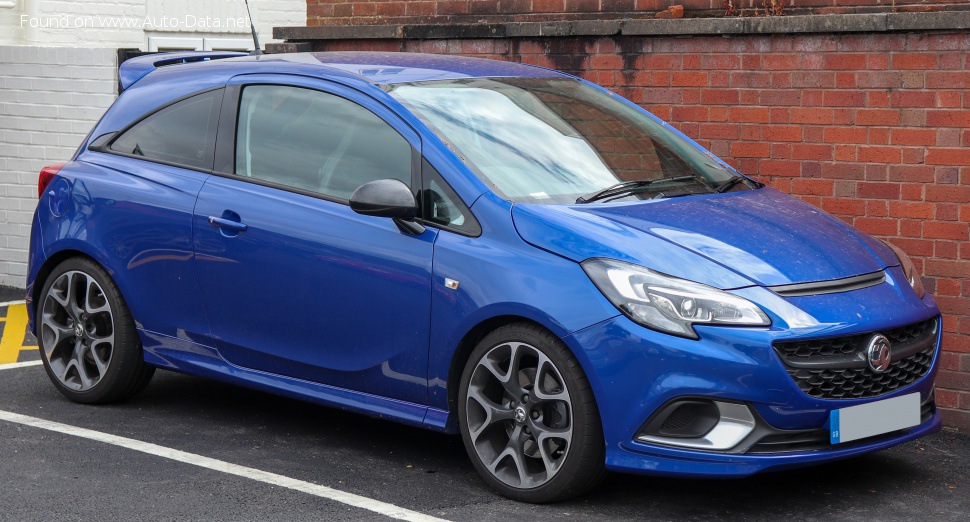
The Vauxhall Corsa E adopted a more mature and sophisticated design compared to its predecessor, featuring sharper lines, a more prominent grille, and updated lighting signatures. As a 5-door hatchback, it prioritized practicality and accessibility, offering seating for five occupants. The interior was also significantly revamped, with higher quality materials and a more ergonomic layout, aiming to provide a more premium feel within its segment. While specific interior features beyond the general data are not provided, it’s typical for cars of this era and segment to offer options like touchscreen infotainment systems, climate control, and various connectivity features.
Dimensionally, the Corsa E maintained a compact footprint suitable for urban driving, with a length of 158.31 inches (4021 mm), a width of 68.35 inches (1736 mm, or 76.54 inches including mirrors), and a height of 58.31 inches (1481 mm). Its wheelbase measured 98.82 inches (2510 mm), contributing to a stable ride and good interior space for its class. The minimum turning circle of 36.09 feet (11.00 m) made it agile in tight spaces.
For a subcompact car, the Corsa E offered reasonable cargo capacity, with a minimum trunk space of 9.89 cubic feet (280 liters), expanding to a generous 38.49 cubic feet (1090 liters) with the rear seats folded down. This flexibility made it a versatile choice for everything from weekly grocery runs to weekend trips. Safety features included standard ABS (Anti-lock Braking System), a fundamental technology for preventing wheel lock-up during hard braking and maintaining steering control. The drivetrain architecture, with the internal combustion engine driving the front wheels, is a common and efficient layout for vehicles in this class, optimizing packaging and handling.
The suspension system comprised an independent McPherson type at the front and a semi-independent coil spring setup at the rear, a typical configuration for balancing ride comfort and handling dynamics in a small car. Braking was handled by disc brakes at both the front and rear, providing confident stopping power. Standard tire sizes ranged from 185/70 R14 to 185/65 R15, fitted on 5.5J x 14 or 6.0J x 15 wheel rims, offering a balance of grip and ride comfort.
Technical Specifications: Vauxhall Corsa E 1.4i Turbo (150 Hp) Start/Stop
| Category | Specification | US Equivalent (where applicable) |
|---|---|---|
| General Information | ||
| Brand | Vauxhall | |
| Model | Corsa | |
| Generation | Corsa E | |
| Type (Engine) | 1.4i Turbo (150 Hp) start/stop | |
| Start of Production | March, 2015 | |
| End of Production | April, 2018 | |
| Powertrain Architecture | Internal Combustion engine | |
| Body Type | Hatchback | |
| Seats | 5 | |
| Doors | 5 | |
| Performance Specs | ||
| Fuel Consumption (urban) | 7.4 l/100 km | 31.8 US mpg |
| Fuel Consumption (extra urban) | 4.8 l/100 km | 49 US mpg |
| Fuel Consumption (combined) | 5.7 l/100 km | 41.3 US mpg |
| CO2 Emissions | 132 g/km | |
| Fuel Type | Petrol (Gasoline) | |
| Acceleration 0 – 60 mph | 8.7 sec | |
| Acceleration 0 – 100 km/h | 9.2 sec | |
| Maximum Speed | 207 km/h | 128.62 mph |
| Emission Standard | Euro 6 | |
| Weight-to-Power Ratio | 7.5 kg/Hp | 133.9 Hp/tonne |
| Weight-to-Torque Ratio | 5.1 kg/Nm | 196.4 Nm/tonne |
| Engine Specs | ||
| Power | 150 Hp @ 5000 rpm | |
| Power per liter | 110 Hp/l | |
| Torque | 220 Nm @ 2750-4500 rpm | 162.26 lb.-ft. @ 2750-4500 rpm |
| Engine Layout | Front, Transverse | |
| Engine Model/Code | B14NEH | |
| Engine Displacement | 1364 cm³ | 83.24 cu. in. |
| Number of Cylinders | 4 | |
| Engine Configuration | Inline | |
| Cylinder Bore | 72.5 mm | 2.85 in. |
| Piston Stroke | 82.6 mm | 3.25 in. |
| Compression Ratio | 9.5:1 | |
| Number of Valves per Cylinder | 4 | |
| Fuel Injection System | Multi-port manifold injection | |
| Engine Aspiration | Turbocharger, Intercooler | |
| Engine Oil Capacity | 4 l | 4.23 US qt |
| Coolant Capacity | 5.1 l | 5.39 US qt |
| Engine Systems | Start & Stop System | |
| Space, Volume and Weights | ||
| Kerb Weight | 1120-1199 kg | 2469.18 – 2643.34 lbs. |
| Max. Weight | 1605-1665 kg | 3538.42 – 3670.7 lbs. |
| Max Load | 466-485 kg | 1027.35 – 1069.24 lbs. |
| Trunk (boot) Space – minimum | 280 l | 9.89 cu. ft. |
| Trunk (boot) Space – maximum | 1090 l | 38.49 cu. ft. |
| Fuel Tank Capacity | 45 l | 11.89 US gal |
| Max. Roof Load | 75 kg | 165.35 lbs. |
| Permitted Trailer Load with brakes (12%) | 700-1200 kg | 1543.24 – 2645.55 lbs. |
| Permitted Trailer Load without brakes | 540-580 kg | 1190.5 – 1278.68 lbs. |
| Dimensions | ||
| Length | 4021 mm | 158.31 in. |
| Width | 1736 mm | 68.35 in. |
| Width including mirrors | 1944 mm | 76.54 in. |
| Height | 1481 mm | 58.31 in. |
| Wheelbase | 2510 mm | 98.82 in. |
| Front Track | 1472 mm | 57.95 in. |
| Rear (Back) Track | 1464 mm | 57.64 in. |
| Front Overhang | 881 mm | 34.69 in. |
| Rear Overhang | 630 mm | 24.8 in. |
| Minimum Turning Circle (turning diameter) | 11.00 m | 36.09 ft. |
| Drivetrain, Brakes and Suspension Specs | ||
| Drivetrain Architecture | Internal combustion engine drives the front wheels. | |
| Drive Wheel | Front wheel drive | |
| Number of Gears and Type of Gearbox | 6 gears, manual transmission | |
| Front Suspension | Independent type McPherson | |
| Rear Suspension | Semi-independent, coil spring | |
| Front Brakes | Disc | |
| Rear Brakes | Disc | |
| Assisting Systems | ABS (Anti-lock braking system) | |
| Steering Type | Steering rack and pinion | |
| Tires Size | 185/70 R14 88; 185/65 R15 88 | |
| Wheel Rims Size | 5.5J x 14; 6.0J x 15 | |
Legacy and Market Impact of the Vauxhall Corsa E
The Vauxhall Corsa has a long-standing legacy in the United Kingdom, consistently ranking among the best-selling cars for decades. The Corsa E generation continued this tradition, proving to be a highly popular and influential model in its segment. Its success was built upon a formula of attractive styling, practical packaging, decent driving dynamics, and a strong value proposition. In the broader European market, its Opel sibling, the Corsa E, enjoyed similar popularity, collectively making it a formidable competitor.
In its primary markets, the Vauxhall Corsa E 1.4i Turbo (150 Hp) start/stop faced intense competition from a host of well-established rivals. Key competitors included the Ford Fiesta, a perennial sales leader known for its agile handling; the Volkswagen Polo, which offered a more refined and premium feel; and the Renault Clio, recognized for its distinctive style and comfortable ride. Other notable contenders included the Peugeot 208, Citroën C3, Skoda Fabia, and Seat Ibiza, each vying for a share of the lucrative supermini market.
The 1.4i Turbo (150 Hp) variant, in particular, played an important role in the Corsa E lineup. It offered a compelling middle ground for buyers who wanted more performance than the standard naturally aspirated engines but didn’t necessarily require or want the higher running costs and harder edge of the range-topping VXR/OPC models. It delivered a genuinely enjoyable driving experience, with enough power to make highway cruising comfortable and city driving sprightly, all while maintaining reasonable fuel efficiency thanks to its turbocharging and start/stop technology.
The Corsa E generation, and especially its more potent versions like the 1.4i Turbo, contributed to Vauxhall’s reputation for producing reliable, accessible, and well-rounded vehicles. Its broad appeal stemmed from its ability to cater to a diverse range of buyers, from young drivers looking for their first car to small families needing a versatile and economical daily driver. The car’s robust sales figures and widespread presence on European roads during its production run underscore its significant market impact and enduring legacy as a practical, efficient, and, in this specific trim, surprisingly engaging supermini. As Vauxhall transitioned ownership from General Motors to PSA Group (now Stellantis) shortly after the Corsa E’s production concluded, this generation stands as a testament to the brand’s heritage under its previous stewardship.