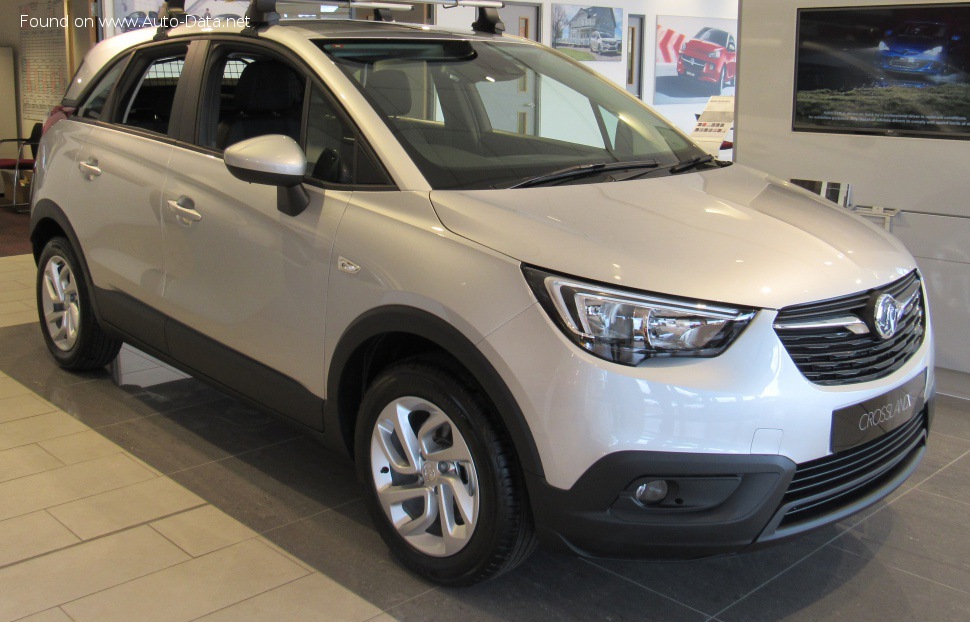
Vauxhall Crossland (facelift 2020) 1.2 Turbo (110 Hp)
The Vauxhall Crossland, particularly its 2020 facelift model equipped with the 1.2-liter Turbo (110 Hp) engine, represents a key offering in the highly competitive European compact SUV segment. As a prominent British automotive brand, Vauxhall operates primarily within the United Kingdom, serving as the sister marque to Opel across continental Europe. The Crossland, a five-door, five-seat compact crossover utility vehicle (CUV), was initially introduced in 2017 as the Crossland X, replacing the Meriva mini MPV. The 2020 facelift dropped the “X” suffix, aligning it with Vauxhall’s updated nomenclature and introducing a refreshed design language, enhanced technology, and improved powertrain options. This specific iteration, with its efficient 1.2-liter turbocharged gasoline engine, is designed to appeal to urban families and individuals seeking a practical, economical, and stylish vehicle for daily commuting and light adventurous pursuits.
The Evolution of the Vauxhall Crossland
The Crossland’s journey began as a joint venture between Opel/Vauxhall and PSA Group (now part of Stellantis) prior to Opel/Vauxhall’s acquisition by PSA. This collaboration led to the Crossland sharing its platform with other PSA models, such as the Peugeot 2008 and Citroën C3 Aircross, emphasizing practicality, efficiency, and a compact footprint. The 2020 facelift brought significant visual updates, most notably the adoption of Vauxhall’s “Vizor” front fascia, a signature design element that integrates the grille, headlights, and brand logo into a single, sleek module. Beyond aesthetics, the refresh also introduced improvements to the chassis and steering for a more engaging driving experience, alongside updated infotainment and driver-assistance systems, solidifying its position as a modern contender in its segment.
Engine and Performance: Powering the Vauxhall Crossland
At the heart of the Vauxhall Crossland 1.2 Turbo (110 Hp) lies a sophisticated F12XHL 1.2-liter (1199 cm3 or 73.17 cu. in.) inline three-cylinder gasoline engine. This powerplant benefits from modern engineering techniques, including a turbocharger and intercooler, direct fuel injection, and a Double Overhead Camshaft (DOHC) valvetrain with Variable Valve Timing (VVT). These technologies combine to deliver a robust 110 horsepower at 5500 revolutions per minute (rpm) and a healthy 151.2 lb.-ft. of torque available from a low 1750 rpm. The early availability of peak torque is crucial for a vehicle of this type, providing responsive acceleration and flexible in-gear performance, particularly beneficial in urban environments and for highway overtaking.
Power is transmitted to the front wheels via a precise 6-speed manual transmission, offering drivers an engaging and efficient driving experience. The Crossland 1.2 Turbo (110 Hp) can accelerate from 0 to 60 miles per hour in a respectable 10.5 seconds and achieve a maximum speed of 116.2 mph. Despite its spirited performance, the engine remains remarkably fuel-efficient, with a combined WLTP fuel consumption rating of 40.6 to 39.9 US miles per gallon. This efficiency is further bolstered by a Start & Stop system and a particulate filter, contributing to lower CO2 emissions of 131-134 grams per kilometer, allowing the vehicle to meet stringent Euro 6d emission standards. The engine’s compact design and aluminum construction also contribute to overall vehicle weight management, enhancing both performance and fuel economy.
Design and Features
The Vauxhall Crossland (facelift 2020) presents a contemporary and robust design, characteristic of the compact SUV segment. Its five-door SUV body type offers practical access for passengers and cargo, while its raised ride height provides a commanding view of the road and ease of entry and exit. The “Vizor” front end, a key differentiator of the facelift model, gives the Crossland a confident and modern aesthetic, distinguishing it from its pre-facelift predecessor. With a length of 165.83 inches, a width of 69.49 inches (77.8 inches including mirrors), and a height of 63.19 inches, the Crossland strikes a balance between urban maneuverability and interior spaciousness. The 102.52-inch wheelbase ensures a stable ride and ample cabin room for five occupants.
Inside, the Crossland focuses on practicality and user-friendly features. The cabin is designed to be ergonomic, with controls logically placed for the driver. The flexible interior offers a minimum trunk space of 14.48 cubic feet, which can expand significantly to 44.32 cubic feet with the rear seats folded down, making it highly versatile for various cargo needs. Standard features for safety and convenience include an Anti-lock Braking System (ABS) and Electric Power Steering, ensuring confident handling and braking performance. The vehicle rides on either 195/60 R16 or 215/50 R17 tires, depending on the trim level, mounted on 16-inch or 17-inch wheel rims, complementing its SUV stance. The drivetrain architecture is front-wheel drive, a common and efficient setup for this class of vehicle.
Technical Specifications
| Category | Specification |
|---|---|
| Brand | Vauxhall |
| Model | Crossland (facelift 2020) |
| Type (Engine) | 1.2 Turbo (110 Hp) |
| Start of Production | October, 2020 |
| Body Type | SUV |
| Seats | 5 |
| Doors | 5 |
| Powertrain Architecture | Internal Combustion Engine (Front-wheel drive) |
| Fuel Type | Petrol (Gasoline) |
| Combined Fuel Consumption (WLTP) | 40.6 – 39.9 US mpg (5.8-5.9 l/100 km) |
| CO2 Emissions (WLTP) | 131-134 g/km |
| Emission Standard | Euro 6d |
| Acceleration 0 – 60 mph | 10.5 seconds |
| Maximum Speed | 116.2 mph (187 km/h) |
| Power | 110 Hp @ 5500 rpm |
| Power per liter | 91.7 Hp/l |
| Torque | 151.2 lb.-ft. @ 1750 rpm (205 Nm) |
| Engine Layout | Front, Transverse |
| Engine Model/Code | F12XHL |
| Engine Displacement | 1.2 liters (1199 cm3 / 73.17 cu. in.) |
| Number of Cylinders | 3 |
| Engine Configuration | Inline |
| Number of Valves per Cylinder | 4 |
| Fuel Injection System | Direct injection |
| Engine Aspiration | Turbocharger, Intercooler |
| Valvetrain | DOHC, VVT |
| Engine Oil Capacity | 3.7 US qt (3.5 l) |
| Coolant Capacity | 6.02 US qt (5.7 l) |
| Engine Systems | Start & Stop System, Particulate Filter |
| Max. Weight (Gross Vehicle Weight) | 3902.18 lbs. (1770 kg) |
| Trunk (boot) Space – Minimum | 14.48 cu. ft. (410 l) |
| Trunk (boot) Space – Maximum | 44.32 cu. ft. (1255 l) |
| Fuel Tank Capacity | 11.89 US gal (45 l) |
| Permitted Trailer Load with Brakes (12%) | 1851.88 lbs. (840 kg) |
| Permitted Trailer Load without Brakes | 1322.77 lbs. (600 kg) |
| Length | 165.83 in. (4212 mm) |
| Width | 69.49 in. (1765 mm) |
| Width Including Mirrors | 77.8 in. (1976 mm) |
| Height | 63.19 in. (1605 mm) |
| Wheelbase | 102.52 in. (2604 mm) |
| Front Overhang | 35.28 in. (896 mm) |
| Rear Overhang | 28.03 in. (712 mm) |
| Drag Coefficient (Cd) | 0.31 |
| Minimum Turning Circle (Turning Diameter) | 36.78 ft. (11.21 m) |
| Drive Wheel | Front-wheel drive |
| Number of Gears and Type of Gearbox | 6 gears, manual transmission |
| Front Suspension | Independent, McPherson with coil spring and anti-roll bar |
| Rear Suspension | Dependent spring suspension |
| Front Brakes | Ventilated discs, 283 mm |
| Rear Brakes | Disc, 249 mm |
| Assisting Systems | ABS (Anti-lock Braking System) |
| Steering Type | Steering rack and pinion |
| Power Steering | Electric Steering |
| Tires Size | 195/60 R16; 215/50 R17 |
| Wheel Rims Size | 16; 17 inches |
Legacy and Market Impact in Europe
The Vauxhall Crossland, particularly its 2020 facelift model, plays a vital role in Vauxhall’s strategy within the highly competitive European automotive market. Positioned as a practical and value-oriented compact SUV, it caters to a broad demographic, from young families to empty nesters, who prioritize fuel efficiency, manageable dimensions, and versatile interior space. Its primary market is the United Kingdom, where Vauxhall maintains a strong brand presence and heritage, but it also shares its design and engineering with the Opel Crossland sold across continental Europe.
In a segment crowded with formidable rivals such as the Nissan Juke, Renault Captur, Peugeot 2008, Ford Puma, and Skoda Kamiq, the Crossland distinguishes itself through its blend of contemporary styling (especially with the “Vizor” front), competitive pricing, and a focus on practicality over outright sportiness. While it may not offer the most dynamic driving experience in its class, its comfortable ride, intuitive controls, and robust build quality appeal to buyers seeking a dependable daily driver. The efficient 1.2-liter turbocharged engine is particularly well-suited to European driving cycles, balancing performance with low running costs, a critical factor for many consumers.
The Crossland’s success is also tied to its heritage as a Vauxhall, a brand synonymous with accessible motoring for generations of British drivers. Its evolution from the Crossland X to the streamlined Crossland nameplate with the 2020 facelift signaled Vauxhall’s commitment to a clearer, more modern brand identity under Stellantis ownership. By offering a compelling package of design, efficiency, and utility, the Vauxhall Crossland continues to be a significant contributor to the brand’s sales volume and market share, reinforcing its reputation as a sensible and stylish choice in the burgeoning compact SUV segment across Europe.