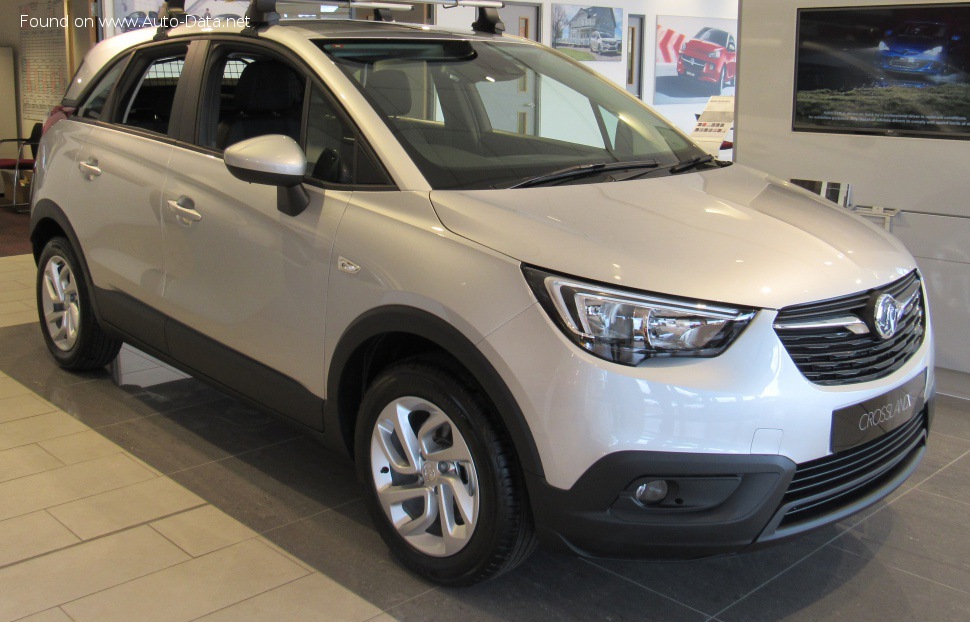
Vauxhall Crossland X 1.2 ecoTEC Turbo (110 Hp): A European Compact Crossover
The Vauxhall Crossland X 1.2 ecoTEC Turbo (110 Hp) represents a significant entry into the highly competitive subcompact crossover SUV segment for the British market. Launched in June 2017, the Crossland X was Vauxhall’s answer to the burgeoning demand for smaller, more versatile SUVs, effectively replacing the compact MPV (multi-purpose vehicle), the Meriva, in its lineup. This specific variant, produced from June 2017 to May 2018, highlights the early adoption of efficient turbocharged gasoline engines within the model range. While not offered in the United States, the Crossland X played a crucial role in Vauxhall’s strategy in Europe, catering to families and urban dwellers seeking a practical, elevated driving position vehicle with respectable fuel economy and maneuverability. It positioned itself as a more family-oriented and practical alternative to the sportier Mokka X, sharing its platform with the Peugeot 2008 and Citroën C3 Aircross, a result of Vauxhall’s then-recent acquisition by PSA Group (now Stellantis).
Engine and Performance of the Vauxhall Crossland X
At the heart of this particular Vauxhall Crossland X model is the 1.2-liter ecoTEC Turbo gasoline engine, a modern three-cylinder unit designed for a balance of efficiency and usable power. With an engine displacement of 1199 cm³ (73.17 cu. in.), this inline-three configuration delivers a healthy 110 horsepower at 5500 revolutions per minute (rpm). More notably for daily driving, it produces a robust 205 Nm (151.2 lb.-ft.) of torque, which is available remarkably early in the rev range, peaking at just 1500 rpm. This low-end torque characteristic is crucial for urban driving, providing brisk acceleration from a standstill and reducing the need for frequent gear changes.
The ecoTEC Turbo engine benefits from advanced technologies such as direct fuel injection, a turbocharger, and an intercooler. These features work in tandem to optimize combustion, boost power output without significantly increasing displacement, and enhance fuel efficiency. Power is routed to the front wheels via a 5-speed manual transmission, a common choice for its direct engagement and efficiency in the European market.
Performance figures reflect the car’s practical orientation. The Crossland X 1.2 ecoTEC Turbo (110 Hp) can reach a maximum speed of 188 km/h (116.82 mph). Fuel economy is a strong suit, with a combined rating of 4.9 liters per 100 kilometers, translating to an impressive 48 US miles per gallon (mpg). Urban driving yields 5.8 l/100 km (40.6 US mpg), while extra-urban (highway) driving improves to 4.3 l/100 km (54.7 US mpg). These figures underscore its design as an economical choice for both city commutes and longer journeys. Furthermore, with CO2 emissions of 111 g/km, the vehicle meets the stringent Euro 6 emission standard, showcasing its environmental responsibility for its production era. The engine oil capacity is 3.5 liters (3.7 US quarts), and the coolant system holds 5.7 liters (6.02 US quarts).
Design and Features
The Vauxhall Crossland X adopts the popular SUV body type, characterized by its elevated stance and rugged styling cues, albeit in a compact package. It is a 5-door vehicle designed to accommodate five occupants comfortably. Its dimensions reflect its urban-friendly nature: a length of 4212 mm (165.83 in.), a width of 1765 mm (69.49 in.) (1976 mm / 77.8 in. including mirrors), and a height of 1605 mm (63.19 in.). The relatively short wheelbase of 2604 mm (102.52 in.) contributes to a compact turning circle of 11.21 meters (36.78 ft.), making it highly maneuverable in tight city streets and parking lots.
Inside, the Crossland X prioritizes practicality and versatility. The trunk (boot) space is generous for its segment, offering a minimum of 410 liters (14.48 cu. ft.) with the rear seats in place. This expands significantly to 1255 liters (44.32 cu. ft.) when the rear seats are folded down, providing ample cargo capacity for various needs, from grocery runs to holiday luggage. The fuel tank capacity is 45 liters (11.89 US gallons), offering a decent range given its efficient engine.
In terms of its chassis and safety features, the Crossland X is equipped with a reliable front-wheel-drive architecture. Braking is handled by ventilated discs at the front and solid discs at the rear, complemented by an Anti-lock Braking System (ABS) as standard, enhancing control during emergency stops. The steering system is a rack and pinion setup with electric power steering, providing light and responsive handling at low speeds while firming up for stability at higher velocities. The vehicle rides on 215/50 R17 tires mounted on 17-inch wheel rims, a common size that balances ride comfort with handling characteristics.
Technical Specifications
| Category | Specification | US Equivalent (where applicable) |
|---|---|---|
| General Information | ||
| Brand | Vauxhall | |
| Model | Crossland | |
| Generation | Crossland X | |
| Engine Type | 1.2 ecoTEC Turbo (110 Hp) | |
| Production Start | June, 2017 | |
| Production End | May, 2018 | |
| Powertrain Architecture | Internal Combustion Engine | |
| Body Type | SUV | |
| Seats | 5 | |
| Doors | 5 | |
| Performance Specs | ||
| Fuel Consumption (Urban) | 5.8 l/100 km | 40.6 US mpg |
| Fuel Consumption (Extra Urban) | 4.3 l/100 km | 54.7 US mpg |
| Fuel Consumption (Combined) | 4.9 l/100 km | 48 US mpg |
| CO2 Emissions | 111 g/km | |
| Fuel Type | Petrol (Gasoline) | |
| Maximum Speed | 188 km/h | 116.82 mph |
| Emission Standard | Euro 6 | |
| Engine Specs | ||
| Power | 110 Hp @ 5500 rpm | |
| Power per Liter | 91.7 Hp/l | |
| Torque | 205 Nm @ 1500 rpm | 151.2 lb.-ft. @ 1500 rpm |
| Engine Layout | Front, Transverse | |
| Engine Model/Code | B12XHL | |
| Engine Displacement | 1199 cm³ | 73.17 cu. in. |
| Number of Cylinders | 3 | |
| Engine Configuration | Inline | |
| Valves per Cylinder | 4 | |
| Fuel Injection System | Direct Injection | |
| Engine Aspiration | Turbocharger, Intercooler | |
| Engine Oil Capacity | 3.5 l | 3.7 US qt |
| Coolant Capacity | 5.7 l | 6.02 US qt |
| Space, Volume and Weights | ||
| Trunk (Boot) Space – Minimum | 410 l | 14.48 cu. ft. |
| Trunk (Boot) Space – Maximum | 1255 l | 44.32 cu. ft. |
| Fuel Tank Capacity | 45 l | 11.89 US gal |
| Dimensions | ||
| Length | 4212 mm | 165.83 in. |
| Width | 1765 mm | 69.49 in. |
| Width Including Mirrors | 1976 mm | 77.8 in. |
| Height | 1605 mm | 63.19 in. |
| Wheelbase | 2604 mm | 102.52 in. |
| Minimum Turning Circle | 11.21 m | 36.78 ft. |
| Drivetrain, Brakes and Suspension | ||
| Drivetrain Architecture | Internal Combustion engine drives front wheels | |
| Drive Wheel | Front-wheel drive | |
| Gearbox Type | 5 gears, manual transmission | |
| Front Brakes | Ventilated discs | |
| Rear Brakes | Disc | |
| Assisting Systems | ABS (Anti-lock braking system) | |
| Steering Type | Steering rack and pinion | |
| Power Steering | Electric Steering | |
| Tire Size | 215/50 R17 | |
| Wheel Rims Size | 17 inches | |
Legacy and Market Impact of the Vauxhall Crossland X
The Vauxhall Crossland X, including the 1.2 ecoTEC Turbo (110 Hp) variant, arrived at a pivotal moment for Vauxhall and the European automotive market. The shift from traditional MPVs to more stylish and perceived rugged compact SUVs was in full swing, and the Crossland X was designed to capture a significant share of this expanding segment. Its role was to offer a compelling option for buyers who valued practicality, interior space, and an elevated driving position, without requiring the all-wheel-drive capabilities or larger footprint of a traditional SUV.
In its primary markets, particularly the UK and continental Europe (where it was sold as the Opel Crossland X), it faced stiff competition from a growing list of rivals. Key competitors included the Nissan Juke, Renault Captur, Peugeot 2008, Citroën C3 Aircross, Ford EcoSport, Hyundai Kona, and Kia Stonic. The Crossland X differentiated itself with its strong emphasis on interior versatility, notably its sliding rear seats (though not explicitly detailed in this variant’s data, it was a common Crossland X feature), and a comfortable, compliant ride quality suited for varying European road conditions.
The 1.2 ecoTEC Turbo engine, with its 110 horsepower, was a popular choice, striking an excellent balance between performance for daily driving and impressive fuel economy. This made it an attractive proposition for both private buyers and fleet operators concerned with running costs and environmental impact, especially given its Euro 6 compliance. Its compact dimensions and electric power steering also cemented its reputation as an agile and easy-to-park vehicle, ideal for bustling urban environments.
The Crossland X’s introduction also marked one of the first products to emerge from Vauxhall/Opel’s new ownership under PSA Group. While much of its development preceded the full integration, it showcased a strategic alignment towards shared platforms and powertrains that would define future models. The vehicle’s success helped solidify Vauxhall’s presence in the lucrative crossover segment, complementing the sportier Mokka X and contributing to the brand’s overall sales performance. Its legacy continues as the model dropped the “X” suffix in 2020, becoming simply the “Vauxhall Crossland,” receiving a facelift and further refinements, demonstrating its enduring relevance and appeal in the European market.