
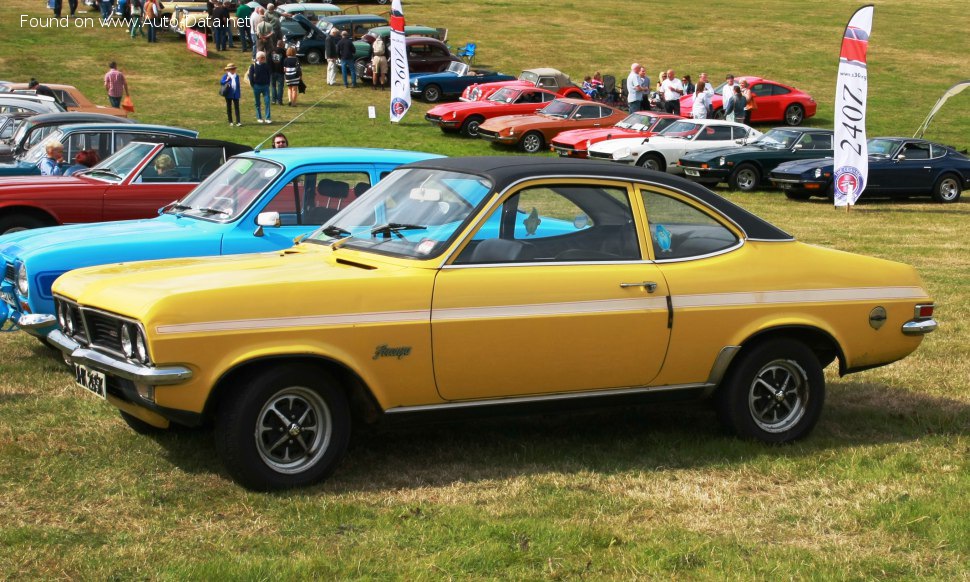
The Vauxhall Firenza Coupe 2300: A British Sporting Contender
The
Vauxhall Firenza Coupe 2300
represents a significant, albeit often overlooked, chapter in British automotive history, embodying Vauxhall’s efforts to inject sportiness and performance into its lineup during the early 1970s. Launched in 1972 as part of the Firenza Coupe generation, this particular variant, with its 2.3-liter engine producing 111 horsepower, stood as a more potent and enthusiast-focused offering within the range. Originating from Vauxhall, a brand primarily focused on the United Kingdom and European markets, the Firenza Coupe was never officially sold in the United States, yet it shares a design language and engineering philosophy common to many global coupes of its era. It was positioned as a stylish and relatively affordable performance coupe, designed to appeal to buyers seeking a blend of practicality and driving engagement. Its rear-wheel-drive architecture and robust engine were key components of its sporting appeal, making it a distinctive presence on British and European roads until the end of its production run in 1974.
Engine and Performance of the Vauxhall Firenza Coupe 2300
At the heart of the
Vauxhall Firenza Coupe 2300
was a naturally aspirated, internal combustion engine designed to deliver a spirited driving experience for its time. This 2.3-liter unit was a derivative of Vauxhall’s robust “Slant Four” engine family, known for its durability and tunability. With a power output of 111 horsepower, the engine provided respectable performance for a car of its class and era. The naturally aspirated design meant a linear power delivery, characteristic of engines from the early 1970s, without the complexities or lag associated with forced induction systems.
Power was transmitted to the rear wheels, a classic setup for performance-oriented vehicles that contributed to the Firenza Coupe’s engaging handling dynamics. This rear-wheel-drive architecture, combined with the 111 horsepower engine, allowed the Firenza Coupe 2300 to offer a lively and somewhat predictable driving experience, appealing to enthusiasts who valued driver involvement. While not a supercar by any stretch, its performance was competitive with other European sporting coupes of the period, providing ample acceleration for spirited road use. The engine’s design emphasized a balance between everyday usability and the capacity for higher-revving performance, making the Firenza Coupe a versatile choice for its target market.
Maintenance considerations for this powertrain included an engine oil capacity of 4.8 liters (5.07 US quarts) and a coolant capacity of 8 liters (8.45 US quarts), standard figures for a four-cylinder engine of this size. These specifications highlight the conventional, yet robust, engineering practices employed by Vauxhall during this period, ensuring reliability and straightforward servicing for owners.
Design and Features
The Vauxhall Firenza Coupe’s design was a product of its time, characterized by sharp lines, a relatively long hood, and a distinctive fastback profile. As a two-door coupe, it exuded a sporty aesthetic that was popular in the early 1970s, aiming to capture the imagination of a younger, more style-conscious demographic. The body type featured seating for five, making it a practical option for small families or groups, despite its sporty pretensions. The two-door configuration emphasized its coupe identity, prioritizing sleekness over ultimate passenger access.
Externally, the Firenza Coupe shared visual cues with other European sporty models, yet maintained a unique Vauxhall identity. The 1972-1974 models generally sported a more conventional front end before the dramatic “Droopsnoot” redesign of the later HPF (High Performance Firenza) model, which would become its most iconic iteration. Nevertheless, the standard Firenza Coupe 2300 still presented a confident and assertive stance.
Inside, the Firenza Coupe offered an interior typical of British cars of the era, focusing on functionality with a touch of sporty flair. Instrumentation was clear and driver-focused, providing essential information without excessive embellishment. While creature comforts were not as lavish as modern vehicles, the Firenza provided a comfortable and engaging environment for its occupants. The five-seat layout offered versatility, allowing for occasional rear passengers, though the coupe body style naturally meant less generous rear headroom and legroom compared to a traditional sedan. Safety features were rudimentary by today’s standards, primarily consisting of seatbelts and a sturdy body structure, reflecting the automotive safety regulations and technologies prevalent in the early 1970s.
Technical Specifications
| Category | Specification |
|---|---|
| General Information | |
| Brand | Vauxhall |
| Model | Firenza Coupe |
| Generation | Firenza Coupe |
| Type (Engine) | 2300 (111 Hp) |
| Start of Production | 1972 year |
| End of Production | 1974 year |
| Powertrain Architecture | Internal Combustion engine |
| Body type | Coupe |
| Seats | 5 |
| Doors | 2 |
| Performance Specs | |
| Fuel Type | Petrol (Gasoline) |
| Power | 111 Hp |
| Engine Aspiration | Naturally aspirated engine |
| Engine Oil Capacity | 4.8 l (5.07 US qt) |
| Coolant Capacity | 8 l (8.45 US qt) |
| Drivetrain, Brakes and Suspension Specs | |
| Drivetrain Architecture | The Internal combustion engine (ICE) drives the rear wheels of the vehicle. |
| Drive Wheel | Rear wheel drive |
Legacy and Market Impact of the Vauxhall Firenza Coupe
The Vauxhall Firenza Coupe, and particularly the 2300 variant, holds a unique place in the pantheon of British performance cars. While Vauxhall was often seen as a more conservative brand compared to its rivals, the Firenza Coupe was a bold attempt to challenge established players in the European sporting coupe segment, most notably the Ford Capri and the Triumph Dolomite Sprint. Its rear-wheel-drive layout and robust “Slant Four” engine provided a solid foundation for performance, offering a more engaging driving experience than many of its front-wheel-drive contemporaries.
Despite its inherent qualities, the Firenza Coupe faced stiff competition. The Ford Capri, with its wider range of engines and more extensive marketing, often overshadowed the Vauxhall. However, the Firenza carved out its own niche, appealing to those who appreciated its distinctive styling and straightforward mechanicals. Its reputation for durability and ease of maintenance also contributed to its appeal among enthusiasts.
The Firenza’s legacy was significantly cemented by the later High Performance Firenza (HPF), often referred to as the “Droopsnoot,” which emerged in 1975. Although the 2300 (111 Hp) model predates this iconic variant, it laid much of the groundwork. The “Droopsnoot,” with its radical aerodynamic nose and uprated mechanicals, became a homologation special for racing and is now highly sought after by collectors. This later model amplified the Firenza’s sporting image, retroactively enhancing the perception of earlier Firenza Coupes as part of a genuine performance lineage.
In terms of historical significance, the Vauxhall Firenza Coupe 2300 represented Vauxhall’s commitment to offering a desirable, sporty car during a challenging economic period for the British automotive industry. It showcased the brand’s engineering capabilities and its willingness to compete in a segment dominated by more glamorous names. Today, the Firenza Coupe is a cherished classic among British car enthusiasts, valued for its distinctive style, engaging driving dynamics, and its connection to a pivotal era in Vauxhall’s history. It stands as a testament to the diverse and often innovative automotive landscape of early 1970s Britain, a period when manufacturers experimented with design and performance to capture the hearts of a discerning public.
