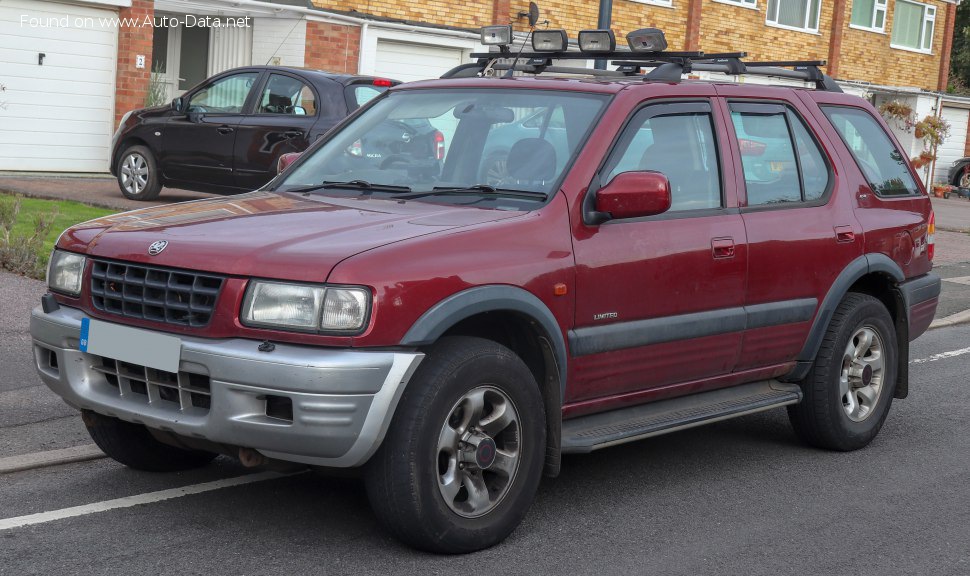
Vauxhall Frontera Mk II Sport 2.0 (116 Hp)
The Vauxhall Frontera Mk II Sport 2.0 (116 Hp) represents a pivotal offering in the burgeoning SUV market of the 1990s, particularly within the United Kingdom and Europe. Launched in 1992 as part of the second generation of the Frontera line, this compact, three-door sport utility vehicle was a rebadged variant of the Isuzu Amigo (also known as the Isuzu Rodeo Sport in North America, and Opel Frontera Sport in other European markets). While the Frontera nameplate itself was not directly sold in the United States, its underlying platform and engineering DNA were familiar to American consumers through its Isuzu siblings. The Mk II Sport, produced until 1998, aimed to capture a segment of buyers looking for a versatile vehicle that combined rugged off-road capability with the practicality of a daily driver, albeit with a sportier, more compact footprint than its five-door counterpart. Positioned as an accessible and relatively affordable SUV, it played a significant role in popularizing the segment across the Atlantic, offering a robust alternative to traditional passenger cars.
Engine and Performance of the Vauxhall Frontera Mk II Sport
Powering the Vauxhall Frontera Mk II Sport was a robust 2.0-liter (1998 cm3 or 121.93 cubic inches) naturally aspirated inline-four gasoline engine, internally designated as the X20SE. This powerplant was designed for durability and a balance of performance and efficiency suitable for both on-road and light off-road duties. Generating a respectable 116 horsepower at 5200 rpm, the engine provided sufficient motivation for the compact SUV. Torque figures stood at 126.86 lb.-ft. (172 Nm) delivered at a relatively low 2800 rpm, which was beneficial for off-road traction and city driving responsiveness. This engine configuration, featuring an Overhead Camshaft (OHC) valvetrain and multi-port manifold injection, was known for its straightforward design and reliability.
Mated to a five-speed manual transmission, the Frontera Mk II Sport channeled its power through an all-wheel-drive (4×4) system, emphasizing its utility and adventurous spirit. Performance metrics for the 2.0-liter variant were modest but adequate for its class and era. The vehicle could accelerate from 0 to 60 mph in a calculated 14.8 seconds, while its top speed was approximately 98.18 mph (158 km/h). Fuel economy, while not a primary selling point for SUVs of this period, was rated at an estimated 20.3 US mpg in urban driving conditions and a more favorable 30.2 US mpg on the extra-urban cycle, making it a reasonably economical choice for its segment at the time. Its weight-to-power ratio stood at 13.5 kg/Hp, or 74.1 Hp/tonne, reflecting its sturdy construction.
Design and Features of the Vauxhall Frontera Mk II Sport
The Vauxhall Frontera Mk II Sport adopted a classic three-door SUV body style, characterized by its relatively short wheelbase and compact dimensions, which contributed to its agility and maneuverability, especially off-road. Measuring 168.03 inches in length, 70.35 inches in width, and 66.61 inches in height, with a wheelbase of 96.93 inches, the Frontera Sport offered a more nimble alternative to its longer, five-door sibling. The design language was typical of 1990s SUVs, featuring a robust, somewhat boxy silhouette, prominent wheel arches, and a spare tire mounted on the rear tailgate, signaling its utilitarian intent.
Inside, the Frontera Mk II Sport was designed to accommodate five occupants, though the rear seating in a three-door SUV could be somewhat constrained. Cargo capacity was practical for its size, offering a minimum trunk space of 10.59 cubic feet (300 liters), which could expand significantly to 40.97 cubic feet (1160 liters) with the rear seats folded, providing ample room for luggage or recreational gear. The interior, while not luxurious, was functional and durable, designed to withstand the rigors of an active lifestyle.
In terms of mechanical design, the Frontera Mk II Sport featured an independent front suspension utilizing torsion bars, paired with a coil spring rear suspension. This setup aimed to provide a balance between on-road comfort and off-road articulation. Braking duties were handled by disc brakes at both the front and rear, augmented by an Anti-lock Braking System (ABS), a significant safety feature for vehicles of its era. Steering was a hydraulic power-assisted worm-reduction unit, providing predictable control. The vehicle rode on 235/70 R16 tires mounted on 6.5J x 16-inch wheel rims, offering a good balance of road grip and off-road capability. Its 80-liter (21.13 US gallon) fuel tank provided a decent cruising range.