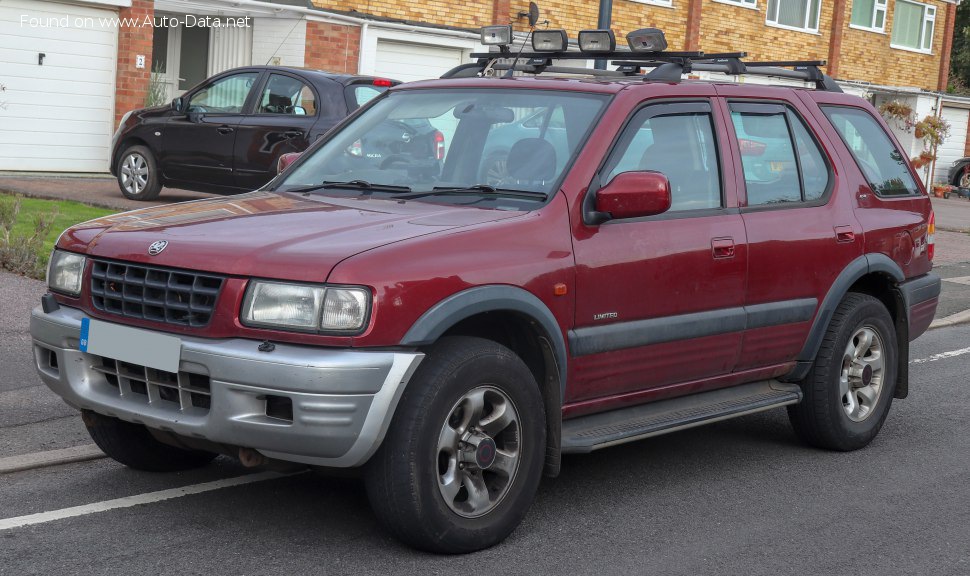
The Vauxhall Frontera Mk II Sport 2.2 DTI (116 Hp): A European Rugged SUV
The Vauxhall Frontera Mk II Sport 2.2 DTI (116 Hp) represents a significant chapter in the history of compact to mid-size sport utility vehicles (SUVs) within the European market, particularly in the United Kingdom where the Vauxhall brand operates as a subsidiary of General Motors. Produced from 1998 to 2003, this second-generation Frontera, known as the Opel Frontera across mainland Europe, was essentially a rebadged and re-engineered version of the Isuzu Rodeo (or Amigo in its two-door form in the North American market). It offered a blend of rugged off-road capability and on-road comfort, aiming to capture a segment of the burgeoning SUV market that valued practicality and robust construction. The “Sport” designation specifically referred to the more compact 3-door body style, which, coupled with its diesel powertrain, positioned it as an economical yet capable contender for those seeking an adventure-ready vehicle without the full bulk of larger SUVs.
At a time when SUVs were transitioning from purely utilitarian vehicles to more lifestyle-oriented options, the Vauxhall Frontera Mk II Sport sought to bridge this gap. Its development leaned heavily on Isuzu’s established four-wheel-drive expertise, providing a reliable platform for Vauxhall and Opel to offer a competitive product. The Mk II generation brought refinements in styling, interior comfort, and powertrain options over its predecessor, solidifying its place in a competitive market segment that included rivals from both European and Asian manufacturers.
Engine and Performance of the Vauxhall Frontera Mk II Sport
Under the hood of the Vauxhall Frontera Mk II Sport 2.2 DTI (116 Hp) lay a robust 2.2-liter (2171 cm3 or 132.48 cu. in.) inline four-cylinder diesel engine. This unit, designated X22DTH, was a direct-injection, turbocharged powerplant designed to deliver a balance of torque for off-road excursions and decent fuel economy for everyday driving. It produced a respectable 116 horsepower at 3800 rpm, which, while not groundbreaking, was adequate for an SUV of its size and intended purpose in the late 1990s. More importantly, the engine generated a healthy 191.77 lb.-ft. (260 Nm) of torque, peaking at a low 1900 rpm. This low-end torque was crucial for climbing steep grades, towing, and navigating challenging terrain, providing the necessary pulling power without excessive revving.
Power was transmitted to an all-wheel-drive (4×4) system via a 5-speed manual transmission, offering drivers full control over gear selection and optimizing power delivery for various conditions. The Frontera Mk II Sport could accelerate from 0 to 60 mph in a calculated 13.2 seconds, with a maximum speed of 96.31 mph (155 km/h). These figures placed it firmly in the mainstream for compact diesel SUVs of its era, emphasizing practicality and capability over outright speed.
Fuel efficiency was a key selling point for diesel engines in Europe, and the 2.2 DTI unit delivered reasonable figures for its class. In urban driving, it consumed approximately 11.5 liters per 100 km, translating to about 20.5 US mpg. On the extra-urban cycle, this improved significantly to 7.7 liters per 100 km, or an impressive 30.5 US mpg. With a 17.17 US gallon (65-liter) fuel tank, the Frontera offered a decent cruising range, making it suitable for longer journeys. The engine’s layout was front, longitudinal, and it featured an OHC (Overhead Camshaft) valvetrain with 4 valves per cylinder and a high compression ratio of 18.5:1, typical for a direct-injection diesel of its time.
Design and Features of the Vauxhall Frontera Mk II Sport
The Vauxhall Frontera Mk II Sport adopted a distinctive 3-door SUV body type, providing a sportier and more compact appearance compared to its 5-door sibling. Its dimensions—168.03 inches (4268 mm) in length, 70.35 inches (1787 mm) in width, and 66.61 inches (1692 mm) in height—made it maneuverable in urban environments while still offering a commanding driving position. The wheelbase measured 96.93 inches (2462 mm), contributing to its stability.
Despite its compact exterior, the interior was designed to accommodate five occupants, though rear access in the 3-door model required some flexibility. Cargo capacity was practical, with a minimum trunk space of 11.3 cu. ft. (320 liters) that could expand significantly to 40.15 cu. ft. (1137 liters) with the rear seats folded, making it versatile for hauling luggage or sports equipment.
In terms of chassis and suspension, the Frontera Mk II Sport featured a torsion bar front suspension and a coil spring rear suspension, a setup that aimed to balance on-road comfort with the articulation needed for off-road travel. Braking was handled by disc brakes at both the front and rear, complemented by an Anti-lock Braking System (ABS) for enhanced safety during emergency stops. The steering system was a hydraulic rack and pinion setup, providing direct feedback to the driver. Standard tires were 235/75 R15, mounted on 6.5J x 15-inch wheel rims, providing a good balance of grip and ride comfort for various terrains. While not laden with the advanced driver-assistance systems found in modern SUVs, the Frontera offered essential safety and convenience features for its era, focusing on robust mechanicals and proven 4×4 capability.
Technical Specifications
| Category | Specification |
|---|---|
| Brand | Vauxhall |
| Model | Frontera Mk II Sport |
| Type (Engine) | 2.2 DTI (116 Hp) |
| Production Years | 1998 – 2003 |
| Body Type | SUV, 3 Doors, 5 Seats |
| Powertrain Architecture | Internal Combustion Engine |
| Performance | |
| Power | 116 Hp @ 3800 rpm |
| Torque | 191.77 lb.-ft. (260 Nm) @ 1900 rpm |
| Acceleration 0-60 mph | 13.2 sec |
| Maximum Speed | 96.31 mph (155 km/h) |
| Fuel Type | Diesel |
| Fuel Consumption (Urban) | 20.5 US mpg (11.5 l/100 km) |
| Fuel Consumption (Extra Urban) | 30.5 US mpg (7.7 l/100 km) |
| Weight-to-power ratio | 14.8 kg/Hp (67.4 Hp/tonne) |
| Weight-to-torque ratio | 6.6 kg/Nm (151.2 Nm/tonne) |
| Engine Specs | |
| Engine Model/Code | X22DTH |
| Engine Layout | Front, Longitudinal |
| Engine Displacement | 2.2 liters (2171 cm3 / 132.48 cu. in.) |
| Number of Cylinders | 4, Inline |
| Cylinder Bore | 3.31 in. (84 mm) |
| Piston Stroke | 3.86 in. (98 mm) |
| Compression Ratio | 18.5:1 |
| Number of Valves per Cylinder | 4 |
| Fuel Injection System | Direct injection |
| Engine Aspiration | Turbocharger |
| Valvetrain | OHC |
| Engine Oil Capacity | 6.45 US qt (6.1 l) |
| Coolant Capacity | 8.35 US qt (7.9 l) |
| Dimensions & Weight | |
| Length | 168.03 in. (4268 mm) |
| Width | 70.35 in. (1787 mm) |
| Height | 66.61 in. (1692 mm) |
| Wheelbase | 96.93 in. (2462 mm) |
| Front Track | 59.65 in. (1515 mm) |
| Rear Track | 59.84 in. (1520 mm) |
| Kerb Weight | 3791.95 lbs. (1720 kg) |
| Max. Weight | 5070.63 lbs. (2300 kg) |
| Max Load | 1278.68 lbs. (580 kg) |
| Trunk Space (Min) | 11.3 cu. ft. (320 l) |
| Trunk Space (Max) | 40.15 cu. ft. (1137 l) |
| Fuel Tank Capacity | 17.17 US gal (65 l) |
| Drivetrain, Brakes & Suspension | |
| Drive Wheel | All-wheel drive (4×4) |
| Gearbox Type | 5 gears, manual transmission |
| Front Suspension | Torsion |
| Rear Suspension | Coil spring |
| Front Brakes | Disc |
| Rear Brakes | Disc |
| Assisting Systems | ABS (Anti-lock Braking System) |
| Steering Type | Steering rack and pinion |
| Power Steering | Hydraulic Steering |
| Tires Size | 235/75 R15 |
| Wheel Rims Size | 6.5J x 15 |
Legacy and Market Impact of the Vauxhall Frontera Mk II Sport
The Vauxhall Frontera Mk II Sport 2.2 DTI (116 Hp), along with its Opel counterpart, played a significant role in the European SUV market during its production run. Positioned as a rugged yet affordable option, it competed against a growing number of rivals, including the Land Rover Freelander, Toyota RAV4, Honda CR-V, and various offerings from European manufacturers like the Nissan Terrano II/Ford Maverick. While some competitors leaned more towards car-like comfort (like the RAV4 and CR-V), the Frontera maintained a more traditional body-on-frame construction, inherited from its Isuzu roots, which endowed it with genuine off-road credentials that many crossover SUVs lacked.
Its reputation was built on reliability, thanks to the robust Isuzu engineering, and its value proposition. For buyers in the UK and mainland Europe seeking a practical 4×4 with decent payload and towing capabilities, the Frontera offered a compelling package. The diesel engine, in particular, was well-suited to European tastes, providing good fuel economy and ample torque for varied driving conditions, from rural roads to highways. The “Sport” 3-door variant appealed to a younger demographic or those who didn’t require the full passenger capacity of the 5-door, often being chosen for its perceived sportiness and compact dimensions.
Despite its strengths, the Frontera faced challenges. The rise of more refined, car-based crossover SUVs began to overshadow traditional, truck-like models. While the Frontera offered a more comfortable ride than its first generation, it couldn’t match the on-road dynamics or interior sophistication of some of its newer, monocoque-chassis rivals. Nonetheless, it carved out a niche for itself as a dependable, no-nonsense SUV. Its legacy is that of a workhorse that capably served its owners, providing a bridge between pure utility vehicles and the more passenger-car-oriented SUVs that would dominate the market in subsequent decades. Today, the Vauxhall Frontera Mk II Sport remains a testament to a period when SUVs were still rugged and utilitarian at heart, offering a tangible connection to off-road heritage within the mainstream automotive landscape.