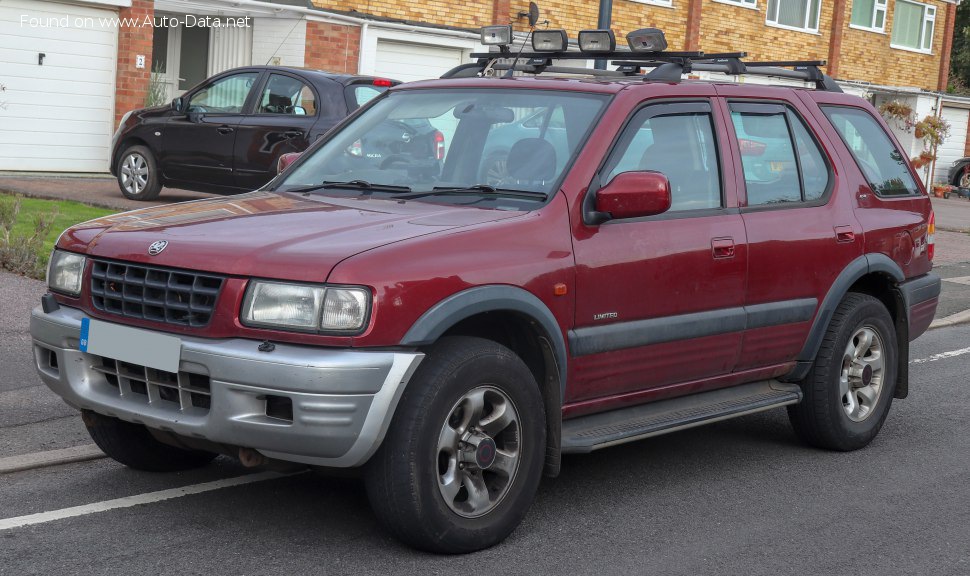
Vauxhall Frontera Mk II Sport 2.2 DTI (116 Hp) Automatic
The Vauxhall Frontera Mk II Sport 2.2 DTI (116 Hp) Automatic represents a significant chapter in the history of compact sport utility vehicles (SUVs) in the European market, particularly within the United Kingdom where Vauxhall operates as a sister brand to Opel. Produced from 1998 to 2003, this second-generation Frontera, known as the Frontera B in some markets, was a rugged, body-on-frame SUV designed to offer both on-road comfort and credible off-road capability. The “Sport” designation indicated the shorter-wheelbase, three-door variant, appealing to a demographic seeking a more compact and perhaps more “lifestyle” oriented 4×4 compared to its five-door sibling. At its core, the Frontera was a rebadged Isuzu Rodeo (or Amigo in North America), leveraging Isuzu’s established reputation for durable utility vehicles and adapting it for European tastes and regulations. This specific model, powered by a 2.2-liter turbo-diesel engine paired with an automatic transmission, aimed to provide a balance of fuel efficiency, torque for towing or off-roading, and ease of driving in an increasingly competitive SUV segment.
Engine and Performance of the Vauxhall Frontera Mk II Sport
Under the hood, the Vauxhall Frontera Mk II Sport 2.2 DTI (116 Hp) Automatic featured an X22DTH engine, a 2.2-liter (2171 cm³ or 132.48 cu. in.) inline-four turbo-diesel unit. This engine was notable for its direct injection fuel system, a technology that was gaining traction in diesel engines of the late 1990s for its improved fuel economy and power delivery. It produced a respectable 116 horsepower at 3800 revolutions per minute (rpm) and a robust 260 Newton meters (191.77 lb.-ft.) of torque, peaking at a low 1900 rpm. This low-end torque was particularly advantageous for an SUV, providing ample pulling power for off-road excursions, towing, or simply navigating challenging terrain.
Power was delivered to all four wheels through a 4-speed automatic transmission, offering a more relaxed driving experience compared to manual counterparts, especially in urban environments or during long-distance cruising. The all-wheel-drive (4×4) system ensured traction in varied conditions, from slippery roads to moderate off-road trails. Despite its utilitarian nature, the Frontera Mk II Sport offered decent performance for its class and era. It could accelerate from 0 to 60 mph in approximately 14.3 seconds, with a top speed of 96.31 mph (155 km/h). While not a speed demon, these figures were competitive for a diesel-powered SUV of its size and purpose. Fuel economy figures, crucial for diesel vehicles in Europe, were rated at 18.7 US mpg (12.6 l/100 km) in urban conditions and 28.7 US mpg (8.2 l/100 km) on the highway, reflecting a reasonable balance between power and efficiency for the period.
Design and Features
The design of the Vauxhall Frontera Mk II Sport was unmistakably that of a rugged SUV, yet it incorporated more refined styling cues than its predecessor. The second generation featured a more rounded and contemporary aesthetic, moving away from the boxy utilitarianism of the original. As a “Sport” model, it was a 3-door SUV, characterized by its shorter wheelbase (96.93 inches or 2462 mm) and overall length of 168.03 inches (4268 mm). This compact footprint made it more agile and easier to maneuver in tight spots, appealing to those who valued practicality and a slightly more youthful image.
The vehicle offered seating for five occupants, though rear access in a three-door configuration could be somewhat constrained. The interior, while functional, prioritized durability and ease of cleaning, consistent with a vehicle designed for adventure. Cargo capacity was practical for its size, offering a minimum trunk space of 11.3 cu. ft. (320 liters) which could expand significantly to 40.15 cu. ft. (1137 liters) with the rear seats folded down, making it versatile for carrying gear. Standard features included hydraulic power steering, a rack and pinion steering type for responsive handling, and an Anti-lock Braking System (ABS), which was becoming a standard safety feature in vehicles of this vintage. The braking system utilized ventilated discs at the front and solid discs at the rear, providing adequate stopping power. The Frontera rode on 235/75 R15 tires, mounted on 6.5J x 15-inch wheel rims, a common setup for SUVs of the era, balancing on-road comfort with off-road capability.
Technical Specifications
| Category | Specification | Value |
|---|---|---|
| General Information | Brand | Vauxhall |
| Model | Frontera | |
| Generation | Frontera Mk II Sport | |
| Type (Engine) | 2.2 DTI (116 Hp) Automatic | |
| Start of Production | 1998 year | |
| End of Production | 2003 year | |
| Powertrain Architecture | Internal Combustion engine | |
| Body type | SUV | |
| Seats | 5 | |
| Doors | 3 | |
| Performance Specs | Fuel consumption (economy) – urban | 12.6 l/100 km (18.7 US mpg) |
| Fuel consumption (economy) – extra urban | 8.2 l/100 km (28.7 US mpg) | |
| Fuel Type | Diesel | |
| Acceleration 0 – 60 mph | 14.3 seconds | |
| Acceleration 0 – 62 mph (0-100 km/h) | 15 seconds | |
| Maximum speed | 155 km/h (96.31 mph) | |
| Weight-to-power ratio | 14.8 kg/Hp (67.4 Hp/tonne) | |
| Weight-to-torque ratio | 6.6 kg/Nm (151.2 Nm/tonne) | |
| Engine Specs | Power | 116 Hp @ 3800 rpm |
| Power per liter | 53.4 Hp/l | |
| Torque | 260 Nm (191.77 lb.-ft.) @ 1900 rpm | |
| Engine layout | Front, Longitudinal | |
| Engine Model/Code | X22DTH | |
| Engine displacement | 2171 cm³ (2.2 liters, 132.48 cu. in.) | |
| Number of cylinders | 4 | |
| Engine configuration | Inline | |
| Cylinder Bore | 84 mm (3.31 in.) | |
| Piston Stroke | 98 mm (3.86 in.) | |
| Compression ratio | 18.5:1 | |
| Number of valves per cylinder | 4 | |
| Fuel injection system | Direct injection | |
| Engine aspiration | Turbocharger | |
| Valvetrain | OHC (Overhead Camshaft) | |
| Engine oil capacity | 6.1 l (6.45 US qt) | |
| Coolant | 7.9 l (8.35 US qt) | |
| Space, Volume and Weights | Kerb Weight | 1720 kg (3791.95 lbs) |
| Max. weight (Gross Vehicle Weight Rating) | 2300 kg (5070.63 lbs) | |
| Max load | 580 kg (1278.68 lbs) | |
| Trunk (boot) space – minimum | 320 l (11.3 cu. ft.) | |
| Trunk (boot) space – maximum | 1137 l (40.15 cu. ft.) | |
| Fuel tank capacity | 65 l (17.17 US gal) | |
| Dimensions | Length | 4268 mm (168.03 in.) |
| Width | 1787 mm (70.35 in.) | |
| Height | 1692 mm (66.61 in.) | |
| Wheelbase | 2462 mm (96.93 in.) | |
| Front track | 1515 mm (59.65 in.) | |
| Rear (Back) track | 1520 mm (59.84 in.) | |
| Drivetrain, Brakes and Suspension Specs | Drive wheel | All wheel drive (4×4) |
| Number of gears and type of gearbox | 4 gears, automatic transmission | |
| Front brakes | Ventilated discs | |
| Rear brakes | Disc | |
| Assisting systems | ABS (Anti-lock braking system) | |
| Steering type | Steering rack and pinion | |
| Power steering | Hydraulic Steering | |
| Tires size | 235/75 R15 | |
| Wheel rims size | 6.5J x 15 |
Legacy and Market Impact
The Vauxhall Frontera Mk II Sport 2.2 DTI (116 Hp) Automatic, like the entire Frontera line, carved out a niche in the burgeoning European SUV market as a reliable and relatively affordable option. Positioned below premium offerings from brands like Land Rover, it competed more directly with vehicles such as the Toyota RAV4, Honda CR-V, Suzuki Grand Vitara, and later, the Land Rover Freelander. Its robust, body-on-frame construction, inherited from its Isuzu origins, gave it a distinct advantage in terms of off-road durability over many of its car-based, unibody competitors, particularly for those needing to tow or venture off paved roads regularly.
In the UK, the Frontera was often praised for its value proposition, offering a genuine 4×4 experience without the hefty price tag of more established marques. The diesel engine, especially with an automatic transmission, made it an attractive choice for European consumers seeking a blend of economy and convenience. However, like many SUVs of its era, it faced scrutiny regarding its on-road refinement and fuel consumption compared to increasingly popular crossover vehicles that prioritized car-like handling and efficiency. Despite these criticisms, the Frontera developed a reputation as a workhorse, often used by farmers, tradespeople, and outdoor enthusiasts.
The Mk II Frontera’s production spanned a period when the SUV market was rapidly evolving. While it successfully updated its styling and retained its rugged core, the shift towards more car-like handling, greater fuel efficiency, and advanced safety features ultimately led to its discontinuation in 2004. Vauxhall, and its Opel counterpart, eventually replaced the Frontera with the Antara, a more modern, unibody crossover, reflecting the changing preferences of the global automotive market. Nevertheless, the Vauxhall Frontera Mk II Sport 2.2 DTI (116 Hp) Automatic remains a testament to an era when SUVs were defined by their go-anywhere capability and robust construction, leaving a lasting legacy as a dependable and accessible 4×4 in the European landscape.