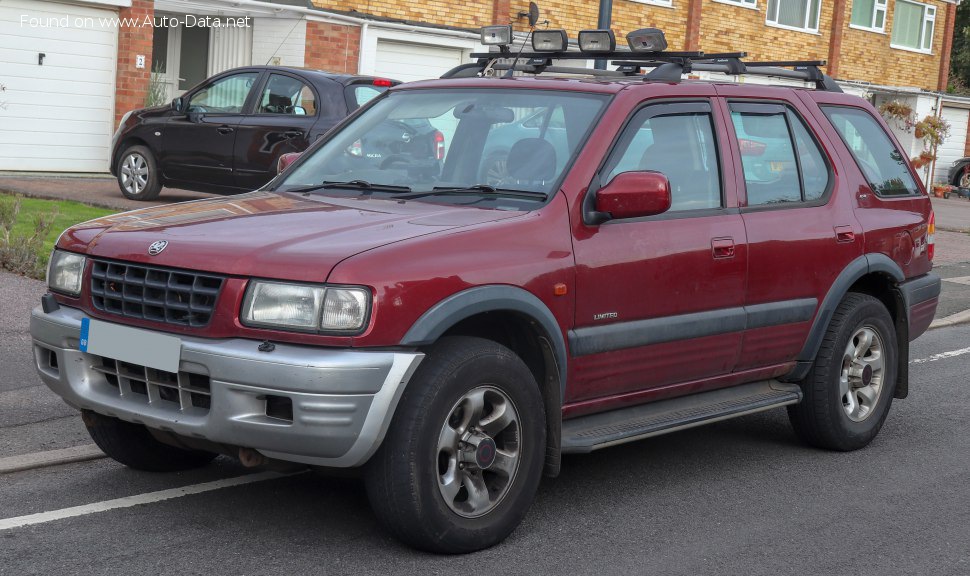
The Vauxhall Frontera Mk II Sport 2.2 DTI (120 Hp): A European Off-Roader
The Vauxhall Frontera Mk II Sport 2.2 DTI (120 Hp) represents a significant chapter in the history of compact and mid-size sport utility vehicles (SUVs) in the European market during the early 2000s. Produced for a brief period between 2003 and 2004, this particular variant was part of the second generation of the Frontera, a vehicle that served as Vauxhall’s rugged, body-on-frame offering in a rapidly evolving SUV landscape. As the British marque of General Motors (GM), Vauxhall often rebadged Opel models for the UK market, and the Frontera itself was a rebadged version of the Isuzu Rodeo (also known as the Isuzu MU Wizard in some markets). The Mk II Sport model, with its three-door configuration, aimed to blend genuine off-road capability with a slightly more compact and agile presence, targeting buyers seeking both utility and a touch of adventurous lifestyle.
Positioned as a competitor to vehicles like the Land Rover Freelander, Toyota RAV4, and Honda CR-V of its era, the Frontera offered a more traditional SUV experience, emphasizing robust construction and four-wheel-drive prowess over the burgeoning trend of car-like crossover comfort. The 2.2 DTI diesel engine, a staple of GM Europe’s powertrain lineup, provided a blend of torque-rich performance and reasonable fuel efficiency, making it a practical choice for both daily driving and more demanding off-road excursions across the diverse terrains of Europe.
Engine and Performance of the Vauxhall Frontera Mk II Sport
At the heart of the Vauxhall Frontera Mk II Sport 2.2 DTI (120 Hp) was its Y22DTH engine, a 2.2-liter (2171 cm³ or 132.48 cu. in.) inline-four turbodiesel unit. This engine, featuring a common rail fuel injection system, was designed to deliver a balance of power and economy, crucial for its target market. It produced a respectable 120 horsepower at 4000 rpm, which for a diesel SUV of its time, provided adequate motivation. More importantly for its intended utility and off-road capabilities, the engine generated a robust 280 Nm (206.52 lb.-ft.) of torque, peaking at a low 1500 rpm. This low-end torque was vital for pulling power, especially when navigating challenging terrain or towing.
Power was delivered to all four wheels via a 5-speed manual transmission, offering direct control and engagement that enthusiasts of traditional 4x4s appreciated. While not built for outright speed, the Frontera Mk II Sport could accelerate from 0 to 60 mph in a measured 13.8 seconds, with a maximum speed of 98.18 mph (158 km/h). These figures underscored its utilitarian nature rather than a focus on on-road performance. Fuel economy was a strong point for the diesel powertrain, with an urban consumption estimated at 22.2 US mpg (10.6 l/100 km) and a more efficient 34.1 US mpg (6.9 l/100 km) on the extra-urban cycle. This efficiency, combined with a 17.17 US gallon (65 l) fuel tank, provided a decent cruising range for long journeys. The engine’s robust design, featuring an 18.5:1 compression ratio and an OHC valvetrain with four valves per cylinder, contributed to its durability and consistent performance.
Design and Features
The Vauxhall Frontera Mk II Sport adopted the classic SUV silhouette, characterized by its sturdy, boxy proportions and high ground clearance. As a three-door model, it presented a more compact and sportier image compared to its five-door sibling, making it appealing to younger buyers or those who didn’t require extensive rear passenger access. Despite its more compact footprint, it comfortably seated five occupants, though rear access naturally required some compromise. The exterior design, while updated for the Mk II generation, retained a functional aesthetic, with prominent wheel arches and a purposeful stance that hinted at its off-road capabilities.
Inside, the Frontera Mk II Sport offered a straightforward and durable cabin, prioritizing functionality over luxury. Features were appropriate for the early 2000s, focusing on driver control and practicality. Key safety and assisting systems included ABS (Anti-lock Braking System), a crucial feature for maintaining control during hard braking, especially on uneven or slippery surfaces. The hydraulic power steering, utilizing a rack and pinion system, provided direct feedback to the driver, enhancing control on and off the road. The vehicle rode on 235/75 R15 tires, mounted on 15-inch wheel rims, a common specification for SUVs of its era, balancing on-road comfort with sufficient sidewall for off-road compliance.
Practicality was further enhanced by its cargo capacity. The minimum trunk space of 11.3 cu. ft. (320 l) was adequate for daily use, expanding significantly to 40.15 cu. ft. (1137 l) with the rear seats folded, demonstrating its versatility for carrying gear or luggage. With a kerb weight of 3791.95 lbs (1720 kg) and a maximum permissible weight of 5070.63 lbs (2300 kg), the Frontera was built to handle considerable loads, reinforcing its utility vehicle credentials.
Technical Specifications
| Category | Specification | Value |
|---|---|---|
| General Information | Brand | Vauxhall |
| Model | Frontera | |
| Generation | Frontera Mk II Sport | |
| Type (Engine) | 2.2 DTI (120 Hp) | |
| Start of production | 2003 year | |
| End of production | 2004 year | |
| Powertrain Architecture | Internal Combustion engine | |
| Body type | SUV | |
| Seats | 5 | |
| Doors | 3 | |
| Performance Specs | Fuel consumption (economy) – urban | 10.6 l/100 km (22.2 US mpg) |
| Fuel consumption (economy) – extra urban | 6.9 l/100 km (34.1 US mpg) | |
| Fuel Type | Diesel | |
| Acceleration 0 – 62 mph (0 – 100 km/h) | 14.5 sec | |
| Acceleration 0 – 60 mph (Calculated) | 13.8 sec | |
| Maximum speed | 158 km/h (98.18 mph) | |
| Weight-to-power ratio | 14.3 kg/Hp (69.8 Hp/tonne) | |
| Weight-to-torque ratio | 6.1 kg/Nm (162.8 Nm/tonne) | |
| Engine Specs | Power | 120 Hp @ 4000 rpm |
| Power per liter | 55.3 Hp/l | |
| Torque | 280 Nm @ 1500 rpm (206.52 lb.-ft. @ 1500 rpm) | |
| Engine layout | Front, Longitudinal | |
| Engine Model/Code | Y22DTH | |
| Engine displacement | 2171 cm³ (2.2 l / 132.48 cu. in.) | |
| Number of cylinders | 4 | |
| Engine configuration | Inline | |
| Cylinder Bore | 84 mm (3.31 in.) | |
| Piston Stroke | 98 mm (3.86 in.) | |
| Compression ratio | 18.5:1 | |
| Number of valves per cylinder | 4 | |
| Fuel injection system | Diesel Commonrail | |
| Engine aspiration | Turbocharger, Intercooler | |
| Valvetrain | OHC | |
| Engine oil capacity | 6.1 l (6.45 US qt) | |
| Coolant | 7.9 l (8.35 US qt) | |
| Space, Volume and Weights | Kerb Weight | 1720 kg (3791.95 lbs) |
| Max. weight | 2300 kg (5070.63 lbs) | |
| Max load | 580 kg (1278.68 lbs) | |
| Trunk (boot) space – minimum | 320 l (11.3 cu. ft.) | |
| Trunk (boot) space – maximum | 1137 l (40.15 cu. ft.) | |
| Fuel tank capacity | 65 l (17.17 US gal) | |
| Dimensions | Length | 4268 mm (168.03 in.) |
| Width | 1814 mm (71.42 in.) | |
| Height | 1755 mm (69.09 in.) | |
| Wheelbase | 2462 mm (96.93 in.) | |
| Front track | 1515 mm (59.65 in.) | |
| Rear (Back) track | 1520 mm (59.84 in.) | |
| Drivetrain, Brakes and Suspension Specs | Drive wheel | All wheel drive (4×4) |
| Number of gears and type of gearbox | 5 gears, manual transmission | |
| Front suspension | Torsion | |
| Rear suspension | Coil spring | |
| Front brakes | Disc | |
| Rear brakes | Disc | |
| Assisting systems | ABS (Anti-lock braking system) | |
| Steering type | Steering rack and pinion | |
| Power steering | Hydraulic Steering | |
| Tires size | 235/75 R15 | |
| Wheel rims size | 15 |
Legacy and Market Impact of the Vauxhall Frontera
The Vauxhall Frontera Mk II Sport 2.2 DTI (120 Hp), along with the rest of the Frontera lineup, carved out a niche in the competitive European SUV market. Its primary appeal stemmed from its robust, body-on-frame construction, which provided genuine off-road capability that many of its car-based crossover rivals could not match. As a rebadged Isuzu, it benefited from Isuzu’s reputation for building durable and capable utility vehicles, a heritage that resonated with buyers looking for a workhorse rather than just a fashion statement.
In its time, the Frontera competed against a diverse array of vehicles. European rivals included the aforementioned Land Rover Freelander, which offered a more premium feel, and various Japanese imports like the first and second-generation Toyota RAV4 and Honda CR-V, which leaned more towards on-road comfort and car-like handling. The Frontera differentiated itself by offering a more traditional, rugged 4×4 experience at a competitive price point. Its diesel engine options, particularly the 2.2 DTI, were well-suited to European driving conditions, providing a good balance of economy for highway cruising and torque for towing or off-road demands.
However, by the early 2000s, the market was rapidly shifting. Consumer preferences began to favor the comfort, fuel efficiency, and perceived safety of unibody crossovers. The Frontera, with its older body-on-frame design, became increasingly seen as less refined on pavement compared to its newer rivals. Its production ending in 2004 marked the close of an era for Vauxhall’s dedicated, traditional SUV offering.
Despite its eventual discontinuation, the Vauxhall Frontera holds a significant place in the brand’s history as a capable and honest SUV. It provided a reliable and affordable option for those in the UK and Europe who needed genuine four-wheel-drive capability, whether for rural living, towing, or simply navigating challenging weather conditions. Its legacy is that of a practical, no-nonsense utility vehicle that, while perhaps overshadowed by the rise of the crossover, remained true to the rugged spirit of the traditional SUV until the very end of its production run.