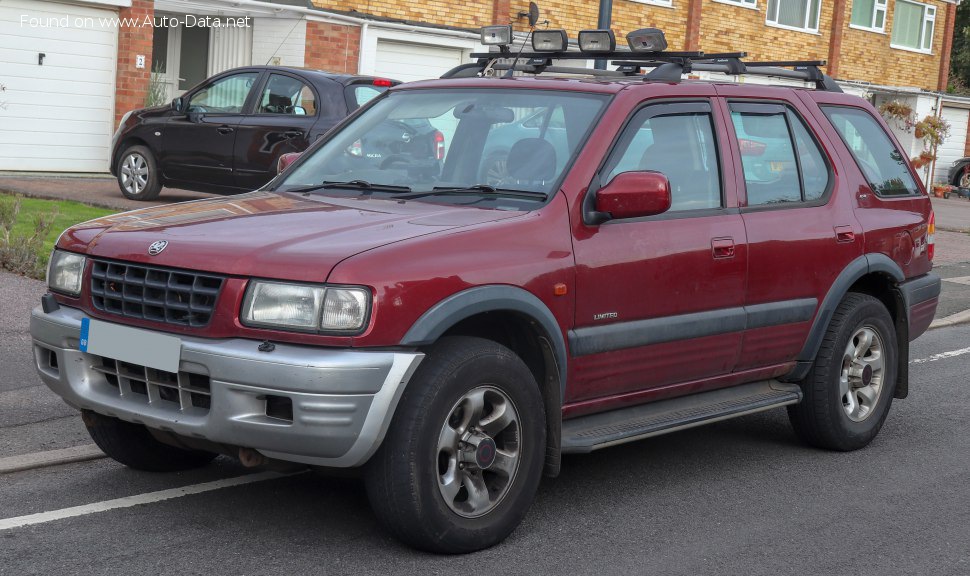
Vauxhall Frontera Mk II Sport 3.2i V6 24V: A Robust European SUV
The Vauxhall Frontera Mk II Sport 3.2i V6 24V (205 Hp) represents a significant iteration of Vauxhall’s second-generation compact SUV, produced between 2003 and 2004. Marketed primarily in the United Kingdom by Vauxhall and across continental Europe as the Opel Frontera, this vehicle was a rebadged version of the Isuzu MU (Mysterious Utility) or Rodeo/Wizard, tailored for European consumer preferences. The Mk II Sport variant, characterized by its three-door body style, offered a more compact and arguably more rugged package compared to its five-door sibling, targeting buyers who desired genuine off-road capability combined with everyday usability. This particular model, equipped with the potent 3.2-liter V6 engine, stood as the performance flagship of the range, delivering a robust 205 horsepower and a driving experience that blended utility with a surprising level of power for its segment.
During its production run, the Frontera Mk II faced an increasingly competitive European SUV market, which was beginning to see a shift towards more car-like crossovers. However, the Frontera remained true to its roots as a traditional, body-on-frame SUV, appealing to a niche of buyers seeking durability, towing capacity, and genuine all-wheel-drive prowess. The 3.2i V6 24V version, in particular, was designed to offer enhanced highway performance and more effortless acceleration, making it a versatile choice for both urban commutes and adventurous excursions.
Engine and Performance of the Vauxhall Frontera Mk II Sport 3.2i V6 24V
At the heart of the Vauxhall Frontera Mk II Sport 3.2i V6 24V (205 Hp) lies a naturally aspirated 3.2-liter (3165 cm³ or 193.14 cu. in.) V6 gasoline engine, designated with the code Y32NE. This sophisticated powerplant features a Double Overhead Camshaft (DOHC) valvetrain with four valves per cylinder, ensuring efficient breathing and optimal power delivery. With a compression ratio of 9.4:1 and a multi-port manifold injection system, the engine was engineered for a balance of power and responsiveness.
The V6 engine generates a peak output of 205 horsepower at 5400 rpm, providing ample thrust for a vehicle of its size. Torque figures are equally impressive, reaching 213.89 lb.-ft. (290 Nm) at a relatively low 3000 rpm. This strong low-end torque was particularly beneficial for off-road driving and towing, allowing the Frontera to tackle demanding conditions with confidence. Mated to a five-speed manual transmission, the power was distributed to all four wheels via a robust all-wheel-drive (4×4) system, emphasizing its off-road credentials.
In terms of outright performance, the Frontera Mk II Sport 3.2i V6 was capable of accelerating from 0 to 60 mph in a respectable 9.8 seconds, with a top speed of 114.33 mph (184 km/h). While not a performance SUV in the modern sense, these figures were competitive for its class and provided a spirited driving experience. Fuel efficiency, as expected for a 3.2-liter V6 in an SUV of this era, reflected its robust nature. Urban driving yielded approximately 13.2 US mpg, while extra-urban conditions improved to around 23.1 US mpg, with a combined cycle offering a practical range from its 17.17 US gallon fuel tank.
Design and Features
The design of the Vauxhall Frontera Mk II Sport retained the rugged aesthetics of its predecessor but incorporated a more contemporary and streamlined look for the early 2000s. As a three-door SUV, it featured a shorter wheelbase (96.93 inches or 2462 mm) compared to the five-door model, which contributed to improved maneuverability and better break-over angles for off-road articulation. The overall length measured 168.03 inches (4268 mm), with a width of 71.42 inches (1814 mm) and a height of 69.09 inches (1755 mm), giving it a purposeful stance on the road.
Despite its compact dimensions, the Frontera Mk II Sport was designed to accommodate five occupants, though rear access in the three-door variant required some agility. The interior, while functional and durable, offered a comfortable environment for its time, with a focus on practicality. Cargo capacity was reasonable for a vehicle of its size, with a minimum trunk space of 11.3 cu. ft. (320 liters), expandable to a generous 40.15 cu. ft. (1137 liters) with the rear seats folded, making it suitable for carrying gear for outdoor activities.
Underneath its skin, the Frontera Mk II Sport featured a robust chassis with a torsion bar front suspension and a coil spring rear suspension, designed to handle rough terrain while providing a decent ride quality on paved roads. Braking was handled by ventilated discs on both the front and rear axles, complemented by an Anti-lock Braking System (ABS), a crucial safety feature for the era. The hydraulic power steering system, based on a worm-reduction unit, offered reliable and predictable control, whether navigating city streets or tackling challenging trails. The vehicle rode on 15-inch wheels fitted with 235/75 R15 tires, providing a good balance of grip and ride comfort for varied surfaces.
Technical Specifications: Vauxhall Frontera Mk II Sport 3.2i V6 24V (205 Hp)
| Category | Specification | US Equivalent |
|---|---|---|
| General Information | ||
| Brand | Vauxhall | |
| Model | Frontera | |
| Generation | Frontera Mk II Sport | |
| Type (Engine) | 3.2i V6 24V (205 Hp) | |
| Start of production | 2003 year | |
| End of production | 2004 year | |
| Powertrain Architecture | Internal Combustion engine | |
| Body type | SUV | |
| Seats | 5 | |
| Doors | 3 | |
| Performance Specs | ||
| Fuel consumption (economy) – urban | 17.8 l/100 km | 13.2 US mpg |
| Fuel consumption (economy) – extra urban | 10.2 l/100 km | 23.1 US mpg |
| Fuel Type | Petrol (Gasoline) | |
| Acceleration 0 – 60 mph | 9.8 sec | 9.8 sec |
| Maximum speed | 184 km/h | 114.33 mph |
| Weight-to-power ratio | 8.4 kg/Hp | 18.52 lbs/Hp |
| Weight-to-torque ratio | 5.9 kg/Nm | 13.01 lbs/Nm |
| Engine Specs | ||
| Power | 205 Hp @ 5400 rpm | 205 Hp @ 5400 rpm |
| Power per liter | 64.8 Hp/l | |
| Torque | 290 Nm @ 3000 rpm | 213.89 lb.-ft. @ 3000 rpm |
| Engine layout | Front, Longitudinal | |
| Engine Model/Code | Y32NE | |
| Engine displacement | 3165 cm³ | 3.2 Liters / 193.14 cu. in. |
| Number of cylinders | 6 | |
| Engine configuration | V-engine | |
| Cylinder Bore | 93.4 mm | 3.68 in. |
| Piston Stroke | 77 mm | 3.03 in. |
| Compression ratio | 9.4:1 | |
| Number of valves per cylinder | 4 | |
| Fuel injection system | Multi-port manifold injection | |
| Engine aspiration | Naturally aspirated engine | |
| Valvetrain | DOHC | |
| Engine oil capacity | 5.2 l | 5.49 US qt |
| Coolant | 8.8 l | 9.3 US qt |
| Space, Volume and Weights | ||
| Kerb Weight | 1720 kg | 3791.95 lbs. |
| Max. weight | 2300 kg | 5070.63 lbs. |
| Max load | 580 kg | 1278.68 lbs. |
| Trunk (boot) space – minimum | 320 l | 11.3 cu. ft. |
| Trunk (boot) space – maximum | 1137 l | 40.15 cu. ft. |
| Fuel tank capacity | 65 l | 17.17 US gal |
| Dimensions | ||
| Length | 4268 mm | 168.03 in. |
| Width | 1814 mm | 71.42 in. |
| Height | 1755 mm | 69.09 in. |
| Wheelbase | 2462 mm | 96.93 in. |
| Front track | 1515 mm | 59.65 in. |
| Rear (Back) track | 1520 mm | 59.84 in. |
| Drivetrain, Brakes and Suspension Specs | ||
| Drive wheel | All wheel drive (4×4) | |
| Number of gears and type of gearbox | 5 gears, manual transmission | |
| Front suspension | Torsion | |
| Rear suspension | Coil spring | |
| Front brakes | Ventilated discs | |
| Rear brakes | Ventilated discs | |
| Assisting systems | ABS (Anti-lock braking system) | |
| Steering type | Worm-reduction unit | |
| Power steering | Hydraulic Steering | |
| Tires size | 235/75 R15 | |
| Wheel rims size | 15 | |
Legacy and Market Impact
The Vauxhall Frontera, particularly the Mk II Sport 3.2i V6, occupied a unique position in the European automotive landscape during its brief run from 2003 to 2004. As a rebadged Isuzu, it benefited from a reputation for Japanese engineering robustness and reliability, which Vauxhall (and Opel) leveraged to offer a competitive product in the burgeoning SUV segment. The Frontera was known for its rugged, utilitarian character, standing in contrast to the more car-like handling and aesthetics of emerging crossovers.
In the United Kingdom and Europe, the Frontera’s primary competitors included vehicles like the Land Rover Freelander, Toyota RAV4, Honda CR-V, Nissan X-Trail, and Suzuki Grand Vitara. While the RAV4 and CR-V pioneered the compact crossover trend with their unibody construction and car-like dynamics, the Frontera, with its body-on-frame architecture, offered superior off-road capability, better towing capacity, and a more traditional SUV feel. The 3.2-liter V6 engine further distinguished it, providing a level of power that many European rivals, often focused on smaller gasoline or diesel engines, could not match.
Despite its strengths, the Frontera’s traditional SUV design eventually became its Achilles’ heel. As consumer preferences shifted towards greater refinement, fuel efficiency, and on-road comfort, the market increasingly favored crossovers. The Frontera, with its somewhat agricultural ride and higher fuel consumption, began to feel dated by the mid-2000s. Its discontinuation in 2004 marked the end of an era for Vauxhall’s dedicated, ladder-frame SUV offering. However, its legacy endures as a testament to a period when SUVs prioritized ruggedness and versatility over urban sophistication. For those who valued genuine off-road prowess and a no-nonsense approach to utility, the Frontera Mk II Sport 3.2i V6 remains a noteworthy and capable vehicle, embodying the spirit of adventure that defined early 21st-century SUVs.