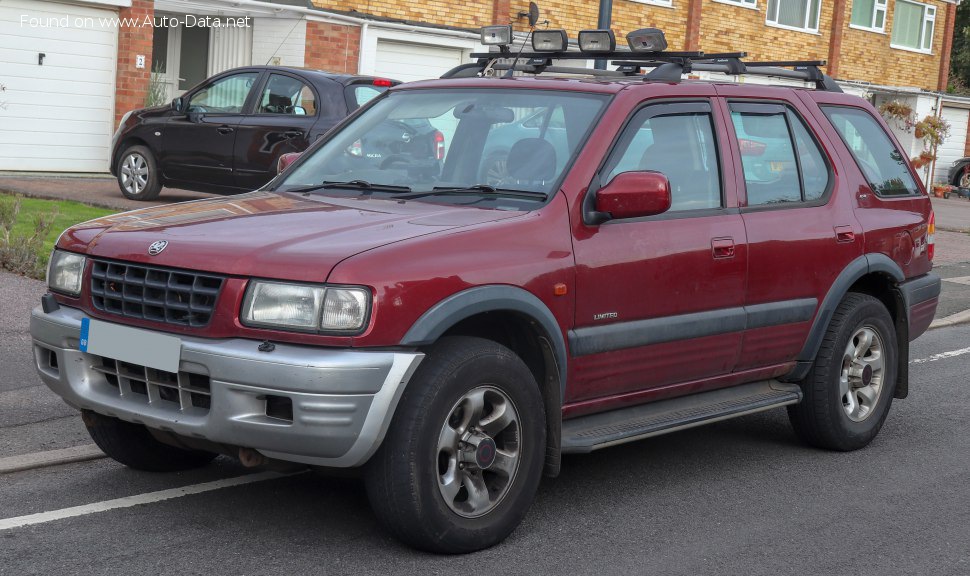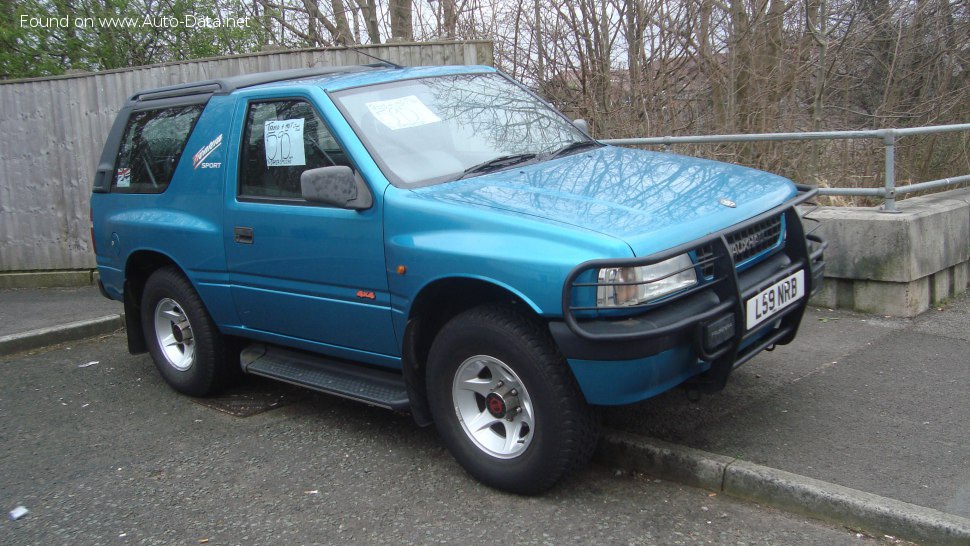
The Vauxhall Frontera Sport 2.0i (115 Hp): A Pioneer in Europe’s SUV Market (1992-1998)
The Vauxhall Frontera Sport 2.0i (115 Hp) represents a significant chapter in the evolution of the sport utility vehicle (SUV) in the European market during the 1990s. Launched in 1992, the Frontera was Vauxhall’s entry into the rapidly expanding SUV segment, offering a more rugged and versatile alternative to traditional sedans and wagons. This particular variant, the Frontera Sport, was the short-wheelbase, three-door model, designed to appeal to a younger, more active demographic seeking a blend of off-road capability and everyday usability. While never officially sold under the Vauxhall badge in the United States, the Frontera was a rebadged version of the Isuzu MU (Mysterious Utility), known as the Isuzu Amigo in North America, highlighting its global General Motors lineage. Produced until 1998, the Frontera Sport carved out a niche as an accessible and practical compact SUV, becoming a familiar sight on British and European roads.
Origins and Market Positioning of the Vauxhall Frontera Sport 2.0i
The Vauxhall Frontera was a product of a collaborative effort between General Motors and Isuzu, a partnership that yielded several rebadged vehicles across different global markets. For Europe, GM’s Opel and Vauxhall brands adopted the Isuzu MU/Rodeo platform, marketing it as the Opel Frontera and Vauxhall Frontera, respectively. This strategy allowed GM to quickly enter the burgeoning SUV market without extensive research and development costs. The Frontera was available in two primary body styles: a five-door long-wheelbase version and the three-door “Sport” variant. The Vauxhall Frontera Sport 2.0i (115 Hp) was positioned as a more agile and lifestyle-oriented vehicle, competing against other compact 4x4s of the era that emphasized both utility and a sense of adventure. Its robust, body-on-frame construction and available four-wheel drive system distinguished it from many car-based SUVs that would follow.
Engine and Performance
Under the hood, the Vauxhall Frontera Sport 2.0i (115 Hp) featured a practical and reliable 2.0-liter (1998 cm3 or 121.93 cu. in.) inline-four engine, designated by the code X20SE. This naturally aspirated, overhead camshaft (OHC) unit utilized a multi-port manifold injection system to deliver its power. The engine produced a respectable 115 horsepower at 5400 rpm, which, while not groundbreaking, was adequate for the vehicle’s intended purpose. Torque output stood at 125.39 lb.-ft. (170 Nm) at a relatively low 2600 rpm, providing good low-end pulling power crucial for off-road excursions or hauling.
Power was routed through a five-speed manual transmission to an all-wheel-drive (4×4) system, offering drivers the flexibility to engage four-wheel drive when conditions demanded. This powertrain configuration, combined with the vehicle’s sturdy chassis, gave the Frontera Sport genuine off-road capability, albeit without the advanced electronic aids found in later SUVs.
In terms of on-road performance, the Frontera Sport 2.0i was not built for speed. It achieved a 0-60 mph acceleration in a measured 14.8 seconds, with a top speed of approximately 98.18 mph (158 km/h). Fuel economy was rated at a combined 23.5 US mpg (10 l/100 km), which was competitive for a compact SUV of its size and era, especially considering its robust construction and four-wheel-drive system. The engine’s simplicity and proven design contributed to its reputation for durability, making it a popular choice for those seeking a no-frills, dependable utility vehicle.
Design and Features
The design of the Vauxhall Frontera Sport 2.0i (115 Hp) was characteristic of early 1990s SUVs: boxy, functional, and rugged. As a three-door SUV, it offered seating for five, though access to the rear seats required some agility. Its compact dimensions – a length of 165.04 inches, width of 70.08 inches, and height of 67.76 inches, with a short 91.73-inch wheelbase – contributed to its maneuverability, particularly in urban environments and on tighter trails.
The exterior styling was straightforward, with prominent wheel arches, a relatively flat hood, and a spare tire mounted on the rear door, a common aesthetic for off-roaders of the period. Inside, the cabin prioritized practicality and durability over luxury. Hard-wearing plastics and cloth upholstery were standard, designed to withstand the rigors of adventurous lifestyles. Despite its utilitarian nature, the Frontera Sport did offer essential features for its time, including hydraulic power steering, which made maneuvering its sizable 235/70 R16 tires manageable. Safety was addressed with the inclusion of an Anti-lock Braking System (ABS) and ventilated disc brakes on both the front and rear wheels, providing solid stopping power for a vehicle of its weight.
Cargo capacity was versatile for a compact SUV. With the rear seats in place, it offered 10.59 cubic feet (300 liters) of trunk space, which could expand significantly to 40.97 cubic feet (1160 liters) when the rear seats were folded down, making it suitable for carrying gear for hobbies or weekend trips. Its 21.13 US gallon (80 liter) fuel tank provided a decent range, an important consideration for a vehicle often used for longer journeys or in remote areas.
Technical Specifications: Vauxhall Frontera Sport 2.0i (115 Hp)
| Category | Specification |
|---|---|
| Brand | Vauxhall |
| Model | Frontera Sport |
| Type (Engine) | 2.0i (115 Hp) |
| Start of Production | 1992 year |
| End of Production | 1998 year |
| Powertrain Architecture | Internal Combustion engine |
| Body type | SUV |
| Seats | 5 |
| Doors | 3 |
| Performance Specs | |
| Fuel consumption (economy) – urban | 19.4 US mpg (12.1 l/100 km) |
| Fuel consumption (economy) – extra urban | 27.7 US mpg (8.5 l/100 km) |
| Fuel consumption (economy) – combined | 23.5 US mpg (10 l/100 km) |
| Fuel Type | Petrol (Gasoline) |
| Acceleration 0 – 60 mph | 14.8 sec |
| Maximum speed | 98.18 mph (158 km/h) |
| Weight-to-power ratio | 14.7 kg/Hp (67.8 Hp/tonne) |
| Weight-to-torque ratio | 10 kg/Nm (100.2 Nm/tonne) |
| Engine Specs | |
| Power | 115 Hp @ 5400 rpm |
| Power per liter | 57.6 Hp/l |
| Torque | 125.39 lb.-ft. @ 2600 rpm (170 Nm @ 2600 rpm) |
| Engine layout | Front, Transverse |
| Engine Model/Code | X20SE |
| Engine displacement | 121.93 cu. in. (1998 cm3) |
| Number of cylinders | 4 |
| Engine configuration | Inline |
| Cylinder Bore | 3.39 in. (86 mm) |
| Piston Stroke | 3.39 in. (86 mm) |
| Compression ratio | 9.2:1 |
| Number of valves per cylinder | 2 |
| Fuel injection system | Multi-port manifold injection |
| Engine aspiration | Naturally aspirated engine |
| Valvetrain | OHC |
| Engine oil capacity | 4.76 US qt (4.5 l) |
| Coolant capacity | 8.77 US qt (8.3 l) |
| Space, Volume and Weights | |
| Kerb Weight | 3739.04 lbs. (1696 kg) |
| Max. weight | 4850.17 lbs. (2200 kg) |
| Max load | 1111.13 lbs. (504 kg) |
| Trunk (boot) space – minimum | 10.59 cu. ft. (300 l) |
| Trunk (boot) space – maximum | 40.97 cu. ft. (1160 l) |
| Fuel tank capacity | 21.13 US gal (80 l) |
| Dimensions | |
| Length | 165.04 in. (4192 mm) |
| Width | 70.08 in. (1780 mm) |
| Height | 67.76 in. (1721 mm) |
| Wheelbase | 91.73 in. (2330 mm) |
| Front track | 57.28 in. (1455 mm) |
| Rear (Back) track | 57.48 in. (1460 mm) |
| Drivetrain, Brakes and Suspension Specs | |
| Drive wheel | All-wheel drive (4×4) |
| Number of gears and type of gearbox | 5 gears, manual transmission |
| Front brakes | Ventilated discs |
| Rear brakes | Ventilated discs |
| Assisting systems | ABS (Anti-lock braking system) |
| Steering type | Worm-reduction unit |
| Power steering | Hydraulic Steering |
| Tires size | 235/70 R16 |
| Wheel rims size | 7J x 16 |
Legacy and Market Impact
The Vauxhall Frontera Sport 2.0i (115 Hp), along with its Opel counterpart, played a crucial role in popularizing the SUV segment in Europe. Before its arrival, the market for off-road-capable vehicles was largely dominated by more utilitarian, often agricultural, offerings like the Land Rover Defender or niche Japanese imports. The Frontera, by contrast, blended rugged capability with more car-like aesthetics and features, making it appealing to a broader audience. It offered a compelling value proposition, providing genuine 4×4 functionality at a more accessible price point than many of its competitors.
Its main rivals in the European market included the Suzuki Vitara (known as the Geo Tracker or Suzuki Sidekick in the US), the Daihatsu Feroza, and later, the first-generation Toyota RAV4 and Land Rover Freelander. Compared to the Vitara, the Frontera was often perceived as a bit larger and more substantial, offering a more robust feel. While it lacked the sophisticated ride quality or advanced technology of later, more premium SUVs, its straightforward mechanicals and relatively low running costs made it a popular choice for families and outdoor enthusiasts alike.
The Frontera’s legacy is that of a workhorse and a pioneer. It helped transition the perception of 4x4s from purely utilitarian machines to versatile “lifestyle” vehicles, paving the way for the explosion of SUV sales that would define the automotive landscape in the late 1990s and beyond. Its body-on-frame construction and robust drivetrain meant it was genuinely capable off-road, a trait that some modern, car-based SUVs struggle to replicate. Despite its eventual replacement by a second generation and then the discontinuation of the Frontera line, the Vauxhall Frontera Sport 2.0i (115 Hp) remains a testament to an era when SUVs were beginning their ascent to mainstream popularity, offering a blend of adventure and practicality that resonated with European consumers.