The Vauxhall Grandland X 1.2 Turbo (130 Hp) Automatic: A European Compact SUV
The Vauxhall Grandland X, specifically the 1.2 Turbo (130 Hp) Automatic variant produced between October 2017 and July 2018, represents a pivotal model in the British marque’s modern lineup. As a compact crossover SUV, the Grandland X was Vauxhall’s entry into one of Europe’s most competitive and rapidly expanding automotive segments. While Vauxhall is primarily known in the United Kingdom, its models are largely rebadged versions of Opel vehicles sold across mainland Europe, reflecting its heritage under General Motors and later, PSA Group (now Stellantis). This particular generation, the Grandland X, marked a significant step for Vauxhall in offering a stylish, practical, and efficient SUV designed to appeal to families and urban drivers alike.
Positioned to compete against established players in the C-segment SUV market, the Grandland X aimed to combine robust styling with comfortable interiors and a range of efficient powertrains. The 1.2 Turbo variant, despite its relatively small displacement, was engineered to deliver a compelling balance of performance and fuel economy, making it a popular choice for consumers prioritizing running costs and environmental considerations without sacrificing everyday usability. Its front-wheel-drive architecture and automatic transmission underscored its intended role as a user-friendly vehicle for a broad demographic.
Engine and Performance: The Heart of the Vauxhall Grandland X
At the core of the Vauxhall Grandland X 1.2 Turbo (130 Hp) Automatic lies a highly efficient and advanced powertrain. This vehicle is equipped with an internal combustion engine, specifically a 1.2-liter (1199 cm3 or 73.17 cu. in.) three-cylinder inline engine. Despite its compact size, this engine is a technological marvel, featuring a turbocharger and intercooler to significantly boost its output. Power delivery is rated at a respectable 130 horsepower at 5500 revolutions per minute, translating to an impressive power per liter figure of 108.4 horsepower per liter. This demonstrates excellent engineering efficiency, extracting substantial power from a small displacement.
Torque, a crucial factor for real-world drivability, stands at 230 Newton meters (169.64 lb.-ft.) available at a low 1750 rpm. This broad torque band ensures responsive acceleration and confident overtaking maneuvers, even with a full complement of passengers or cargo. The engine’s layout is front, transverse, contributing to efficient packaging and maximizing interior space. Fuel delivery is handled by a direct injection system, optimizing combustion efficiency and reducing emissions, aligning with the Euro 6 emission standard.
Mated to this potent engine is a smooth-shifting 6-speed automatic transmission. This gearbox is designed to provide seamless power delivery and contributes significantly to the vehicle’s comfortable driving experience. The drivetrain architecture is front-wheel drive, a common and effective configuration for compact SUVs, offering a good balance of traction, efficiency, and cost-effectiveness. The combination of the turbocharged engine and automatic transmission allows the Grandland X to reach a maximum speed of 116.82 miles per hour (188 km/h), making it perfectly capable for highway cruising.
Fuel economy figures for this variant are commendable, reflecting its focus on efficiency. In urban driving conditions, it achieves 36.8 US miles per gallon (6.4 l/100 km). On extra-urban routes, this improves significantly to 48 US miles per gallon (4.9 l/100 km). The combined fuel consumption is an impressive 42.8 US miles per gallon (5.5 l/100 km), with CO2 emissions rated at 127 grams per kilometer, making it a relatively eco-friendly option in its class. The fuel type is Petrol (Gasoline), and it has a fuel tank capacity of 14 US gallons (53 liters).
Design and Features: Practicality Meets Modern Aesthetics
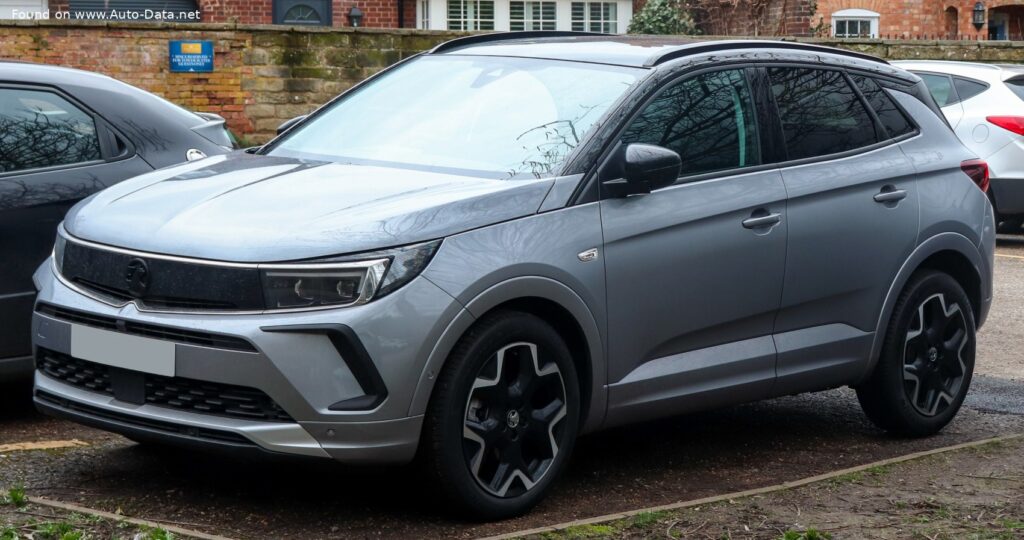
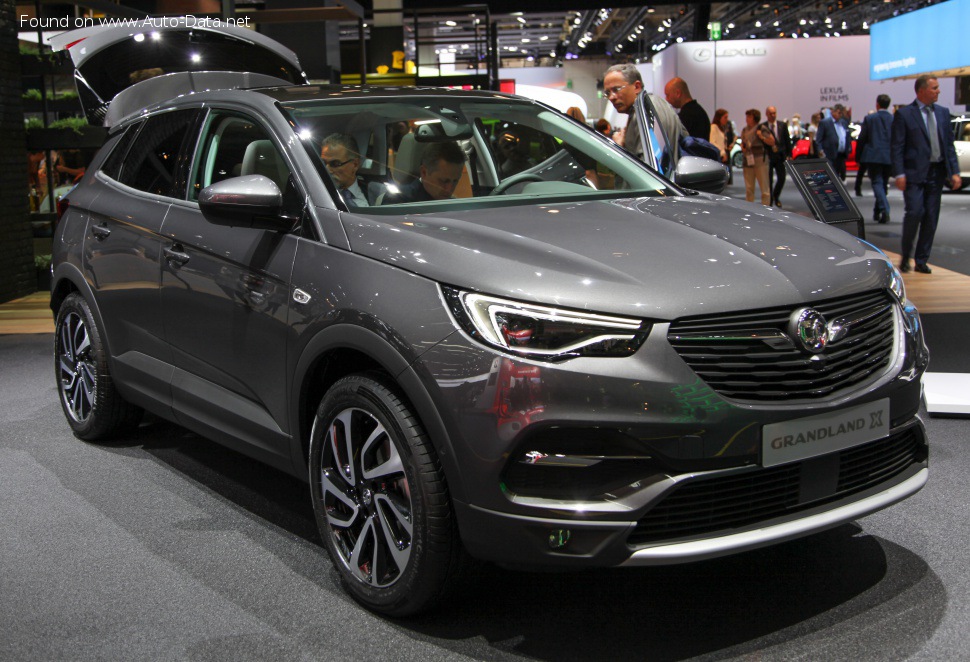
The Vauxhall Grandland X adopts a contemporary SUV body type, characterized by its robust stance, elevated driving position, and practical five-door configuration. Designed to accommodate five occupants comfortably, the Grandland X offers a family-friendly package that doesn’t compromise on style. Its dimensions are well-proportioned for the compact SUV segment, with a length of 176.26 inches (4477 mm), a width of 73.07 inches (1856 mm) (or 82.6 inches / 2098 mm including mirrors), and a height of 63.35 inches (1609 mm). The wheelbase measures 105.31 inches (2675 mm), contributing to a stable ride and generous interior volume.
From a design perspective, the Grandland X exhibits Vauxhall’s contemporary design language, featuring sleek lines, a prominent grille, and distinctive lighting signatures. The exterior is complemented by 19-inch wheel rims, shod with 235/50 R19 tires, which fill the wheel arches confidently and contribute to both its visual appeal and road holding. The elevated ground clearance, typical of SUVs, provides a commanding view of the road and adds to its adventurous appeal, even if its primary domain is urban and suburban environments.
Inside, the Grandland X focuses on ergonomics and practicality. The five-seat layout offers ample head and legroom for passengers. Storage capacity is a key strength, with a minimum trunk space of 18.15 cubic feet (514 liters), which expands significantly to a maximum of 58.34 cubic feet (1652 liters) with the rear seats folded down. This flexibility makes it highly versatile for everything from weekly grocery runs to hauling luggage for family vacations.
In terms of safety and driving aids, the Grandland X comes equipped with essential systems for its era. Front brakes are ventilated discs, while the rear brakes are solid discs, providing reliable stopping power. An Anti-lock Braking System (ABS) is standard, enhancing control during emergency braking. The steering system is a rack and pinion type with electric power steering, offering light and precise handling, particularly beneficial in city driving and parking maneuvers.
Technical Specifications
| Category | Specification |
|---|---|
| Brand | Vauxhall |
| Model | Grandland |
| Generation | Grandland X |
| Type (Engine) | 1.2 Turbo (130 Hp) Automatic |
| Start of Production | October, 2017 |
| End of Production | July, 2018 |
| Powertrain Architecture | Internal Combustion engine |
| Body type | SUV |
| Seats | 5 |
| Doors | 5 |
| Fuel consumption (economy) – urban | 6.4 l/100 km (36.8 US mpg) |
| Fuel consumption (economy) – extra urban | 4.9 l/100 km (48 US mpg) |
| Fuel consumption (economy) – combined | 5.5 l/100 km (42.8 US mpg) |
| CO2 emissions | 127 g/km |
| Fuel Type | Petrol (Gasoline) |
| Maximum speed | 188 km/h (116.82 mph) |
| Emission standard | Euro 6 |
| Power | 130 Hp @ 5500 rpm |
| Power per liter | 108.4 Hp/l |
| Torque | 230 Nm @ 1750 rpm (169.64 lb.-ft. @ 1750 rpm) |
| Engine layout | Front, Transverse |
| Engine Model/Code | B12XHT |
| Engine displacement | 1199 cm3 (73.17 cu. in.) |
| Number of cylinders | 3 |
| Engine configuration | Inline |
| Number of valves per cylinder | 4 |
| Fuel injection system | Direct injection |
| Engine aspiration | Turbocharger, Intercooler |
| Engine oil capacity | 3.5 l (3.7 US qt) |
| Trunk (boot) space – minimum | 514 l (18.15 cu. ft.) |
| Trunk (boot) space – maximum | 1652 l (58.34 cu. ft.) |
| Fuel tank capacity | 53 l (14 US gal) |
| Length | 4477 mm (176.26 in.) |
| Width | 1856 mm (73.07 in.) |
| Width including mirrors | 2098 mm (82.6 in.) |
| Height | 1609 mm (63.35 in.) |
| Wheelbase | 2675 mm (105.31 in.) |
| Drivetrain Architecture | The Internal combustion engine (ICE) drives the front wheels of the vehicle. |
| Drive wheel | Front wheel drive |
| Number of gears and type of gearbox | 6 gears, automatic transmission |
| Front brakes | Ventilated discs |
| Rear brakes | Disc |
| Assisting systems | ABS (Anti-lock braking system) |
| Steering type | Steering rack and pinion |
| Power steering | Electric Steering |
| Tires size | 235/50 R19 |
| Wheel rims size | 19 inches |
Legacy and Market Impact of the Grandland X
The Vauxhall Grandland X, particularly the 1.2 Turbo (130 Hp) Automatic model, played a crucial role in Vauxhall’s strategy to capture a significant share of the booming European compact SUV market. Launched at a time when consumer preference was rapidly shifting away from traditional sedans and hatchbacks towards more versatile and family-oriented SUVs, the Grandland X was a much-needed addition to the brand’s portfolio. Its introduction also coincided with a significant period of change for Vauxhall and its German counterpart, Opel, as they transitioned from General Motors ownership to the PSA Group.
This transition heavily influenced the Grandland X’s development. It shared its EMP2 platform with PSA stablemates like the highly successful Peugeot 3008 and Citroën C5 Aircross. This platform sharing allowed Vauxhall to leverage PSA’s expertise in compact SUV design and engineering, particularly regarding efficient powertrains and chassis tuning. For consumers, this meant access to a proven, modern architecture that delivered competitive driving dynamics and safety features, while retaining Vauxhall’s distinct styling and brand appeal.
In the fiercely competitive European market, the Grandland X faced formidable rivals such as the Nissan Qashqai, Volkswagen Tiguan, Kia Sportage, Hyundai Tucson, and its platform-mate, the Peugeot 3008. Its strengths lay in its comfortable ride, practical interior, generous trunk space, and the efficiency of its turbocharged engines. The 1.2-liter turbo engine, in particular, was praised for its surprising refinement and sufficient power for most driving scenarios, coupled with excellent fuel economy that appealed to budget-conscious buyers.
While the Grandland X wasn’t sold in the United States, its impact in its primary markets, especially the UK and mainland Europe (as the Opel Grandland X), was substantial. It contributed to Vauxhall’s sales volumes and helped solidify its position in the SUV segment. Its reputation was built on reliability, affordability, and a strong value proposition. The model’s success demonstrated that a well-executed compact SUV with efficient powertrains and practical features could thrive even against established segment leaders.
The Grandland X’s legacy is one of adaptability and strategic positioning. It successfully navigated a period of corporate transition and changing market demands, offering a compelling package that resonated with European consumers. It paved the way for future Vauxhall/Opel SUVs and underscored the brand’s commitment to offering modern, efficient, and family-friendly vehicles in key market segments. The 1.2 Turbo (130 Hp) Automatic variant stands out as a prime example of this success, balancing performance, economy, and practicality in a stylish SUV package.