Vauxhall Insignia I Country Tourer: A Rugged European Estate
The Vauxhall Insignia I Country Tourer 2.0 CDTi ecoTEC (163 Hp) 4×4 Automatic represents a specialized, more adventurous iteration of Vauxhall’s flagship Insignia model, specifically tailored for the European market. Launched in 2013 and produced until 2017, this first-generation Country Tourer aimed to blend the practicality and driving dynamics of a traditional station wagon (known as an estate in the UK) with the rugged aesthetics and enhanced capability often associated with sport utility vehicles (SUVs). Positioned as a versatile family vehicle, it offered a compelling package for buyers seeking increased ground clearance, all-wheel drive traction, and a more robust design without fully committing to the larger footprint or potentially higher running costs of a dedicated SUV.
As a Vauxhall, this model was primarily sold in the United Kingdom, mirroring its Opel Insignia Country Tourer counterpart across continental Europe. While the standard Opel Insignia was rebadged and sold in the United States as the Buick Regal (second generation, 2011-2017), this specific Country Tourer variant, with its raised suspension and diesel powertrain, was not officially offered in the North American market. However, its underlying platform and engineering principles are shared with vehicles familiar to American consumers, showcasing General Motors’ global vehicle development strategy during this era. This article will delve into the specific characteristics of the Vauxhall Insignia I Country Tourer 2.0 CDTi ecoTEC (163 Hp) 4×4 Automatic, using American English terminology for consistency and clarity.
Vauxhall Insignia I Country Tourer: Engineering and Design Philosophy
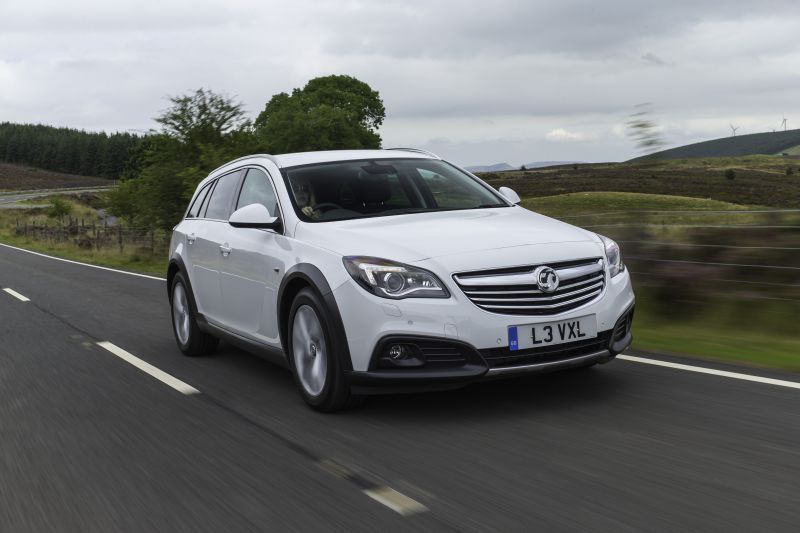
The design ethos behind the Vauxhall Insignia I Country Tourer was to create a vehicle that was equally at home on paved roads and light unpaved trails. This was achieved by taking the already well-regarded Insignia Sports Tourer (wagon) and enhancing it with a series of modifications. Visually, the Country Tourer distinguished itself with prominent protective body cladding around the wheel arches and lower body panels, redesigned bumpers with integrated skid plates, and a slightly elevated ride height. These aesthetic and functional upgrades gave the vehicle a more commanding presence and hinted at its enhanced capabilities.
Beyond the visual cues, the engineering modifications focused on improving versatility. The all-wheel-drive system provided greater traction and stability in adverse weather conditions or on loose surfaces, a significant advantage over its front-wheel-drive siblings. The raised suspension not only contributed to the rugged look but also improved ground clearance, reducing the risk of scraping the undercarriage on uneven terrain. Inside, the Insignia Country Tourer retained the spacious and comfortable cabin of the standard Insignia, offering ample room for five occupants and a generous cargo area, making it a highly practical choice for families and those with active lifestyles.
Powertrain and Driving Dynamics
At the heart of the Vauxhall Insignia I Country Tourer (163 Hp) 4×4 Automatic lies its efficient and robust 2.0-liter CDTi ecoTEC diesel engine. This inline four-cylinder powerplant, identified by the engine code A20DTH, was engineered for a balance of power, torque, and fuel economy. Utilizing a sophisticated common rail direct fuel injection system, a turbocharger, and an intercooler, the engine produces a respectable 163 horsepower at 4000 rpm. More importantly for a vehicle of this type, it delivers a substantial 258.15 lb-ft of torque, available across a broad rev range from 1750 to 2500 rpm. This strong torque output is crucial for effortless highway cruising, confident overtaking, and providing the necessary grunt for off-road excursions or towing.
The ecoTEC designation signifies Vauxhall’s commitment to environmental efficiency, incorporating technologies aimed at reducing emissions and improving fuel consumption. This particular model adheres to the Euro 5 emission standard and is equipped with a particulate filter, a key component in minimizing diesel particulate emissions. Power is smoothly delivered to all four wheels via a responsive 6-speed automatic transmission and a sophisticated all-wheel-drive (4×4) system. This combination ensures optimal traction and stability in varying driving conditions, from slippery roads to light off-road tracks.
In terms of performance, the Insignia Country Tourer with this powertrain accelerates from 0 to 60 mph in a respectable 10.8 seconds, with a top speed of 124.27 mph. These figures highlight its capability as a comfortable long-distance cruiser that can also handle daily driving demands with ease. Fuel economy, a crucial factor for diesel vehicles, is impressive for an all-wheel-drive wagon of its size. The combined cycle consumption is rated at 36.8 US mpg (6.4 liters per 100 km), with extra-urban driving achieving an even better 46.1 US mpg (5.1 liters per 100 km). These figures underscore the efficiency benefits of the CDTi ecoTEC engine and make the Country Tourer an economical choice for extended journeys.
Exterior and Interior Design
The Vauxhall Insignia I Country Tourer is a quintessential station wagon (estate) with five doors and seating for five occupants. Its overall length measures 193.7 inches (4920 mm), with a width of 73.07 inches (1856 mm) (82.05 inches or 2084 mm including mirrors), and a height of 59.96 inches (1523 mm). The wheelbase of 107.76 inches (2737 mm) contributes to a stable ride and generous interior space. The minimum turning circle of 37.4 feet (11.4 m) makes it reasonably maneuverable for its size.
Inside, the Country Tourer prioritizes practicality and comfort. The cargo area is particularly versatile, offering a minimum trunk space of 19.07 cubic feet (540 liters) with the rear seats up, expanding significantly to a cavernous 54.03 cubic feet (1530 liters) when the rear seats are folded down. This ample space makes it ideal for carrying luggage, sports equipment, or even larger items, reinforcing its utility as an adventure-ready family car. The fuel tank capacity of 18.49 US gallons (70 liters) ensures a long driving range between fill-ups, especially considering its efficient diesel engine.
The chassis features an independent McPherson strut suspension with coil springs and an anti-roll bar at the front, paired with an independent multi-link suspension at the rear. This setup provides a comfortable ride and competent handling, balancing passenger comfort with driving engagement. Braking is handled by ventilated discs at the front and disc brakes at the rear, augmented by an Anti-lock Braking System (ABS) for enhanced safety and control during emergency braking maneuvers. The vehicle’s kerb weight stands at 4063.12 lbs (1843 kg), with a maximum permissible weight of 5379.28 lbs (2440 kg), allowing for a maximum load of 1316.16 lbs (597 kg). It is also capable of towing a braked trailer up to 4409.25 lbs (2000 kg) and an unbraked trailer up to 1653.47 lbs (750 kg), further extending its utility.
Technical Specifications
| Category | Specification | Value (US/Imperial) |
|---|---|---|
| General Information | ||
| Brand | Vauxhall | N/A |
| Model | Insignia | N/A |
| Generation | Insignia I Country Tourer | N/A |
| Type (Engine) | 2.0 CDTi ecoTEC (163 Hp) 4×4 Automatic | N/A |
| Start of Production | 2013 year | N/A |
| End of Production | 2017 year | N/A |
| Powertrain Architecture | Internal Combustion engine | N/A |
| Body type | Station wagon (estate) | N/A |
| Seats | 5 | N/A |
| Doors | 5 | N/A |
| Performance Specs | ||
| Fuel consumption (economy) – urban | 8.7 l/100 km | 27 US mpg |
| Fuel consumption (economy) – extra urban | 5.1 l/100 km | 46.1 US mpg |
| Fuel consumption (economy) – combined | 6.4 l/100 km | 36.8 US mpg |
| CO2 emissions | 169 g/km | N/A |
| Fuel Type | Diesel | N/A |
| Acceleration 0 – 60 mph | 10.8 sec | N/A |
| Maximum speed | 200 km/h | 124.27 mph |
| Emission standard | Euro 5 | N/A |
| Weight-to-power ratio | 11.3 kg/Hp | 88.4 Hp/tonne |
| Weight-to-torque ratio | 5.3 kg/Nm | 189.9 Nm/tonne |
| Engine Specs | ||
| Power | 163 Hp @ 4000 rpm | N/A |
| Power per liter | 83.3 Hp/l | N/A |
| Torque | 350 Nm @ 1750-2500 rpm | 258.15 lb.-ft. @ 1750-2500 rpm |
| Engine layout | Front, Transverse | N/A |
| Engine Model/Code | A20DTH | N/A |
| Engine displacement | 1956 cm3 | 119.36 cu. in. (2.0 liters) |
| Number of cylinders | 4 | N/A |
| Engine configuration | Inline | N/A |
| Cylinder Bore | 83 mm | 3.27 in. |
| Piston Stroke | 90.4 mm | 3.56 in. |
| Number of valves per cylinder | 4 | N/A |
| Fuel injection system | Diesel Commonrail | N/A |
| Engine aspiration | Turbocharger, Intercooler | N/A |
| Valvetrain | DOHC | N/A |
| Engine oil capacity | 4.5 l | 4.76 US qt |
| Coolant | 9 l | 9.51 US qt |
| Engine systems | Particulate filter | N/A |
| Space, Volume and Weights | ||
| Kerb Weight | 1843 kg | 4063.12 lbs. |
| Max. weight | 2440 kg | 5379.28 lbs. |
| Max load | 597 kg | 1316.16 lbs. |
| Trunk (boot) space – minimum | 540 l | 19.07 cu. ft. |
| Trunk (boot) space – maximum | 1530 l | 54.03 cu. ft. |
| Fuel tank capacity | 70 l | 18.49 US gal |
| Permitted trailer load with brakes (12%) | 2000 kg | 4409.25 lbs. |
| Permitted trailer load without brakes | 750 kg | 1653.47 lbs. |
| Dimensions | ||
| Length | 4920 mm | 193.7 in. |
| Width | 1856 mm | 73.07 in. |
| Width including mirrors | 2084 mm | 82.05 in. |
| Height | 1523 mm | 59.96 in. |
| Wheelbase | 2737 mm | 107.76 in. |
| Front overhang | 1020 mm | 40.16 in. |
| Rear overhang | 1163 mm | 45.79 in. |
| Minimum turning circle (turning diameter) | 11.4 m | 37.4 ft. |
| Drivetrain, Brakes and Suspension Specs | ||
| Drive wheel | All wheel drive (4×4) | N/A |
| Number of gears and type of gearbox | 6 gears, automatic transmission | N/A |
| Front suspension | Independent, type McPherson with coil spring and anti-roll bar | N/A |
| Rear suspension | Independent multi-link suspension | N/A |
| Front brakes | Ventilated discs | N/A |
| Rear brakes | Disc | N/A |
| Assisting systems | ABS (Anti-lock braking system) | N/A |
Legacy and Market Impact
The Vauxhall Insignia I Country Tourer carved out a significant niche in the European automotive landscape during its production run. It competed in a growing segment of “all-road” or “crossover” wagons, offering a more refined and car-like driving experience compared to traditional SUVs, while still providing enhanced capability for adverse conditions. Its primary competitors included models like the Volkswagen Passat Alltrack, Skoda Octavia Scout, and to some extent, premium offerings such as the Audi A4 Allroad and Volvo V60 Cross Country, though the Insignia typically targeted a more mainstream price point.
The Country Tourer’s reputation was built on its blend of practicality, comfort, and understated ruggedness. Owners and critics often lauded its spacious interior, large cargo capacity, and comfortable ride, especially during long highway journeys. The 2.0 CDTi ecoTEC engine was praised for its strong torque delivery and impressive fuel economy, making it an attractive option for high-mileage drivers and families. The inclusion of an automatic transmission and all-wheel drive further bolstered its appeal, offering ease of use and improved traction in challenging weather conditions, which are prevalent in many parts of Europe.
Historically, the Insignia Country Tourer represented Vauxhall’s response to changing consumer preferences, bridging the gap between conventional wagons and the burgeoning SUV market. It demonstrated that a family-friendly estate could also possess an adventurous spirit and enhanced capabilities without compromising on driving dynamics or efficiency. While it never made its way to the American market in this specific configuration, its existence highlights a European trend toward versatile, all-weather wagons that offer a compelling alternative to larger, less fuel-efficient SUVs. It contributed to the broader recognition of the Insignia as a versatile and well-rounded flagship model for Vauxhall, showcasing the brand’s ability to adapt to evolving market demands and offer specialized variants that cater to diverse customer needs.